
What is AI lead qualification, and why does it beat traditional web forms?
AI lead qualification means putting a smart conversational assistant on your website to chat with visitors, answer their questions, and figure out whether they’re a real fit for your business. Instead of handing people a contact form to fill out or quote requests, the AI collects what it needs naturally — through actual conversation.
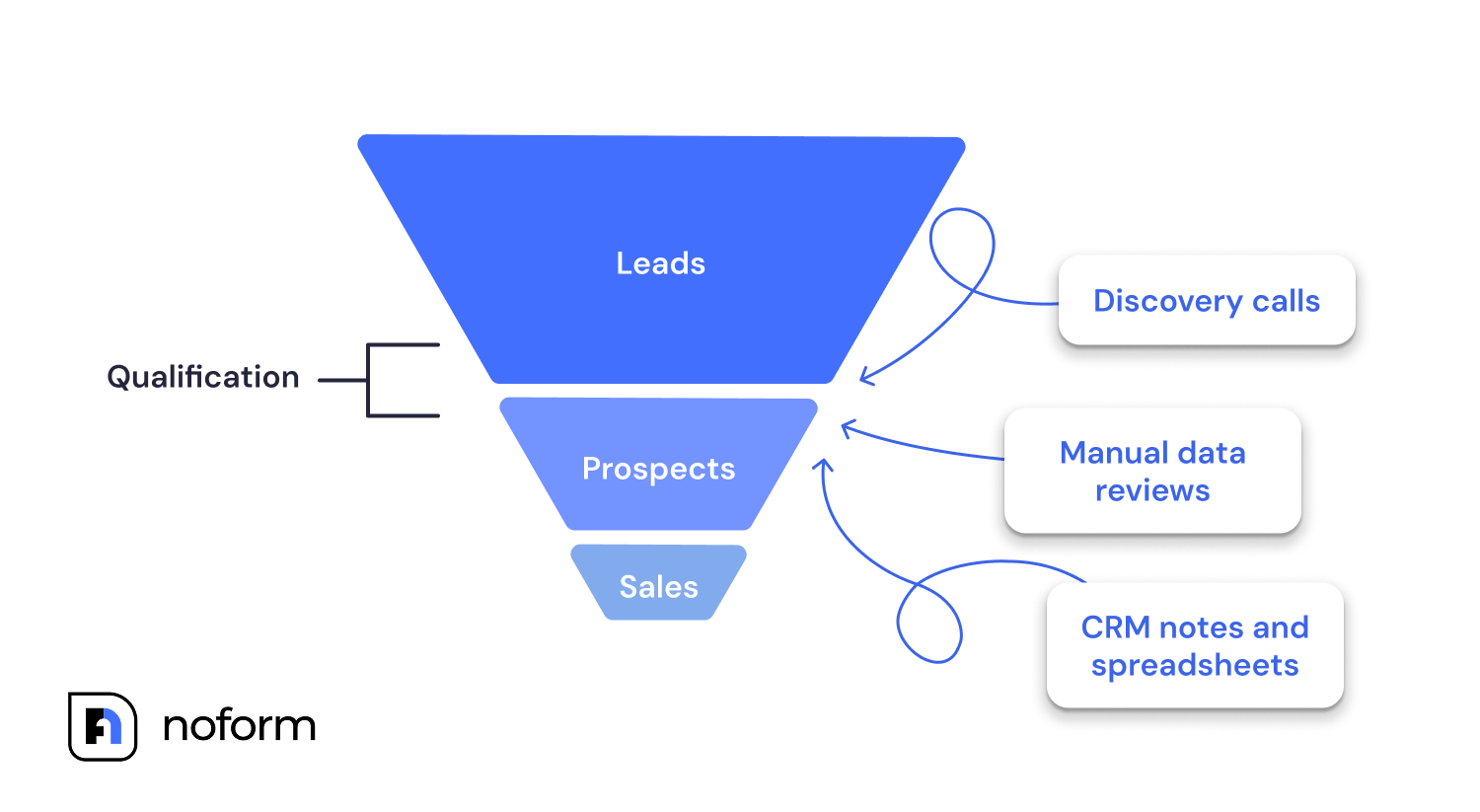
The Problem: Nobody likes filling out forms
Here’s the core problem with forms: people hate them. About 98% of website visitors leave without doing anything.
That’s not because your product is bad. The real blocker is the friction caused by traditional lead capture.
Whether you rely on a “Get a Quote” form, a “Book a Demo” request, an “Appointment Booking”, or a simple “Contact Us” page on your site, static forms all share a major flaw: they demand effort before delivering any value.
A visitor arrives with a simple question about pricing or features. But instead of getting a quick answer, they are handed a six-field form to fill out. On mobile phones, this is even more frustrating. So, they just leave.
The solution: Speed, context, and conversational AI
The fix isn’t just a faster form. It’s a different approach entirely.
Research by Lead Connect found that 78% of customers buy from the first company that responds to their inquiry. Not the cheapest. Not the best-reviewed. The first. Traditional forms and manual follow-ups can’t compete with that speed. An AI assistant can — it’s live 24/7, greets every visitor the moment they arrive, and starts the qualification process immediately.
The real shift is in the sequence. The AI answers their questions first, earns some trust, and only asks for contact details once the visitor is actually ready to give them. That’s the opposite of what a form does.
Why conversational AI wins
When you replace a static form with a helpful, natural conversation, the results are massive.
- 3x more leads: By simply talking to visitors instead of making them fill out forms, businesses see up to 3 times as many conversions.
- 25–35% conversion improvement: According to a 2026 Landbase analysis of B2B sales data, companies using AI chatbots to qualify leads improved their overall conversion rates by 25% to 35%.
- 40% increase in accuracy: The Landbase data showed a 40% increase in the accuracy of qualifying those leads, meaning your sales team spends less time on dead ends.
What is the difference between AI lead generation and AI lead qualification?
These two terms appear together constantly, but they describe two completely different jobs. Mixing them up leads to the wrong tool, the wrong strategy, and wasted budget.
AI lead generation is outbound. It’s the process of finding and attracting people who haven’t heard of your business yet — AI tools scanning databases, building prospect lists, writing cold emails, and identifying companies that match your ideal customer profile. The goal is getting new names into your funnel.
AI lead qualification is what happens after someone arrives. It’s inbound. Whether they found you through your own marketing, a paid ad, an organic search, or a referral, the question now is: which of these people is actually worth a sales conversation? That’s where conversational AI chatbots come in.
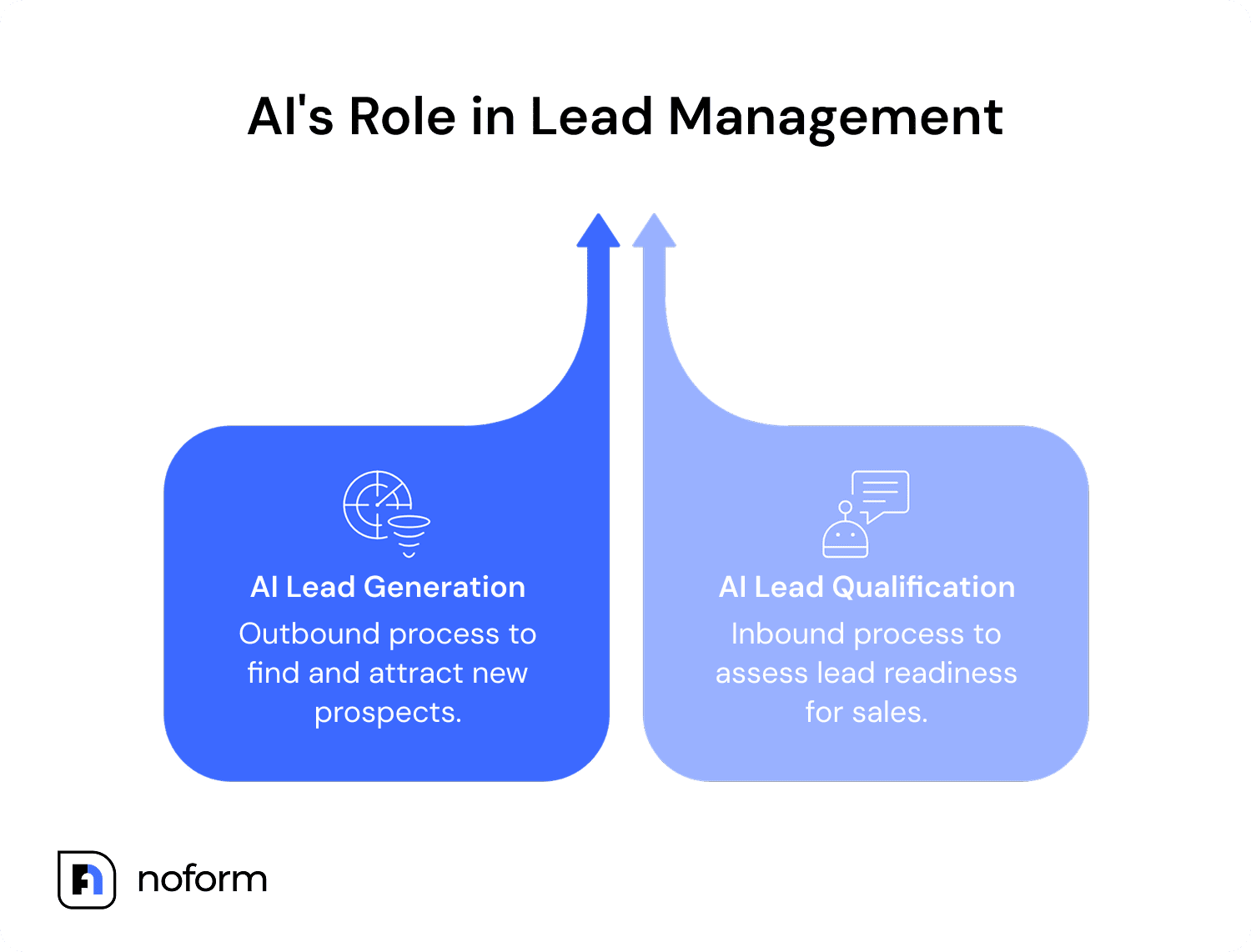
Think of it this way: AI lead generation fills the pipeline. The AI lead qualification decides who moves through it.
| AI Lead Generation | AI Lead Qualification | |
| Direction | Outbound | Inbound |
| Goal | Create awareness, attract new contacts | Identify which contacts are sales-ready |
| Primary tool | Prospecting software, email automation | Conversational chatbot on your website |
| Output | A list of potential leads | A scored, context-rich lead ready for a sales rep |
Most businesses need both. But if you’ve already got traffic and those visitors aren’t converting, qualification is the higher-priority fix, because you’re already paying to bring people to your site and losing them before they ever raise their hand.
What are the key AI lead qualification strategies for better sales results?
To get the most out of conversational AI, you need a strategy. Here are seven proven tactics to turn your website into an automated lead-generation machine.
Strategy 1: Replace static forms with conversational qualification
The most impactful change you can make is getting rid of form-first qualification. Forms demand commitment before delivering any value. Conversation flips that. It gives the visitor something useful (answers, guidance, relevance, a sense of direction) before it asks for anything in return.
NoForm AI is a good example of this. Instead of confronting visitors with a blank contact form, it deploys an assistant that trains itself on your website content (product pages, FAQs, service descriptions). The result feels like talking to someone who actually knows the business, not filling out a support ticket.
How do AI chatbots actually qualify leads through conversation?
At its core, AI lead qualification does exactly what a great sales rep, real estate agent, or intake coordinator would do: ask the right questions, listen, and figure out how to help. The difference is that an AI chatbot does this for every single visitor instantly, 24/7, without ever getting tired or going off-script.
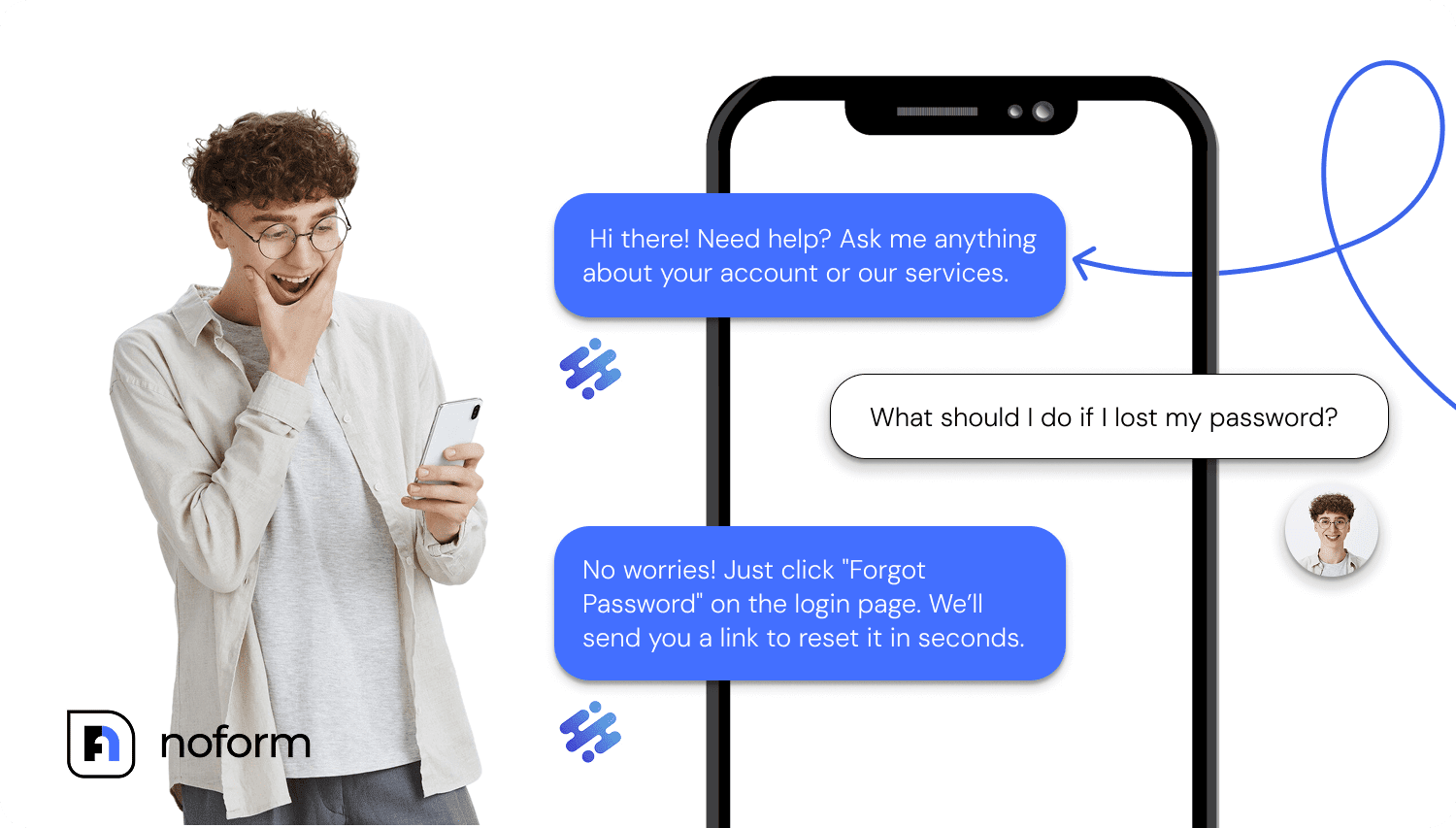
The most effective AI chatbots operate on a “value-first” sequence. They use what’s called “progressive profiling”—gathering information one natural question at a time, rather than overwhelming the visitor.
Here is how this conversational sequence unfolds to turn casual browsers into highly qualified leads:
Step 1: Instant, page-specific greetings
The AI initiates a conversation the moment a visitor arrives with a greeting specific to the page they’re on. A visitor on a SaaS pricing page receives a different welcome than someone looking at a local real estate neighborhood guide.
Step 2: Give answers before asking questions
Traditional forms demand commitment upfront. But the AI answers questions first, demonstrating it’s actually useful before it ever asks for anything.
Step 3: Natural information gathering
As the conversation flows, the AI gathers structured data. Instead of an interrogation, each question naturally follows the previous answer. Instead of asking “Company size?” as a form field, the chatbot embeds the question naturally: “Is this for your personal use or your team?”.
As the conversation develops, the AI naturally gathers structured data. Instead of a form field that says “Company size?”, the chatbot might ask “Is this for your personal use or for a team?” Similarly, if a homeowner says they have a roof leak, the AI knows to ask if it’s a residential or commercial property next.
Step 4: Request contact details at peak intent
Once the visitor has gotten real help and shown genuine interest, the AI transitions naturally: It might say, “Let me have our team send you a custom quote. What’s the best email to reach you?” That’s the moment of peak intent, and that’s when asking for contact details actually works.
Step 5: Instant summaries & sales handoff
The second they share an email or phone number, they become a qualified lead. The AI generates a quick 2-4 sentence summary of the conversation and immediately alerts your team, so your sales reps already know the context when they follow up.
The BANT framework, adapted for conversation
BANT stands for Budget, Authority, Need, and Timeline — the four signals that tell a sales team whether a lead is worth pursuing. Most teams apply this framework manually, one qualification call at a time. AI chatbots can execute the same framework conversationally across any industry, without a single form field:
| BANT Criterion | Form Approach | AI Chatbot Approach |
| Budget | “Budget range: $___” | “Are you exploring options for a team, or looking for something more enterprise-scale?” |
| Authority | “Are you the decision-maker?” | “Would you be making this call yourself, or would others on your team be involved?” |
| Need | “Describe your challenge” | The prospect’s specific needs organically emerge through the questions they ask the chatbot about shipping, services, or software integrations. |
| Timeline | “When do you plan to purchase?” | “Are you looking to get something live in the next few weeks, or are you still in research mode?” |
Visitors are far more likely to answer informal questions in a chat window than they are to fill in blank fields on a web form. And by the time they share their contact info, they’ve already had a positive experience with your brand. That’s a completely different starting point for a sales call.
Strategy 2: Define clear qualification criteria before you deploy
An AI qualification system is only as sharp as what you feed it. Before you deploy anything, you need a clear picture of what a qualified lead actually looks like for your specific business.

In the Lead Qualification tab of a NoForm AI tool, you define what makes someone worth following up with. The defaults are email and phone number. But beyond those, you can set custom data points the AI should collect. The moment a contact is captured alongside those custom attributes, the conversation gets automatically flagged as a qualified lead in your dashboard.
What qualification attributes should you configure in your AI chatbot?
The qualification attributes you set up in your AI chatbot decide which conversations are flagged as sales-ready leads—and dictate exactly what context your sales team gets before they make that first call.
Because every industry qualifies leads differently, here are the most critical attributes to configure based on your business type:
- B2B SaaS companies: Company size (team headcount), current tech stack or integrations needed, specific use case or pain point, timeline to implementation, budget range
- Small businesses & home services (roofing, HVAC, plumbers): Service type of interest, geographic area or location, project scope or budget, urgency or start date
- Real estate firms: Property type (buying vs. renting, residential vs. commercial), budget range or pre-approval status, preferred neighborhoods or school districts, moving timeline
- Healthcare & professional services (dental, law, financial advisors): Appointment type or specific legal/financial concern, new vs. returning client status, insurance provider or billing preference
- E-commerce & retail stores: Product category of interest, purchase intent (just browsing vs. ready to buy), specific size, variant, or configuration needs
The value: Automatic routing and prioritization
The goal of custom attributes isn’t just to hoard data—it’s to act fast.
When your chatbot discovers that a visitor runs a 500-person company with an urgent timeline, your sales team can prioritize that person over someone who’s clearly still just researching. All that sorting happens before a human ever reviews the conversation.
Strategy 3: Use context-aware questioning to reduce friction
An effective AI qualification completely ignores the fixed-script approach. Instead, it adapts directly to the specific page a visitor happens to be reading.
You can craft engagement hooks to make the conversation feel natural. Instead of a generic greeting, write a specific welcome message tailored to the page. You can also add conversation starters (suggested questions that appear as clickable buttons) and enable contextual quick replies, allowing the AI to suggest response buttons mid-conversation based on what’s being discussed.
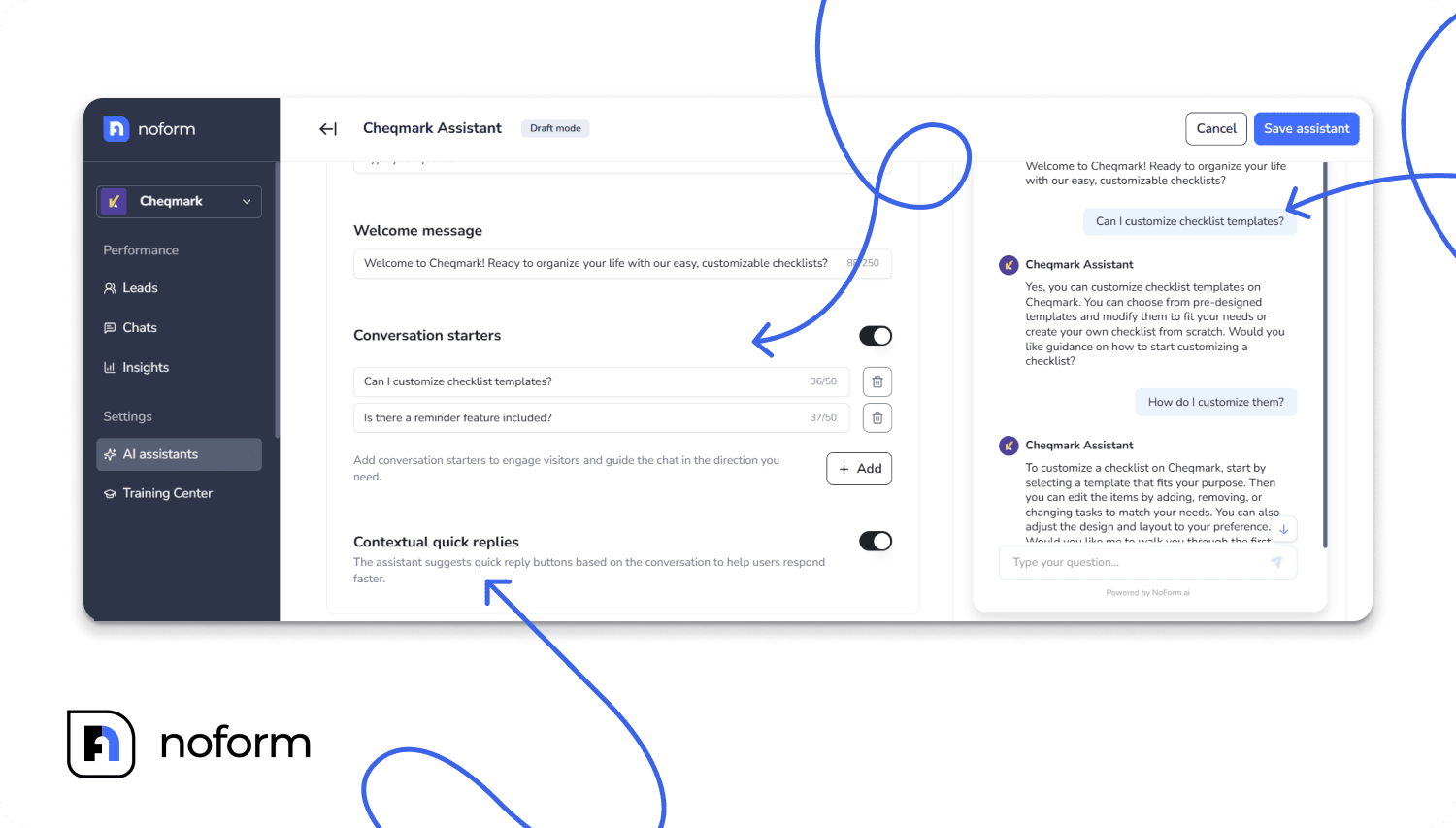
When it all fits together, the conversation feels natural instead of like an intake form dressed up in chat bubbles.
Strategy 4: Prioritize speed-to-lead above almost everything else
The data on response speed is unambiguous. HBR (Harvard Business Review) found that responding to a lead within 5 minutes makes a business 21 times more likely to qualify that prospect compared to responding within 30 minutes. Because the industry average response time is much slower, instant response is the difference between winning and losing a deal.
AI chatbots eliminate this speed problem. NoForm AI runs 24/7, capturing leads during nights, weekends, and traffic spikes, moments when human teams are unavailable, but buyer intent is just as real. The chatbot:
- Responds in under 3 seconds, 24 hours a day, 7 days a week
- Captures contact details before the visitor loses momentum
- Delivers the conversation context and an AI-generated summary to your sales team immediately
- Enables same-day or next-morning follow-up with full lead context already in hand
Here is what that looks like mechanically: the moment a visitor shares their contact details, NoForm AI runs a rapid five-step pipeline. The conversation officially closes out after about 15 minutes of inactivity. The AI then confirms the lead, writes a summary, and sends an email notification out to your entire team—typically within a single minute. No one has to be glued to a dashboard for a lead to reach the right people.
Because the AI has already gathered the qualification data, your sales rep’s first call is a second conversation, not a cold introduction.
Strategy 5: Deliver pre-qualified leads with full conversation context
One of the most underrated advantages of AI qualification is the quality of what gets handed off to your sales team. Instead of a generic form notification, every qualified conversation comes with contact details and a tight, AI-generated summary of what the visitor asked and what they’re trying to solve.
That vital context arrives in a single, clean email featuring the subject line “You have a new lead!”. It includes the visitor’s contact details, the AI summary, their geographic location, the page they were chatting from, and a direct link straight into the conversation. Your rep can open one email and know exactly who to call and why.
This context shortens the sales cycle. LinkedIn research found that AI implementation reduces sales cycles by approximately one full week because sales reps arrive at the first real conversation already informed. Your team knows exactly what the prospect asked and what problem they are trying to solve before ever picking up the phone. They skip the “so, tell me what brought you here today” stage entirely.
Strategy 6: Train your AI on your actual business knowledge
Generic AI responses erode trust fast. A chatbot that can’t answer a specific question about your pricing or services sends people running. Your AI is only as useful as what you’ve taught it.
To make it an expert, head to the Training Center to give it access to your business knowledge. You can paste your website URLs, and if you add a parent page, the system will automatically detect and include its subpages. You can also upload internal documents like product manuals or service playbooks (.doc, .docx, .txt, and .pdf formats up to 10 MB). Treat AI training as an ongoing process to ensure visitors always receive accurate information.
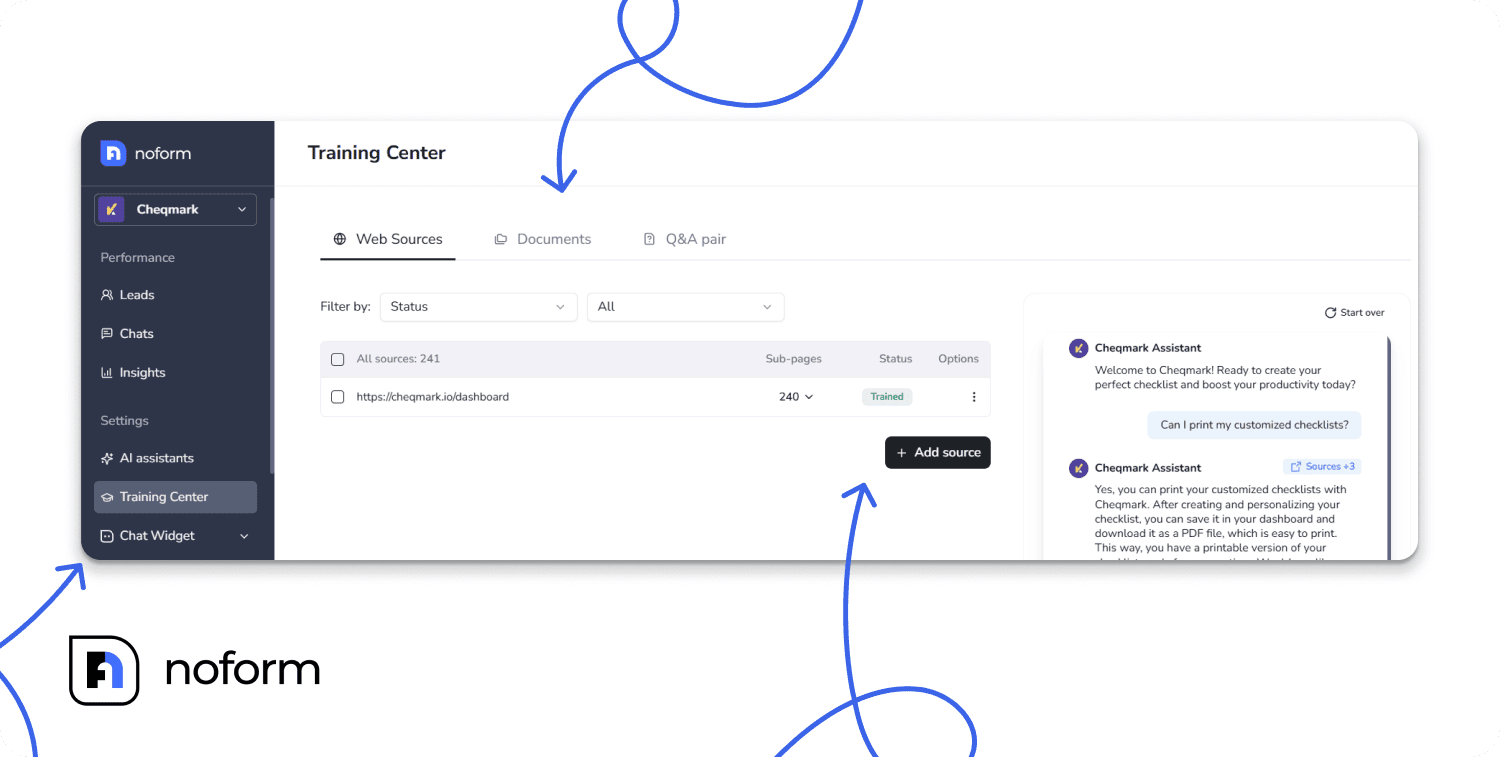
When your pricing changes or you launch a new service, update the knowledge base. Stale information in a chatbot is worse than no chatbot at all.
Strategy 7: Create specialized assistants for high-intent pages
A single general-purpose AI assistant can’t be optimized for every page on your site. Someone reading a blog post is in a completely different mindset than someone on your pricing page comparing plans.
NoForm AI lets you create multiple AI assistants, each assigned to specific pages or URL patterns. One for pricing. One for your support section. Another for product pages. Each one is configured to capture the signals most relevant to where that visitor is in their decision process.
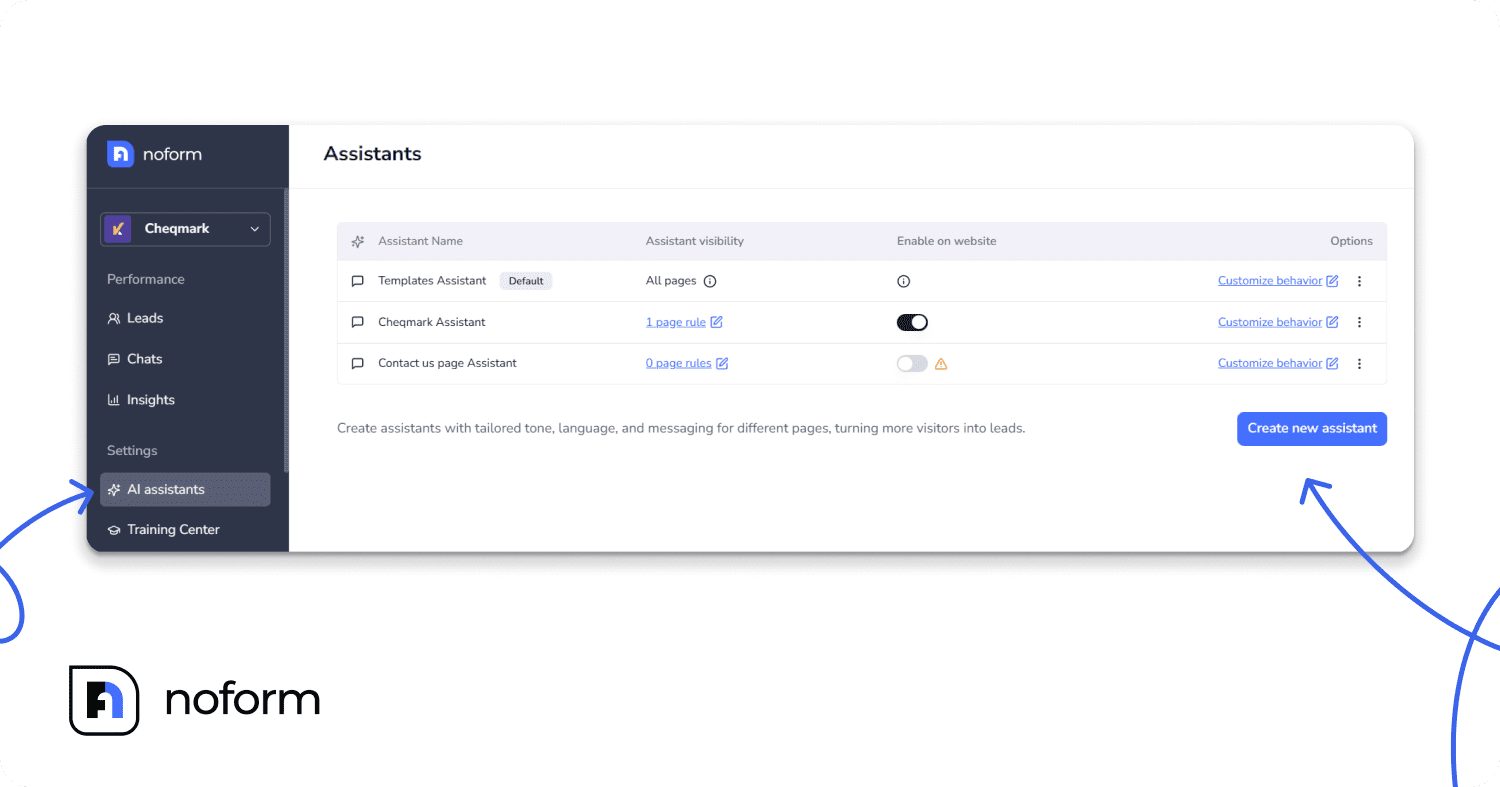
Here is how different page types should be configured:
- Pricing & service pages: Focus on plan comparisons, ROI, and booking demos or quotes.
- Product & feature pages: Educate on capabilities, surface use-case fit.
- Blog & content pages: Focus on delivering value to lower-intent visitors and capturing leads.
- Contact & booking/demo pages: Transition high-intent visitors quickly to booking an appointment.
Platforms like NoForm AI allow you to assign these specific bots to precise URLs, while a “Default Assistant” acts as a safety net for any remaining pages, ensuring your entire site always has coverage.
How do you measure whether your AI lead qualification is working?
Having a chatbot on your website is no longer enough. You need to track what’s actually happening inside those conversations.
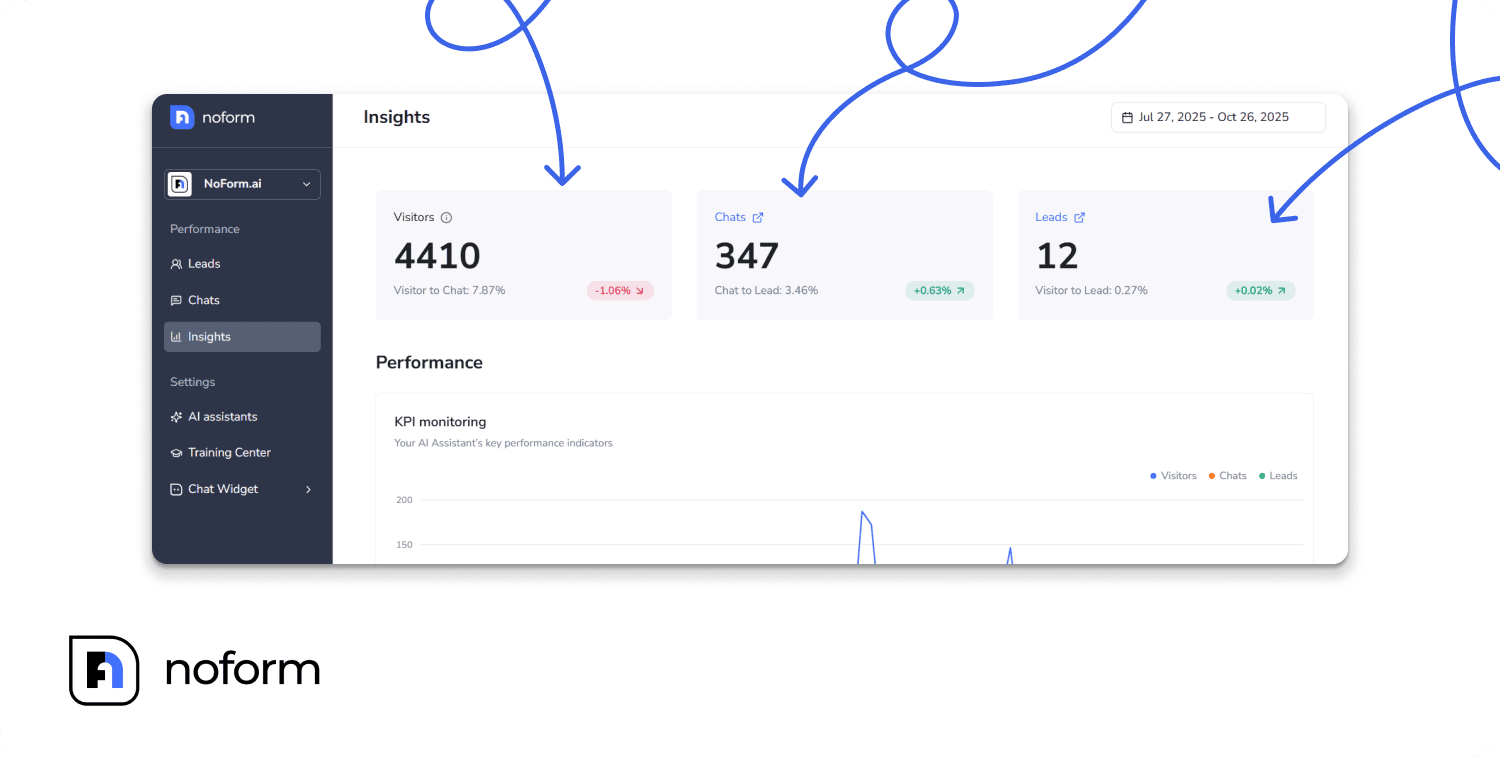
- Visitor to Chat Rate (Engagement)
The percentage of visitors who open the chat and send a message. A healthy range is between 5% and 15%. If you’re below that, your chat bubble might not be visible enough, or the welcome message isn’t pulling people in.
- Chat to Lead Rate (Capture)
The percentage of chatbot conversations that result in a captured email or phone number. A solid rate is between 3% and 10%. The top performers get there by delivering real value before asking for contact info.
- Visitor to Lead Rate (Conversion)
This is your ultimate success metric, the percentage of all visitors who become qualified leads. Even a rate of 0.5% to 2% can be transformative for your business.
Don’t stop at the numbers, either. Review your conversation logs weekly. The questions visitors ask most often will show you exactly where your website content or pricing page is leaving people confused.
Beyond your aggregate conversion rate, the Traffic Sources table in your Insights dashboard breaks these numbers down by channel. It displays Visitors, Chats, Leads, and Visitor-to-Lead % for every single campaign, ad, or referring site. This is how you find out whether your best-performing source is actually organic search, a specific paid ad, or a partner referral.
What are the most common AI lead qualification mistakes to avoid?
Even with great tools, it is easy to misinterpret data or fail to set up your AI correctly. Avoid these common pitfalls:
- Asking for contact details too early. If your bot asks for an email before answering a single question, visitors won’t see enough value to share their information. Let the conversation breathe and answer questions first.
- Using one generic chatbot for the entire website. What works on a pricing page confuses visitors on a features page. Deploy page-specific assistants with custom welcome messages tailored to the visitor’s intent.
- Ignoring the conversation logs. Your chatbot’s chat history is a goldmine of buyer intelligence. Regular audits reveal exactly what your customers are asking and where your site’s content is lacking.
- No CRM integration. A chatbot that captures leads in isolation creates manual data entry and follow-up delays. Connect your chatbot to your CRM (via Zapier or Make integrations) so leads sync in real time with full context attached.
How hard is it to install? (A no-code setup)
You might understand the strategy, but getting it live on your website is the final hurdle. Fortunately, deploying an AI qualification assistant like NoForm AI requires zero coding and no developer team.
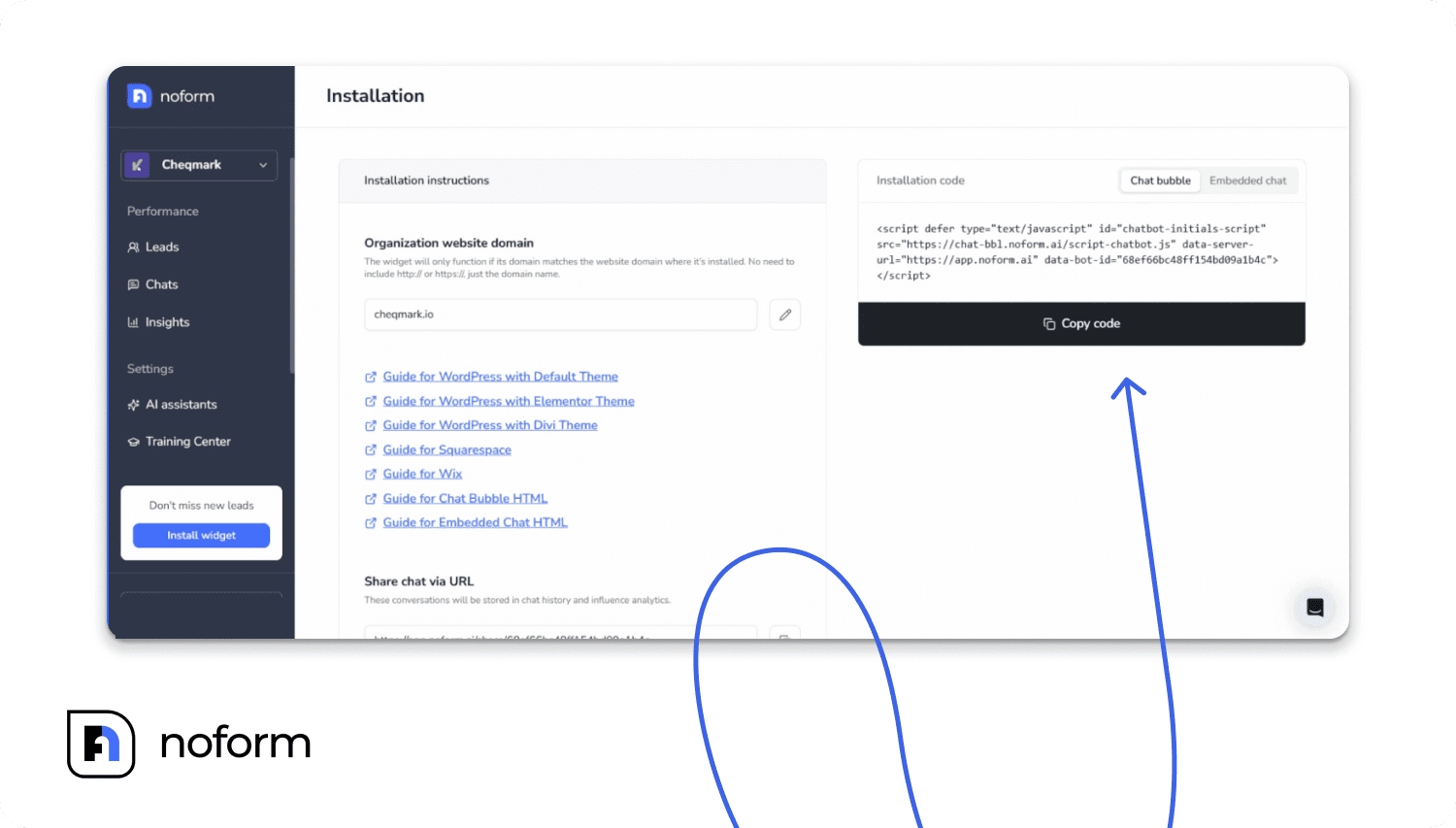
Once your bot is trained and your custom attributes are set, the actual installation takes less than five minutes:
- For WordPress: Simply install the official NoForm AI plugin, no code required.
- For other platforms (Wix, Squarespace, Webflow, Framer): Navigate to the Installation tab, copy your unique embed code, and paste it into your site’s header or footer. The chatbot goes live immediately.
- The CRM connection: Connect your account to Zapier or Make to ensure every qualified lead (and their AI-generated chat summary) drops instantly into HubSpot, Salesforce, or Pipedrive without any manual data entry.
Conclusion
The biggest problem with traditional contact forms is that they ask for too much effort before actually helping the customer. When people can’t get immediate answers, they simply leave.
AI chatbots fix this by talking to visitors instantly. Instead of making them fill out a long form, the AI answers their questions and naturally asks for their contact details in a simple chat.
Whether you run a local plumbing business, a SaaS company, a dental clinic, or a real estate firm, the mechanics are the same. Conversations convert better than forms. Context beats cold calls. And a chatbot that’s live at 2 AM doesn’t care that your office is closed.
The shift from static forms to AI conversation isn’t a big technical undertaking. It is a strategic decision to stop making your visitors work before your product has earned their trust.
Ready to turn your website visitors into qualified leads? Set up your AI assistant today, or book a demo call to see NoForm AI in action.

Frequently Asked Questions (FAQ)
What is an AI lead qualification?
AI lead qualification is the process of using artificial intelligence, typically a conversational chatbot, to engage website visitors, answer their questions, and determine if they match your ideal customer profile in real time. Unlike manual review, an AI lead qualification agent identifies sales-ready prospects the moment they arrive on your site and start chatting. Using artificial intelligence for sales leads this way means your team only spends time on prospects who are genuinely worth pursuing, not everyone who submits a form.
What is the difference between AI lead generation and AI lead qualification?
AI lead generation is outbound: AI tools find and attract new prospects who have not yet discovered your business, through prospecting databases, cold email automation, and social outreach.
AI lead qualification is inbound: AI tools sort the visitors already arriving at your website, determining who is sales-ready and who needs more nurturing. Most businesses need both, but if your traffic is already there and not converting, qualification is the more urgent fix.
How to qualify leads with AI?
To qualify leads with AI, deploy a conversational AI lead qualification chatbot on your website, trained on your business knowledge and configured with your qualification criteria (company size, budget, timeline, and any custom attributes your sales process requires). The chatbot answers visitor questions first to build trust, then gathers qualification data naturally through dialogue. When a visitor provides their contact details alongside your defined attributes, they are automatically flagged as a qualified lead with a conversation summary ready for your sales team.
How do AI chatbots support lead qualification — and how does that differ from a standard chatbot?
AI chatbots support lead qualification through a technique called progressive profiling — asking one natural question at a time instead of presenting a wall of form fields. They greet visitors instantly, answer product questions, gather qualification data, and request contact details at the moment of peak intent. A standard rule-based chatbot follows a fixed script. An AI lead qualification agent is different: it interprets free-text answers, infers intent from context, and dynamically adjusts its next question. If a visitor mentions they are evaluating vendors, the agent recognizes the buying signal and shifts toward contact capture. If they say they are just researching, it keeps delivering value without pushing.
What is automated lead qualification using AI, and how do you set it up?
Automated lead qualification using AI means the entire top-of-funnel screening process runs without human involvement. A visitor arrives, the AI engages them in conversation, and once a prospect qualifies, it automatically creates a new contact, attaches an AI-generated chat summary, and notifies a sales rep for immediate follow-up.
Setting it up involves five steps:
- train the AI on your website content;
- define your qualification criteria;
- configure page-specific assistants with tailored welcome messages;
- install the chatbot via embed code or plugin;
- and connect it to your CRM via Zapier or Make.
The entire AI lead qualification automation then runs without manual input.
How do you train an AI chatbot for lead qualification?
Training an AI chatbot for lead qualification requires two inputs: your business knowledge and your qualification logic. Business knowledge (website URLs and uploaded documents like product manuals, service guides, and FAQs) teaches the AI what to say. Qualification logic (the custom attributes that define a sales-ready lead, such as budget range, company size, or timeline) teaches it what to collect.
Modern AI lead qualification tools handle this through a no-code interface: paste your URLs, upload your documents, and configure your attributes. No developer needed. Update the knowledge base whenever your pricing or products change to keep responses accurate.
How effective is AI-powered lead qualification?
It is highly effective. Data shows that businesses replacing static forms with conversational AI convert up to 3 times more website visitors into leads. According to a 2026 Landbase analysis, companies using AI tools for lead qualification improved overall conversion rates by 25–35% and increased qualification accuracy by 40%. AI lead qualification systems achieve 85–95% accuracy in identifying sales-ready prospects when custom attributes are precisely defined. On top of that, AI-powered lead qualification reduces sales cycles because sales reps skip the discovery phase and start the first call already knowing the prospect’s needs, budget, and timeline.
What is the best AI lead qualification software?
The best AI lead qualification software trains itself on your existing website content instead of requiring manual scripting, supports configurable custom attributes beyond basic email capture, assigns different assistants to different pages, delivers AI-generated conversation summaries alongside contact details, and connects to your CRM in real time. These are the criteria that separate a true AI lead qualification platform from a basic contact form with a chat window. NoForm AI is built specifically for this use case, and it meets all these criteria.