
With the rapidly increasing AI capabilities, chatbots have evolved from limited tools with predefined responses to an integral part of any business.
From handling complex workflows to proactively anticipating customers’ needs, AI-based chatbots help free up resources and even close sales completely independently.
According to Gartner, by 2027, chatbots will be the primary customer service channel for a quarter of organizations.
But what are some of the most exciting chatbot features you can utilize today? And how can they help your business?
Let’s explore the different aspects of chatbot functionality below.

What are the essential core functionalities every chatbot should have?
Even though AI chatbots can offer a variety of excellent features, in the end, they’re still primarily used for a few core functionalities that make them an indispensable part of customer support.
Natural Language Processing (NLP)
Natural Language Processing (NLP) is the foundational feature that lets a chatbot understand what a person means, not just what they typed.
The most capable chatbots are based on Natural Language Processing, which allows chatbots not just to interpret human language but to actually understand the meaning and context behind the words.
This deeper understanding helps to recognize the intent behind what a user wants, resulting in a much more human-like interaction.
Because of that, the answers that an AI-based chatbot can provide are usually much more relevant, accurate, and helpful. Instead of being a source of frustration, this chatbot feature, paired with the right training, can significantly reduce the number of queries requiring human intervention, as AI chatbots can help resolve even more complex issues.
24/7 availability
82% of users expect immediate problem resolution from customer support agents. But for most businesses, having human support agents round the clock is not feasible. The good news is that chatbots are a cost-friendly alternative, which is actually expected by 73% of users because of their convenience.
Accessibility and 24/7 availability are some of the best chat bot features, allowing businesses to serve customers across all time zones and during holidays.

This not only helps boost customer satisfaction but is also crucial for customer engagement and even lead generation, with many AI chatbots like NoForm having the ability to guide users towards the right solution for their needs without any need for human support staff.
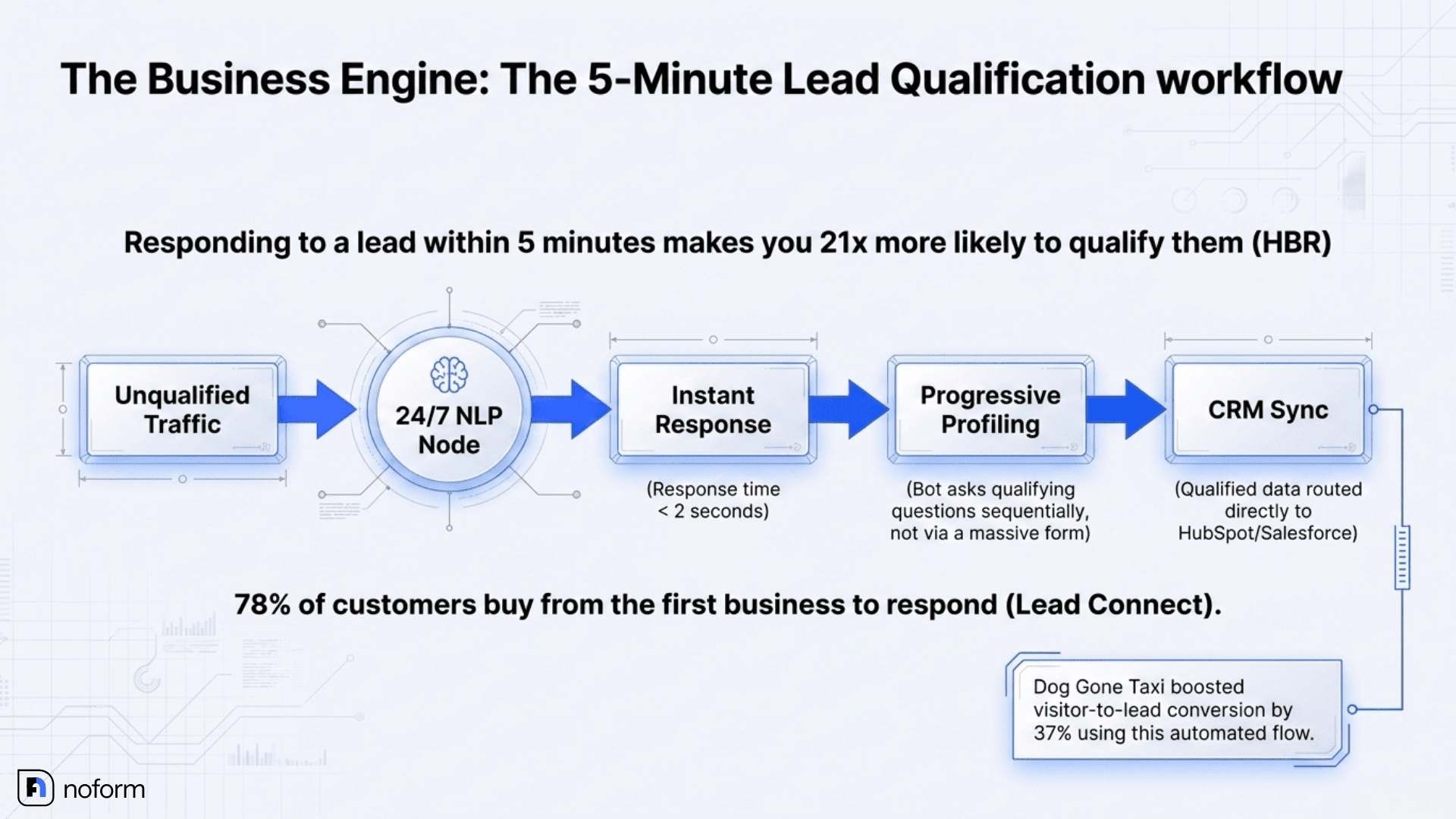
Dog Gone Taxi used this round-the-clock availability to increase online requests, creating more sales opportunities and boosting the visitor-to-lead conversion rate by 37%.
Contextual awareness
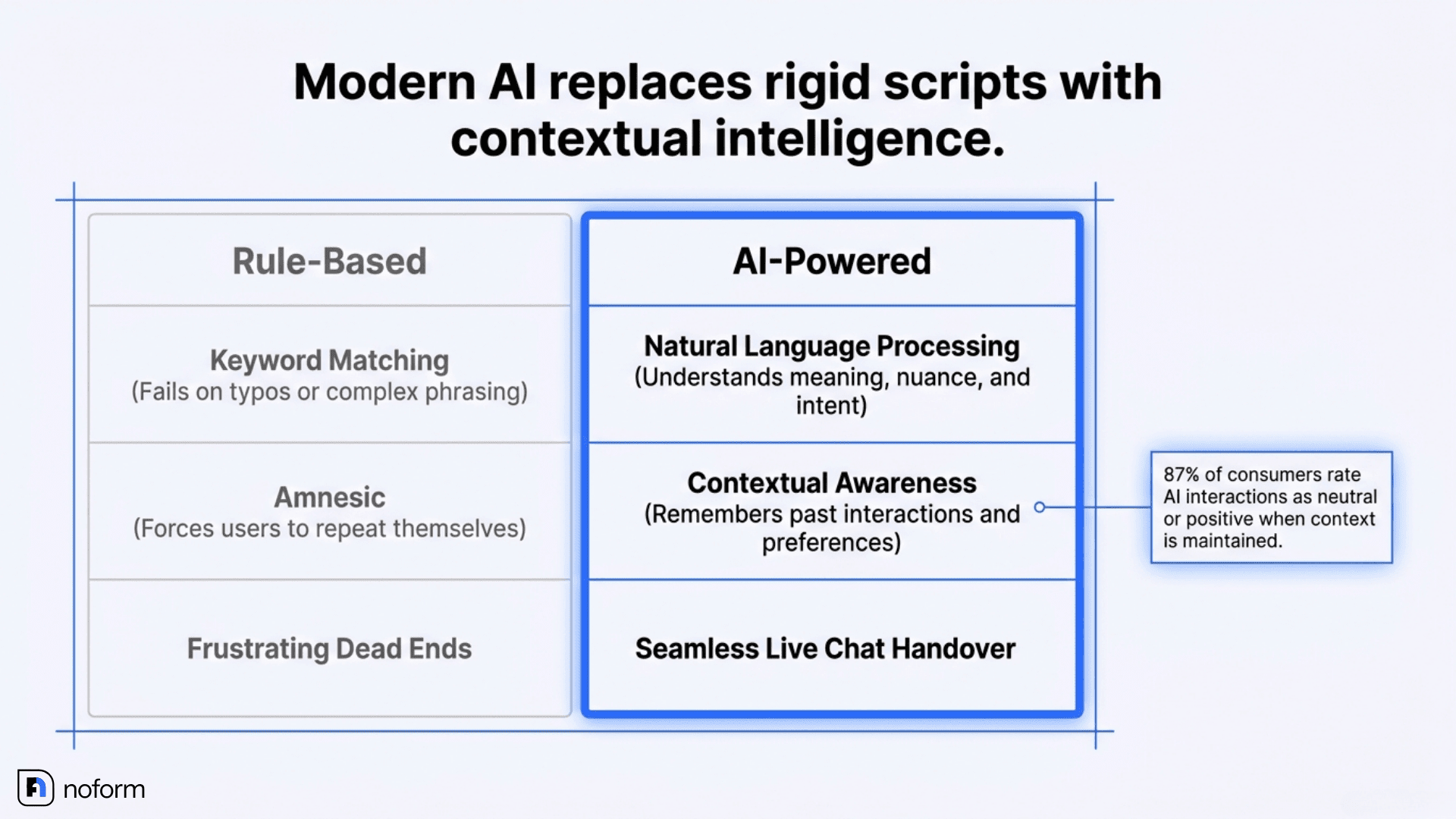
Contextual awareness is one of the most fundamental characteristics that distinguishes between basic, rule-based chatbots and modern AI-based solutions. It allows chatbots to go beyond each individual conversation and provide more meaningful, personal responses.
By remembering past interactions with users and their preferences, advanced chatbots can learn to provide more relevant responses, maintain continuity in the chat, and dramatically improve the user experience.
These types of new AI chatbot features are one of the main reasons why more than 87% of consumers rate their interactions with bots as either neutral or positive, indicating a growing acceptance of this technology.
Which chatbot features make it more engaging for users?
One of the main functions of chatbots is to provide a seamless and convenient experience that mimics human agents and helps effectively resolve queries. Here are the best chatbot features to accomplish this.
Multilingual support
An increasingly important part of providing a great user experience is communicating in the customer’s preferred language. The adaptability of chatbots makes them the perfect tool for providing personalized support to people from all around the world without any friction.
In fact, chatbots like NoForm can seamlessly switch between different languages depending on where the person is from or their preferences. They can do so while being aware of any cultural sensitivities, avoiding misinterpretations, and understanding linguistic nuances that help provide accurate responses no matter how the queries are formulated.
For businesses that are or want to go global, chatbots also offer an accessible way to ensure their support and communication remain consistent, simplifying localization and helping them enter new markets much faster.
Personalization
78% of customers expect more personalization in interactions than ever. Customers want experiences that are tailored to their needs and preferences, with instant answers to questions and solutions to problems.
With the help of powerful AI chatbot features, businesses can meet these customer expectations, providing relevant and personalized recommendations immediately. For example, a chatbot on an eCommerce website can make timely recommendations based on the user’s activity, past purchases, or questions.

These personalized experiences would be impossible without chatbots, as even the most robust human support team can’t provide relevant solutions this quickly. That’s why AI chatbots are so effective for increasing engagement and improving the customer experience, all while driving business results.
Live chat handover
Modern chatbots can handle even complex issues that involve multiple steps, making it no surprise that 65% of users feel comfortable resolving issues without human intervention.
Still, some situations are beyond the capabilities of chatbots because of their complexity, nuance, or unclear solutions that are beyond the chatbot’s training. That’s when the chatbot must be capable of quickly transferring the chat to a live support person who can take over and provide the needed human touch.
Smooth chat handover must ensure that the user doesn’t have to repeat any of the key information and that the live support agent can access it.
Customization
Chatbots are an extension of your brand. As such, they need to align with your brand identity, including tone of voice, conversational style, and even appearance.
Today’s leading chatbot software solutions offer the ability to add branding elements, such as colors and fonts, to maintain consistency. By having a chatbot look consistent with your brand, you can make it easier to recognize and more trustworthy, allowing your customers to seek help with confidence.
Omnichannel capabilities
53% of buyers are more likely to shop with businesses offering messaging services. That means companies that want to excel in their markets must be willing to adopt a variety of ways for customers to reach out and get help in an instant.
In terms of chatbots, that means leveraging a messaging platform that allows customers to continue their conversations across different channels without having to repeat themselves or start over. It also means making chatbots visible and accessible at different parts of your customer journey, so that people are always just a click away from receiving personalized assistance.
Business-focused features
Chatbots are incredibly useful for communicating with customers. But they can also be integral business tools, helping attract leads, scale your business, and align with your business goals while providing valuable insights into your customers.
Lead generation and qualification
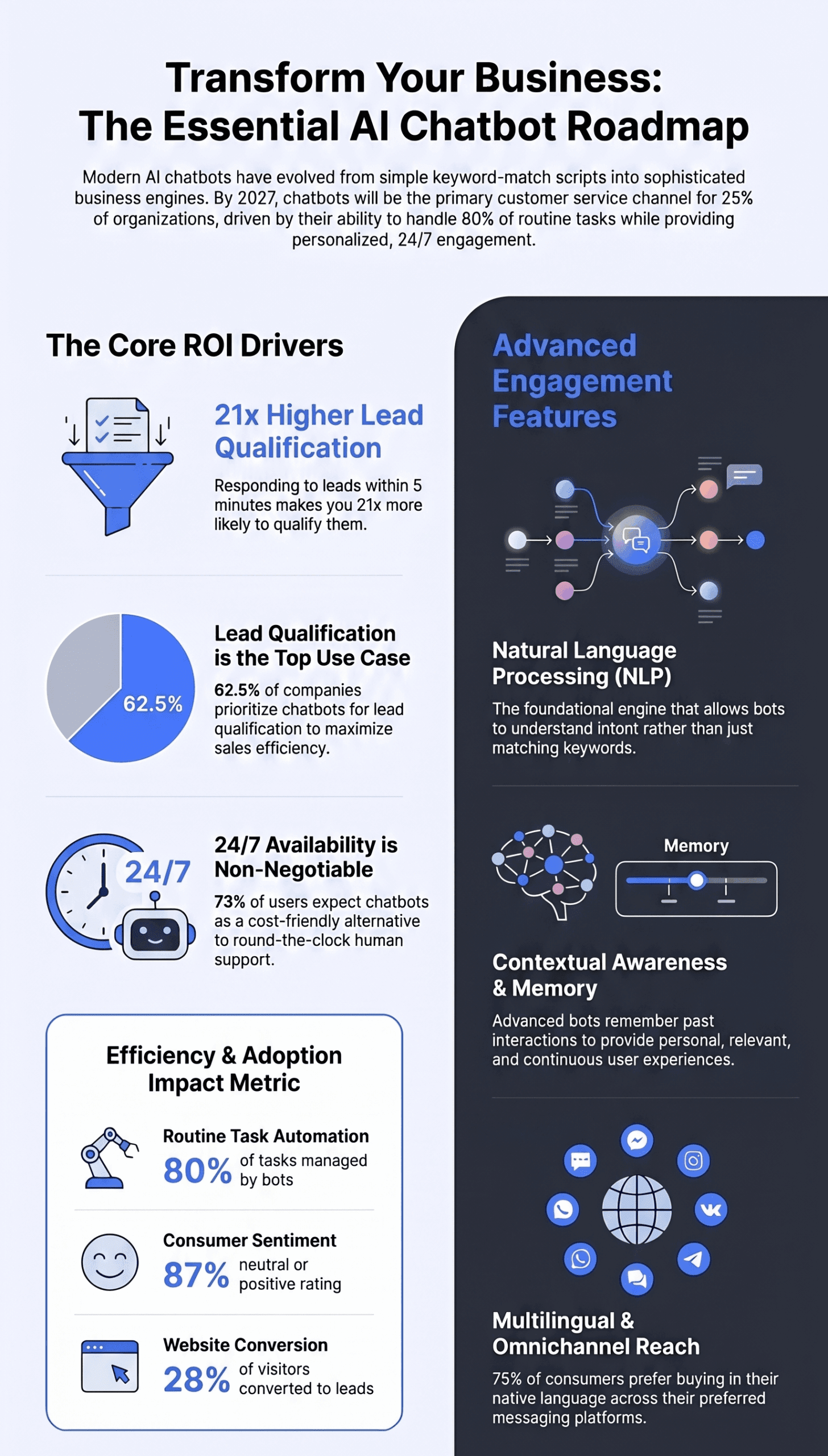
36% of companies use digital assistants to generate leads, while 62.5% also use them for lead qualification. More businesses are recognizing that chatbots are not just about answering queries. They can serve as virtual salesmen, guiding leads toward the next step in their journey and helping them see how your business can solve their problems.
For example, marketing chatbots initiate conversations and gather information about the visitor’s intent based on predefined criteria, guiding them towards relevant products and services or capturing their information for your sales team. Dog Gone Taxi implemented the NoForm chatbot and it helped qualify leads, send their details to the sales team, all while improving the customer experience.

With the help of AI, chatbots can provide personalized experiences to each user, understanding their specific needs, scoring them as leads based on predefined criteria, and even nurturing them through automated follow-up messages. This can effectively turn chatbots into AI sales assistants, closing deals for your business completely on autopilot.
Data security and privacy
Your customers will only use a chatbot if they feel their data is secure. That’s why it falls on your business to choose the right chatbot solution that prioritizes data security and privacy and goes beyond mere compliance, offering the most robust protections to keep customer data private.
For one thing, leading chatbots use end-to-end encryption, especially when any sensitive information or personal details are shared. Modern chatbots also offer access control and authentication solutions, only allowing authorized personnel to access the data and the conversations.
Scalability
One of the biggest obstacles to scaling a business is the increasing number of customer interactions, which can quickly overwhelm a support team. Luckily, well-implemented chatbots can completely solve that problem.
Research from IBM shows chatbots manage 30% of live chat communications and 80% of routine tasks, freeing up human agents to focus on more complex query cases. And AI-based chatbots available today can even handle many of the more complex tasks as well.
Plus, chatbots are able to handle varying volumes of interactions without compromising performance and ensuring uninterrupted service. This helps scale your business without sacrificing the customer experience while ensuring that the first interactions with your company are positive.
Integrations
Implementing a chatbot into your workflow can seem like a daunting task. You already have a process for managing customer query cases, and any new technology must fit with your business tools to be practical.
The good news is that chatbot tools can seamlessly integrate with a variety of other tools, including leading customer relationship management (CRM) software, project management tools, and other platforms used in business operations. This ensures you can set up the chatbot quickly, without a complicated implementation process, and without having to change how you run your business.
Analytics and reporting
Chatbots can be plugged into almost any business and enhance its user experience. But to truly reach their full potential, chatbots need to be monitored to continually improve their bot performance metrics and find ways they could better serve the needs of the users.
Chatbots today make this much easier than before, offering insights into their performance such as customer engagement, conversation flow, goal completion, and more. These insights enable data-driven decision-making, enabling gradual improvements that enhance the user experience, help resolve queries faster, and maximize ROI in the process.
Advanced features
The rise of Artificial Intelligence technology has been rapidly reshaping the possibilities in the world of chatbots. Leading solutions are capable of automating entire workflows, sentiment analysis, and even predictive responses.
Automated workflows
One of the biggest advantages of today’s chatbots is their ability to handle a variety of tasks that would normally fall on human support agents.
Chatbots are able to schedule appointments, answer FAQs, and resolve customer queries, all without the need for your staff to intervene. Solutions based on generative AI can take it a step further, handling complex, multi-step processes and adjusting based on the user’s answers and unique needs.
For example, a chatbot could guide the customer through a purchase process, helping them make modifications to the order, change the order address, or even recommend additional products based on their needs. These and other automations can make a huge difference because they free up time and resources that can be used in other areas.
Sentiment analysis (Emotional intelligence)
For a long time, perhaps the biggest limitation of chatbots was their inability to imitate real human conversation. They would struggle to read subtle cues in the customer’s language, understand their emotions, or detect interest in products to nudge customers towards a purchase.

But as AI chatbot technology continues to evolve, chatbots today no longer have these limitations. They have advanced sentiment analysis capabilities which allow chatbots to identify what the customer is feeling and what they’re trying to say, making the entire conversation seem more natural.
For example, an AI-based chatbot on a healthcare website could detect a patient’s anxiety and fear and offer reassurance while connecting them with a healthcare professional.
Machine learning and adaptability
To remain effective over time, chatbots must evolve together with the changing needs of the needs of the customers. And chatbots powered by machine learning are capable of continuous learning from each interaction to improve responses and provide more value.
Machine learning allows chatbots to improve the accuracy of their answers, personalize interactions by identifying behavior patterns, and become better at tackling unique situations based on previous experiences.
For example, a chatbot for an internet services provider might discover that the most common cause for slow internet is outdated firmware. It can then start proactively asking users about their firmware version, getting ahead of the problem, and helping resolve it faster.
AI-powered predictive responses
28% of website visitors are converted into leads by digital sales assistants. And with the recent advances in AI, chatbots are becoming even more effective at proactively anticipating the needs of users and offering personalized guidance.
By analyzing user data and historical interactions, AI-powered chatbots effectively anticipate the needs of the users and offer more relevant solutions to problems.
Whether it’s product recommendations, useful resources, or even timely promotions, chatbots are designed to identify opportunities to direct users toward the next step, boosting the customer experience and helping grow your business.
Voice recognition
Chatbots play a vital role not just for convenience but accessibility as well. And today’s chatbots can facilitate that by offering help not just in a chat, but in verbal conversation.
Voice-enabled chatbots can make online services more accessible for people with disabilities, such as visual impairments or mobility limitations. It also offers a hands-free experience to those who cannot type at that time, serving as a great way to quickly get information or make an appointment on the go.
For example, a voice-enabled AI chatbot could work the customer through a problem they’re facing conversationally, providing step-by-step guidance on how to solve a problem.
Industry-specific chatbot capabilities
35% of business leaders credit digital assistants with closing deals. And that’s not surprising, considering that modern chatbots like NoForm can be tailored to meet the unique challenges and needs of businesses in different industries, offering a variety of specific capabilities in various scenarios.

Let’s explore some of these scenarios below.
- Finance and banking: By leveraging machine learning and AI technology, chatbots are able to uncover financial goals and investment preferences to provide recommendations, such as budgeting tips or financial planning advice.
- Healthcare: Chatbots in the healthcare space can utilize automated workflows to guide users through appointment booking. They can also proactively gather patient details such as symptoms, directing them to resources or healthcare professionals.
- Real estate: A chatbot can qualify website visitors by asking about their budget and preferences and helping schedule an appointment. They can also answer questions about the process or the specific features of different property listings.
- eCommerce: A chatbot on an eCommerce store can use predictive responses and personalization to proactively recommend products based on user preferences. They can also walk visitors through the buying process, answering questions and providing assistance.
- Transportation and logistics: AI chatbots for a website in the logistics or transportation industry are great for answering questions on shipment status, delivery estimates, or potential delays. They can also answer repetitive inquiries or direct to knowledge base articles.
- Car dealerships: A chatbot on a car dealership site can streamline lead generation and become a virtual salesperson, offering information about the vehicles, answering common questions, and scheduling test drives or consultations, all while qualifying leads in the process.
- Roofing and home services: A roofing and home services bot can ask questions about the roof size, damage details, and budget to evaluate the customer’s needs and offer recommendations for services, or even cost estimates.
- Pet services: Chatbots in the pet care industry can give personalized advice to pet owners based on their situation. They can even offer emergency support, helping them assess the situation and connecting them with veterinary professionals if needed.
What are the must-have features in a chatbot?
Not every chatbot feature carries equal weight. If you’re evaluating a platform or building your first AI assistant, these are the capabilities that separate functional chatbots from ones that actually move the needle for your business.
- Natural Language Processing (NLP) — Without it, the bot can only match keywords, not understand questions. This is non-negotiable.
- Contextual memory — A bot that forgets the previous message forces users to repeat themselves. Contextual awareness keeps conversations coherent.
- Lead capture and qualification — For any business that relies on inbound inquiries, the chatbot must be able to collect contact information and flag high-intent visitors for the sales team.
- CRM and tool integrations — A chatbot that can’t pass data to your existing workflow (HubSpot, Salesforce, Pipedrive, etc.) creates a manual step that defeats the purpose of automation.
- 24/7 availability with instant response — 78% of customers buy from the first business to respond. A chatbot that responds in under 3 seconds at 2 AM is a genuine competitive advantage.
- Analytics and fallback tracking — You need to know how many conversations turn into leads, where users drop off, and when the bot fails to answer (the fallback rate). Without data, you can’t improve.
Nice-to-have features — valuable but not essential from day one — include voice recognition, omnichannel support, A/B testing, and predictive response engines. Get the six above working first.
What chatbot features matter most for user engagement?
User engagement is how often visitors actually use the chatbot, how long they stay in conversation, and whether they complete a meaningful action (like sharing their contact info or getting a question answered).
The features that most directly drive engagement aren’t the flashiest ones. They’re the practical ones:
- Conversation starters and suggested replies — Visitors who don’t know what to ask often leave. Clickable prompt buttons reduce the friction of starting a conversation and set the tone for what the bot can do.
- Progressive profiling — Instead of presenting a form with five fields, an engaging chatbot asks one question at a time, woven naturally into the conversation. Users share more when it feels like a dialogue, not an interrogation.
- Personalization based on page context — A chatbot on your pricing page should open with a different message than one on your support page. Page-aware welcome messages can dramatically improve conversation rates.
- Response speed — Anything over 3 seconds feels broken. Under 2 seconds feels human. Engagement drops sharply when bots take too long to reply.
- Multilingual support — 75% of consumers prefer to buy in their native language. A chatbot that auto-detects language and responds accordingly removes a significant barrier for international visitors.
Engagement isn’t a feature you turn on — it’s the result of configuring the right features well. The chatbots that get used are the ones that answer questions confidently, ask for information naturally, and never make the visitor feel like they’re talking to a script.
Bottom line
Gartner predicts that by 2027, chatbots will become the primary customer support channel for 25 percent of all businesses. But even though now is the time to embrace this technology, it’s also crucial to choose a solution that allows you to take full advantage of today’s chatbot capabilities.
If you choose the NoForm chatbot builder, you can access cutting-edge AI chatbot features and capabilities — built specifically for lead qualification and sales handoff, not just customer support. Create your first chatbot with Noform today!
Frequently Asked Questions
What features should a chatbot have?
Every effective chatbot needs Natural Language Processing to understand intent, contextual memory to maintain conversation continuity, 24/7 availability, and the ability to integrate with your existing tools. For sales and lead generation, add lead capture, qualification logic, and CRM sync to that list.
What are the key features of an AI chatbot?
The key features of an AI chatbot are NLP for language understanding, machine learning for continuous improvement, contextual awareness for coherent conversations, multilingual support, and real-time analytics. AI chatbots differ from rule-based bots in that they understand intent rather than matching predefined keywords.
What can a chatbot do for my business?
A chatbot can answer frequently asked questions, qualify inbound leads, capture contact information, route visitors to the right resources, and hand off complex queries to human agents — all without staff involvement. For businesses with website traffic that isn’t converting, this means capturing leads around the clock, including nights, weekends, and holidays.
What is a good chatbot feature for user engagement?
The most impactful engagement features are conversation starters (clickable prompts that reduce the friction of starting a chat), contextual quick replies (suggested responses based on what’s being discussed), and page-aware welcome messages. Faster response times also correlate strongly with higher engagement rates.
What’s the difference between basic and advanced chatbot features?
Basic chatbot features handle structured tasks: answering FAQs, collecting contact details, routing queries. Advanced features involve AI-driven capabilities like sentiment analysis (detecting user frustration), predictive responses (anticipating what the user needs next), machine learning (improving from each conversation), and automated multi-step workflows that don’t require human scripting.