Your customers are already talking—are they talking to you or your competitors? In a world of short attention spans and endless choices, a conversational marketing chatbot can be the difference between winning a customer and losing them in seconds. Chatbots for conversational marketing replace one-way brand monologues with real-time, human-like conversations that guide, engage, and convert.
People expect instant answers, personal attention, and interactions that feel natural. That’s why chatbots and conversational marketing are now inseparable. The global AI chatbot market is projected to hit $46.64 billion by 2029, growing at 24.53% CAGR. In the past year, 88% of people have used a chatbot, one-third of Americans in just the last three months. Thirty-five percent turned to them instead of search engines, and 80% rated the experience positively.
In this article, you’ll see why conversational marketing is now a strategic must-have, how AI chatbots are driving the shift, the features and benefits that matter, real-world results, and how to build your own high-performing bot with NoForm AI.
What is conversational marketing?
Conversational marketing is a digital marketing approach centered on real-time interactions with website visitors, prospects, and customers. Instead of relying on broad marketing campaigns and waiting for replies, it creates instant, two-way dialogue through preferred communication channels like live chat, messaging apps, or embedded chat interfaces.
Its purpose is to guide potential customers through the customer journey quickly and naturally: from first visit to decision. With an effective strategy, every message is personal, timely, and relevant, addressing customer questions, highlighting products and services, and removing friction along the way.
Conversational marketing vs. traditional marketing
Unlike traditional marketing, which pushes out one-way messages and waits for slow, occasional responses, conversational marketing is built for speed and relevance.
From a user experience standpoint, it feels seamless. Customers don’t have to dig through endless pages for information, wait on a sales rep, or adjust to the company’s schedule. They immediately get custom responses, all while being qualified in the background.
The role of AI and NLP in conversational marketing
This shift is why conversational AI marketing has become standard practice: a 2023 Salesforce State of Marketing report found that 83% of marketing organizations now use AI in some capacity, with conversational tools among the fastest-growing applications.
Powered by artificial intelligence, machine learning, and natural language processing, these platforms can understand intent, interpret phrasing, and deliver personalized, real-time interactions that feel natural.
This technology is what makes human-like exchanges at scale possible — conversations that feel personal even when the bot is handling thousands of them at once. And it’s especially powerful when applied to chatbots and conversational marketing!
AI chatbots as the engine of conversational marketing
AI chatbots are virtual agents powered by chatbot technology and artificial intelligence, capable of holding a meaningful conversation with a human in natural language.
In chat bots for conversational marketing, they serve as an always-available link between a business and its target audience.
Here’s how they drive conversational marketing at scale:
- Intelligent, instant answers: Customers expect answers the moment they ask. A trained AI chatbot can resolve pain points, accurately respond to common questions, and recommend relevant products and services in seconds—without waiting for human intervention.
- Scalability with personalization: Unlike models limited by headcount, a conversational marketing bot manages thousands of customer interactions at once while keeping each reply tailored and high-quality.
- Conversation as a brand experience: Every exchange shapes perception. A well-designed chat bot for conversational marketing reinforces brand voice, builds trust, and delivers meaningful interactions that guide people through the customer journey.
When integrated into a conversational marketing platform, these capabilities turn casual chats into strategic touchpoints and make them central to modern conversational marketing strategies.
What are the core benefits of using conversational marketing chatbots for your business?
The capabilities outlined earlier are exactly why conversational marketing with bots delivers such numerous benefits to businesses. The different features of AI chatbots allow them to handle everything from routine queries to complex interactions, strengthening customer relationships and driving measurable results.
In fact, 79% of companies say their conversational marketing bot improved customer loyalty, sales, and revenue.
- 24/7 availability: Over 60% of customers expect round-the-clock service, and 39% of conversations happen outside business hours. No wonder 64% appreciate chatbots’ nonstop presence.
- Reduced drop-off with instant responses: Beyond 24/7 availability, speed is key to a competitive edge. A 5-minute delay makes visitors 10x more likely to leave, and 10 minutes raises that to 100x. Even the fastest human agent can’t match a bot’s instant replies.
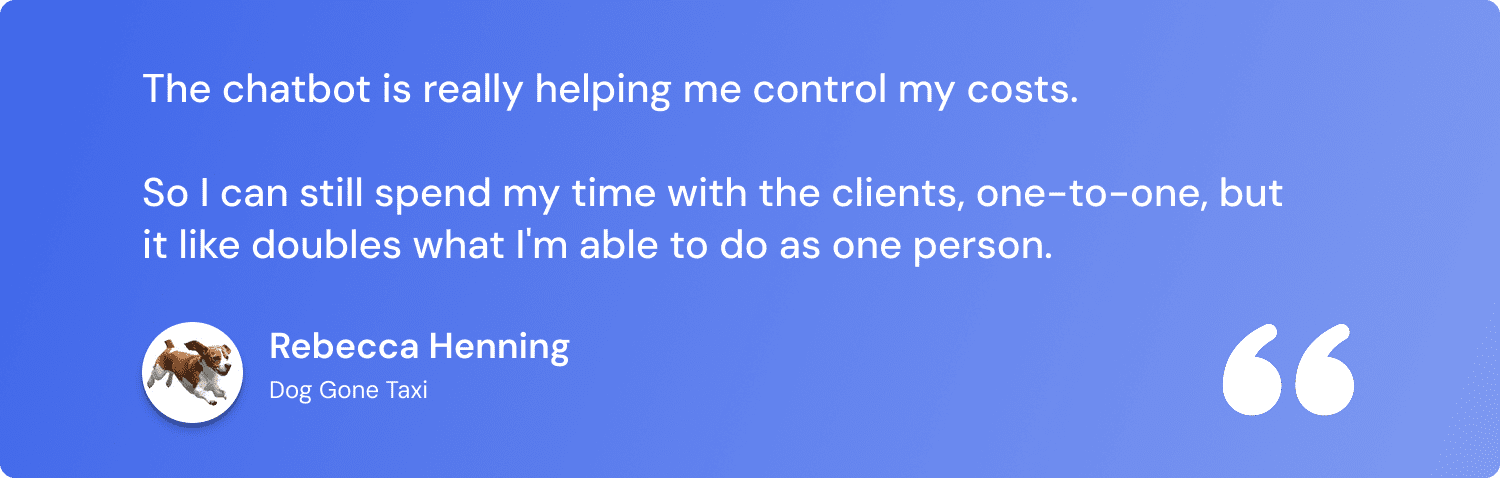
- Personalized customer interactions at scale: Modern bots deliver personalized experiences across thousands of simultaneous customer interactions. Dog Gone Taxi, for instance, automated over 1,100 conversations (around 3,300 queries).
- Reduced operational costs: Conversational AI can cut customer support costs by up to 30%. Automation of repetitive processes frees live teams to focus on business-critical tasks. Beyond immediate benefits, Forrester research indicates that businesses implementing conversational AI can achieve an impressive 315% return on investment over three years, showcasing its significant financial impact.
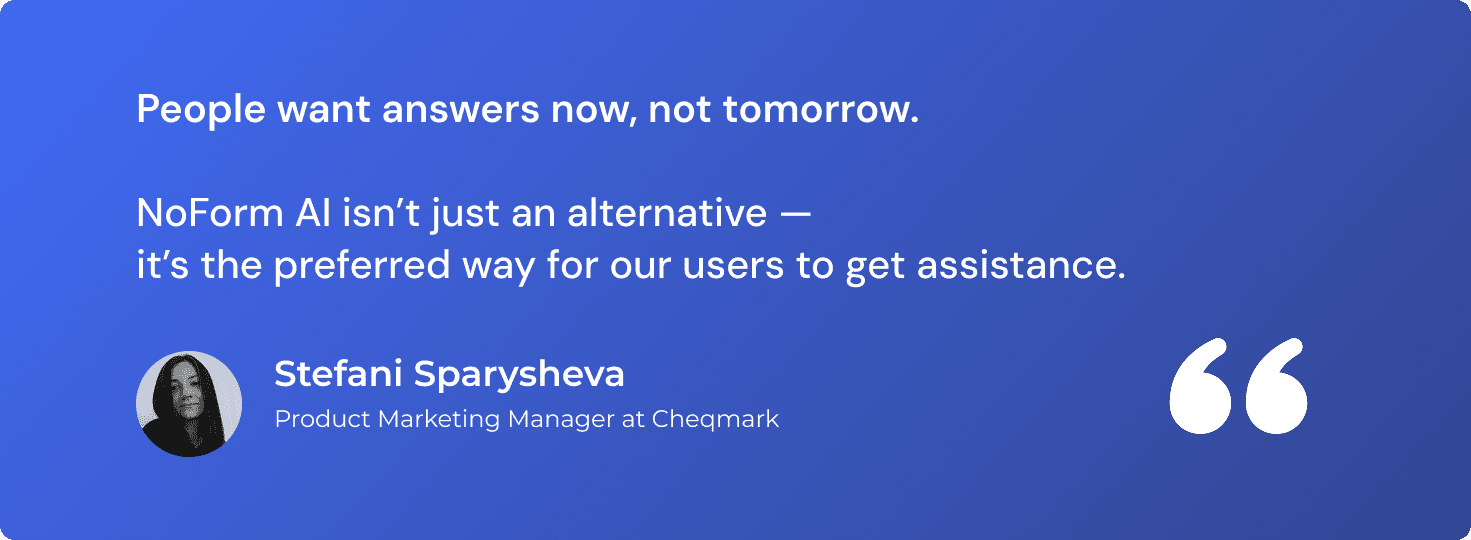
- Higher engagement and conversion rates: 41% of business chatbots are used for sales, and 35% of business leaders say they help close deals faster. For instance, by using NoForm AI to power their website’s chatbot, Cheqmark saw an impressive conversion rate boost of up to 200% on their key template pages, as the bot helped users quickly find what they were looking for. Furthermore, HubSpot data suggests that companies leveraging chatbots can see a 20% increase in qualified leads, directly contributing to sales pipeline growth.
- Better customer data insights for optimization: Bots capture customer preferences, pain points, intent, and motivation during natural exchanges, feeding valuable data back into inbound marketing strategies and customer journey improvements.
The psychology behind conversational marketing
The pros of using chatbots are clear. Let’s look at why they work so well:
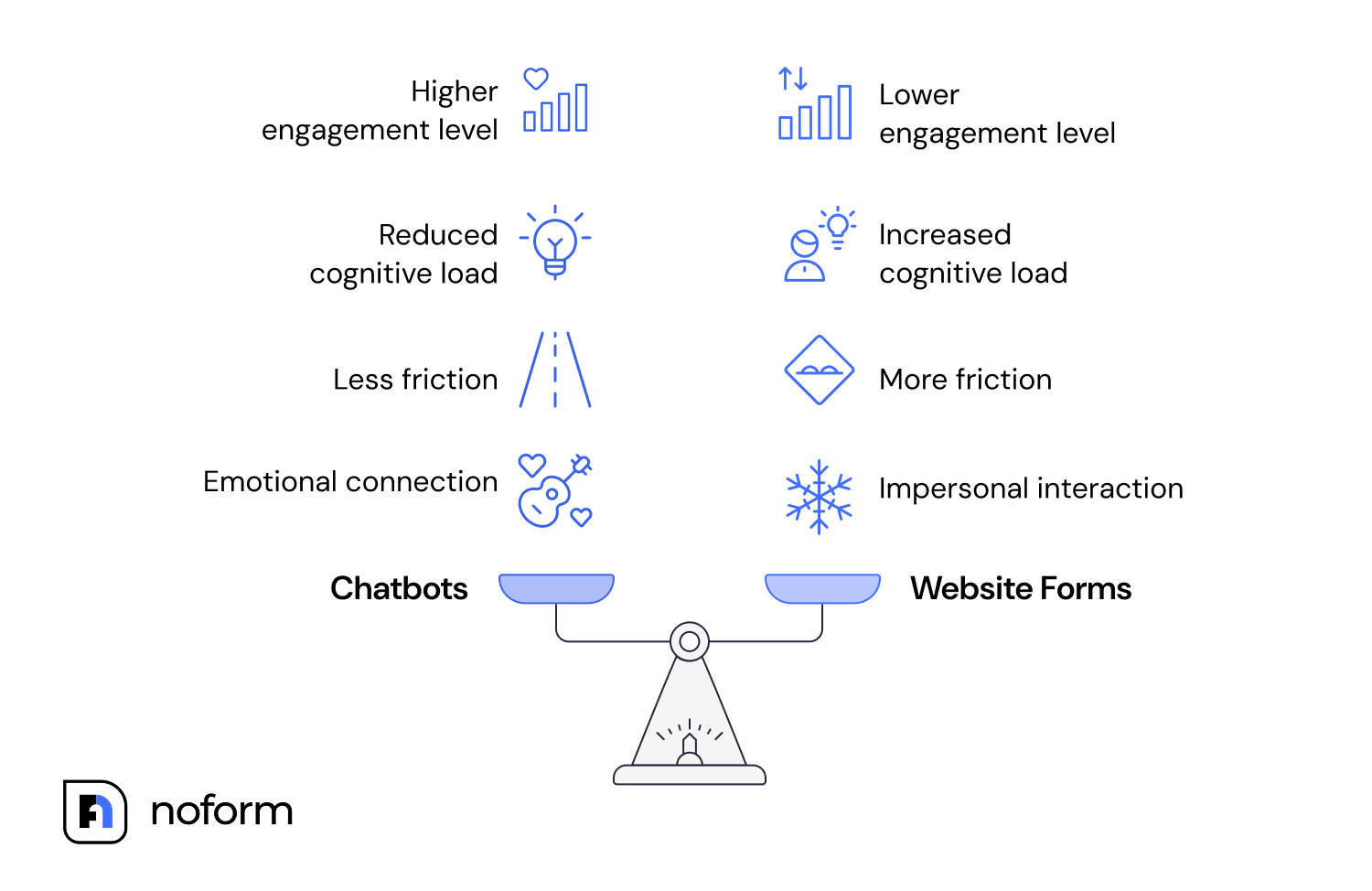
- People engage more with bots than forms: In the digital space, a casual conversation—even with a bot—feels more engaging that a long static form. Businesses using chatbots achieve 3x higher sales conversions than those with website forms.
- Instant gratification and reduced cognitive load: In an on-demand world, people expect answers fast. Conversational marketing meets that need by cutting the effort of finding information, breaking decisions into simple steps that sustain customer engagement and momentum.
- Conversational UI means less friction: A natural dialogue makes action effortless. Instead of navigating pages or menus, users just ask and receive. This reduces friction, increases completed actions, and leads to better marketing results.
- Emotional ROI and trust: A personal dialogue builds rapport faster than impersonal campaigns. Bots that personalize responses create a sense of being understood, even without a human agent on the other side. That trust directly impacts how likely someone is to continue the interaction (and eventually convert).
How do conversational marketing chatbots qualify leads in real time?
A conversational marketing chatbot qualifies leads in real time by collecting intent signals through natural dialogue — asking about budget, timeline, company size, or specific needs as part of the conversation, rather than front-loading a form with mandatory fields.
Here’s how that qualification loop works in practice:
- Visitor lands on a page — the chatbot greets them with a message tailored to that page’s context (a pricing page gets a different opener than a blog post).
- Visitor asks a question — the bot answers using the business’s own content: service pages, FAQs, case studies.
- Bot gathers qualification signals progressively — one natural question at a time, covering BANT criteria (Budget, Authority, Need, Timeline) without the visitor realizing they’re being screened.
- At peak intent — when the visitor is most engaged — the bot asks for contact details in context: “What’s the best email to send your quote to?”
- Contact captured = qualified lead — the moment an email or phone number is shared, the conversation is flagged as a lead, a 2–4 sentence AI summary is generated, and the sales team gets an instant email notification with the visitor’s details, location, and key intent signals.
This is fundamentally different from form-gating. The visitor gets value first — answers, context, trust. The contact ask comes after that trust is established, which is why chatbots convert at higher rates than forms. Businesses report up to a 37% visitor-to-lead conversion rate with AI-powered sales assistants (NoForm AI data).
The qualification logic is also configurable. Platforms like NoForm AI let you define exactly what counts as a qualified lead — not just email and phone, but custom attributes like company size, service type, budget range, or project timeline. Only conversations that hit those thresholds get flagged, so the sales team’s queue stays focused.
How does conversational marketing improve inbound conversion rates?
Conversational marketing improves inbound conversion rates by removing the friction that causes visitors to leave. Static forms demand effort before delivering value — fill this out, and maybe someone will get back to you. Chatbots flip that sequence: answer first, ask second.
The conversion improvement comes from three concrete mechanisms:
- Speed eliminates drop-off. Responding within 5 minutes makes a prospect 21x more likely to qualify versus a 30-minute delay (Harvard Business Review). A chatbot replies in under 3 seconds, 24/7. Even the fastest sales rep can’t match that during off-hours.
- Progressive profiling reduces friction. Instead of a 10-field form that asks for everything upfront, a chatbot collects the same information across a natural back-and-forth. Fewer fields visible at once = fewer abandoned conversations.
- Value before ask builds trust. A visitor who’s had their questions answered is far more likely to share contact details than one who hit a form as the first interaction. The 2026 Landbase B2B analysis found a 25–35% conversion rate improvement among businesses using AI-assisted conversational flows versus static forms.
What does conversational marketing cost — and what’s the ROI?
Conversational marketing platform pricing ranges widely. Entry-level AI chatbot tools for marketing start around $29–$99/month for a single site, while enterprise platforms with CRM integrations and multi-site support run $300–$500/month or higher. Most SMBs running a single website can get fully operational for under $100/month.
The ROI math works in most scenarios: a Forrester Total Economic Impact study found 315% ROI over three years for businesses adopting conversational AI, driven by reduced support costs, faster sales cycles, and higher lead qualification rates. If your website generates even a handful of qualified leads per month, the math on a $99/month tool tends to close quickly.
For reference, NoForm AI’s Business plan starts at $29 for the first month, then $99/month — designed for a single website with no-code setup.
What are the most advanced conversational marketing tactics and emerging trends?
Knowing why conversational marketing for chatbots works is only half the equation. The real advantage comes from how you apply it.
Predictive suggestions based on customer behavior
Bots that anticipate needs from browsing patterns, past purchases, or interaction history can guide users before they ask.
Use conversational marketing bots to surface exclusive content, complementary products, or relevant product info at the moment it’s most likely to drive action, shortening decisions and smoothing the path to purchase.
Micro-conversion nudges
Not every win is a direct sale. Prompts like “Want to check today’s deals?” keep momentum alive, nudging actions (downloading a guide, adding to a wishlist, exploring relevant content) that move users toward conversion and sustain customer engagement.
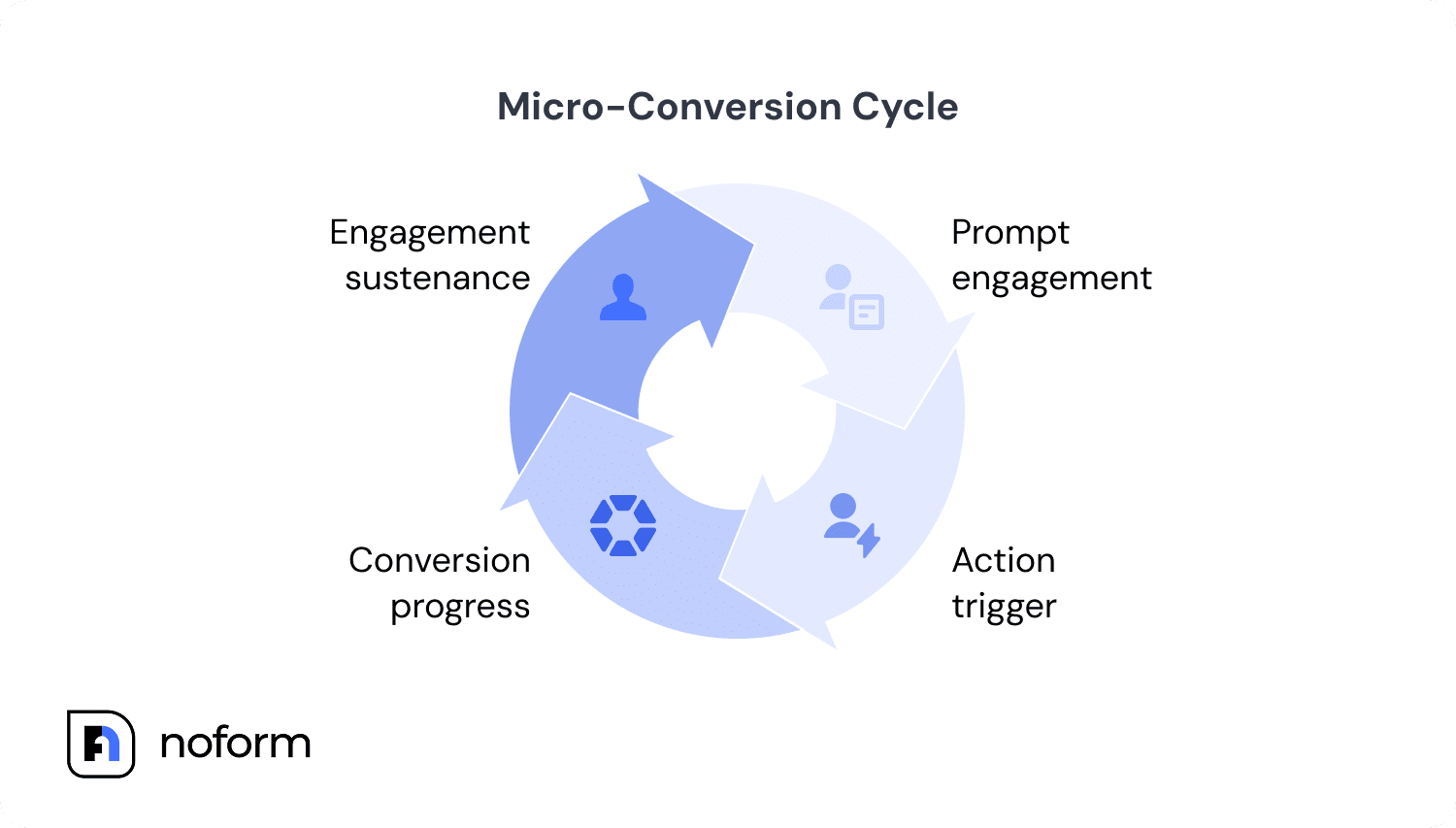
Tip: Make micro-conversion prompts a part of your customer acquisition chatbot to create a smooth, non-aggressive user experience.
“Chat triggers” for high-exit or product pages
If a visitor lingers too long or moves toward the exit on a key product page, a proactive chat invite can re-capture attention. By offering quick help, personalized recommendations, or exclusive content, you address uncertainty before it becomes abandonment.
This tactic not only salvages potential sales but can also help qualify leads more effectively.
Dynamic lead scoring through chat behavior
A conversation reveals intent faster than a static form. Tracking the depth, type, and frequency of interactions allows your conversational marketing chatbot to automatically qualify leads.
This real-time scoring ensures your sales team focuses on the most promising opportunities while bots continue to nurture those not yet ready to convert.
Multilingual NLP bots
If your audience spans multiple regions, multilingual bots remove a major barrier. Natural language processing in multiple languages allows you to use conversational marketing globally without losing nuance. Customers can interact in their preferred language, improving comfort, trust, and ultimately conversion likelihood.
Emotion-aware bots & sentiment analysis
Incorporate emotion-aware chatbots to engage visitors on a deeper level, using sentiment analysis to detect frustration, excitement, or hesitation and adjust responses instantly. This versatile tool can route dissatisfied users to a human agent or leverage positive sentiment to offer upsells.
Use chat insights to fuel SEO strategy
Conversations are a goldmine for discovering long-tail keywords, FAQs, and blog topics your audience actually cares about. Mining chatbot interactions reveals the exact language customers use, allowing you to align content with real search intent and strengthen both your conversational marketing and SEO efforts.
What are some real-world use cases and examples of conversational marketing with bots?
The conversational AI market offers a wide range of ways to use chatbots as a flexible solution for different stages of the customer lifecycle.
Acquisition & Conversion
Conversational marketing chatbots can power lead generation, improve sales strategies, and accelerate conversions by handling:
- Lead generation & qualification: Chatbots identify prospects, collect contact details, and assess interest automatically. The NoForm AI website chatbot helped Dog Gone Taxi lift visitor-to-lead conversion by 37% while enhancing the customer experience.
- Quote generation: Bots guide customers through essential questions to capture accurate pricing details, cutting errors and speeding confirmations.
- Upselling & cross-selling: AI chatbots can suggest upgrades or complementary products conversationally, boosting order value without disrupting the flow.
- Abandoned cart recovery: An AI chatbot for website can be programmed to proactively engage visitors on key pages. It can start a conversation, resolve objections, answer questions, or offer incentives to complete a purchase.
Engagement & Retention
Once acquired, customers stay engaged when chatbots streamline interactions across marketing channels:
- Customer support: AI chatbots manage routine queries like basic troubleshooting, freeing agents for complex cases. With 64% of service agents reporting this shift, teams boost efficiency and customer satisfaction.
- Streamlined onboarding process: Bots can efficiently guide new customers through setup, ensuring no critical step is missed.
- Event processes: A bot for events can answer common event questions (like the agenda, speakers, or location) and provide a direct link to the registration form.
- Feedback collection & NPS: AI chatbots automate gathering feedback after interactions or purchases, helping spot trends and issues quickly.
- Loyalty programs: The bot can provide information about your loyalty program and guide users on how to check their points and redeem rewards.
Business enablement
Finally, the most creative—and often more relaxed—side of chatbot use cases: the ones that go beyond day-to-day support and sales to build brand presence, keep relationships warm, and uncover valuable insights.
- Appointment and demo booking: Conversational marketing bots instantly qualify visitors and provide a direct link to your scheduling tool (like Calendly). This streamlines the booking process, ensuring your team only receives high-quality leads.
- Content distribution: Chat bots for conversational marketing can recommend articles, guides, or exclusive content tailored to user preferences.
- Re-engaging inactive users: A conversational marketing bot sends timely prompts or offers that spark renewed interest.
- Market research & surveys: Bots use conversations to collect valuable insights on needs, preferences, and pain points.
- Brand storytelling & education: Chatbots act as an additional marketing channel, using interactive formats to reinforce your brand image, share its values, and build long-term trust.
Conversational marketing using NoForm AI
You don’t need a degree in software engineering to build a custom conversational marketing chatbot for your business. With NoForm AI, you can reap all the benefits of chatbot-driven marketing without writing a single line of code.
NoForm AI is a no-code platform designed to help businesses use conversational marketing effectively. It gives you the tools to easily design, deploy, and refine AI chatbots that generate leads, engage customers, and support your business goals.
Here’s what you get if you decide to create a chatbot using NoForm AI.
Features built for results
NoForm AI comes with everything you need to excel at conversational marketing with chatbots:
- Chatbot testing to identify gaps and fine-tune before launch
- No-code setup in minutes
- Works with platforms like WordPress, Wix, Squarespace and more
- CRM integrations (via Zapier, Make) to sync data
- Multi-language support
- GDPR & CCPA compliance
Intelligent engagement
Beyond setup, NoForm AI equips you with tools to turn conversations into conversions. Conversation starters can be customized per page, ensuring the right message appears at the right time.
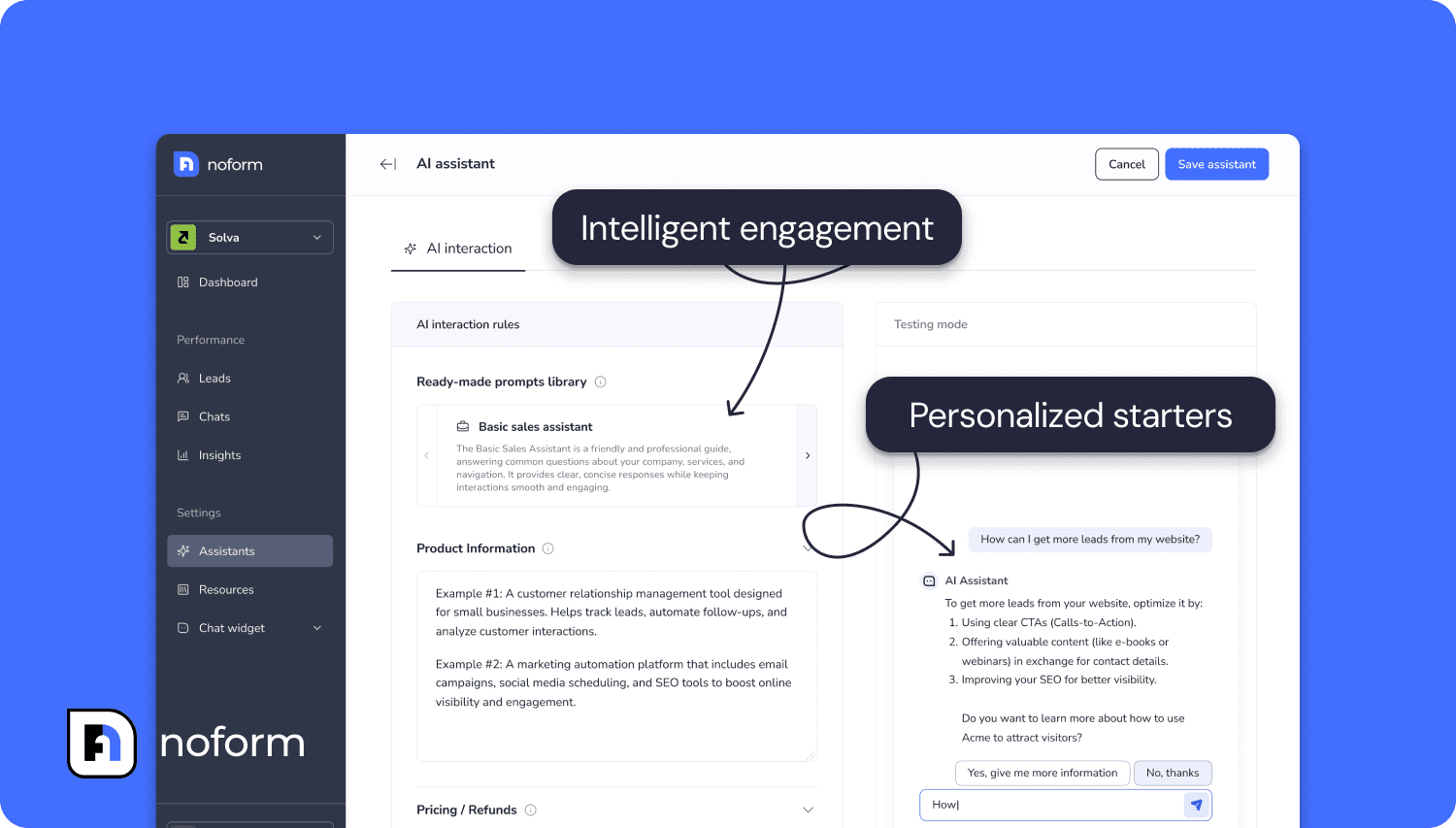
AI-generated quick replies keep exchanges smooth, while lead scoring and qualification happen automatically in the background to allow your sales team to spend time only on the most promising opportunities.
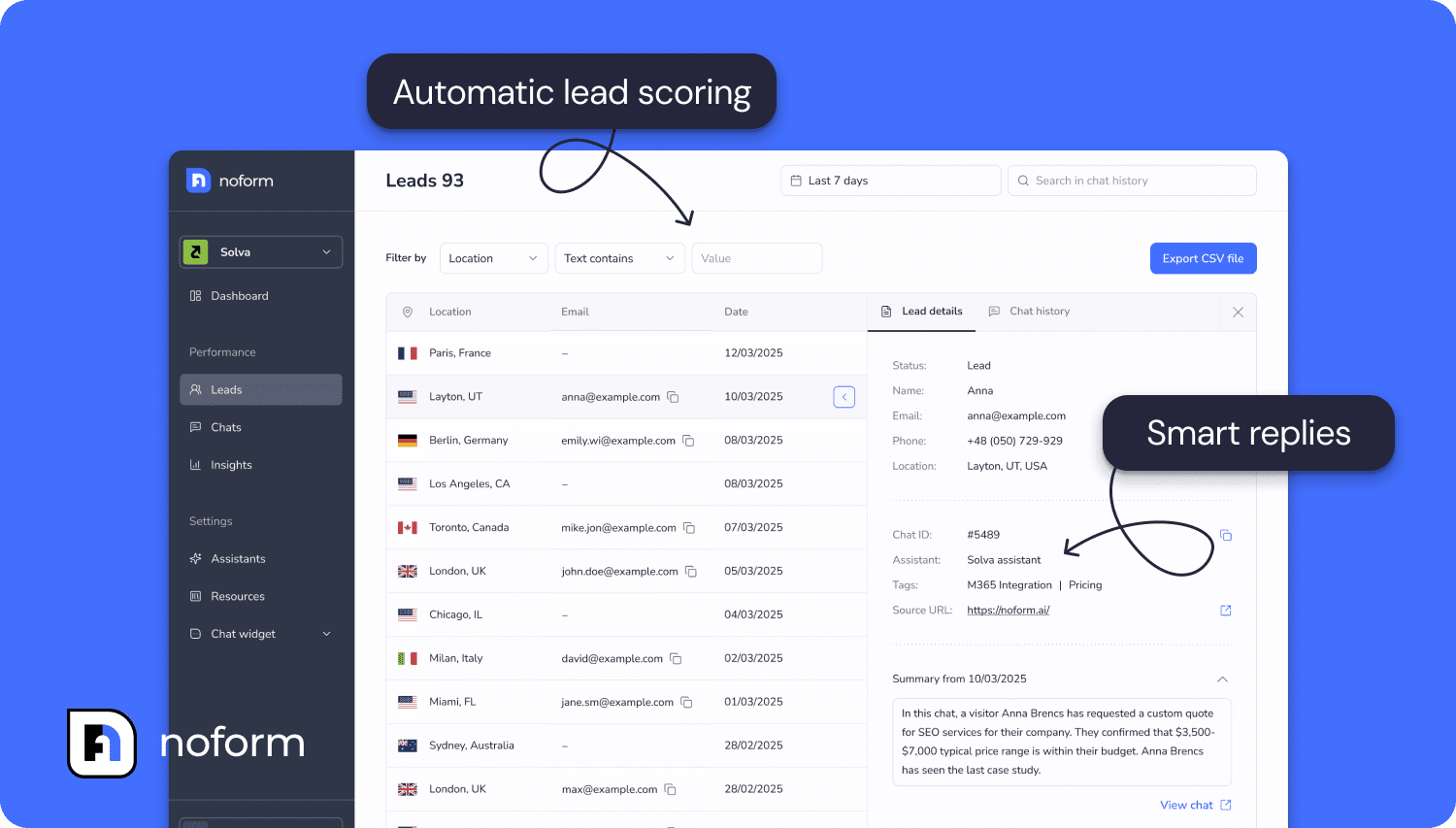
And when those leads are ready to pass on, chat summaries give your team the full context they need to follow up effectively, without sifting through chat logs.
Insight & optimization
Finally, NoForm AI provides continuous feedback loops so you can refine and improve over time:
- User journey mapping: See where users drop off, what they ask first, and what triggers action or abandonment. This clarity makes it easier to address objections early.
- Continuous improvement through chat analytics: NoForm AI mines conversations for visitor needs and pain points, helping you improve your site, sharpen marketing, and refine offers to boost conversions.
With these insights, your chatbot is more than a reactive tool. It’s a constantly learning, performance-driven asset that aligns with your business goals.
Final thoughts
Conversational marketing isn’t a “nice extra” anymore. It’s the baseline for how customers expect to interact with brands. And in that reality, conversational marketing chatbots aren’t a sidekick; they’re the engine that keeps those conversations moving.
Of course, they don’t replace your sales team. They amplify it, making it faster, sharper, and more effective.
With a platform like NoForm AI, you can capture better leads, close sales faster, and cut support costs, all while creating experiences that feel personal at scale.
Your site already draws visitors. Don’t let them click away without connecting. Start with NoForm AI or book a demo today and turn conversations into conversions.
Frequently Asked Questions (FAQ)
What is conversational marketing?
Conversational marketing is a customer-centric strategy that uses real-time, two-way dialogue to engage website visitors, rather than relying on passive forms or static pages. By using tools like AI chatbots and live chat, businesses can answer questions instantly, guide users through the sales funnel, and shorten the cycle from visitor to customer.
Why is conversational marketing a “must-have” in 2026?
Conversational marketing is essential in 2026 because modern consumers demand instant gratification; 78% of customers buy from the company that responds first. With 88% of people having used a chatbot in the last year, businesses that fail to offer real-time, 24/7 engagement risk losing high-intent leads to faster competitors.
How do AI chatbots improve lead generation?
AI chatbots improve lead generation by proactively engaging visitors the moment they land on your site and automating the qualification process. Instead of waiting for a form fill, the bot asks targeted questions (like budget or timeline) in natural language to identify high-quality leads, then instantly syncs that data to your CRM or books a meeting for your sales team.
Can a conversational marketing chatbot replace human sales reps?
No, conversational marketing chatbots are designed to augment sales teams, not replace them. They handle the repetitive “grunt work”—such as answering FAQs, qualifying leads at scale, and scheduling demos—so that human sales representatives can focus entirely on high-value conversations and closing deals.
How does NoForm AI help with conversational marketing?
NoForm AI is a no-code platform that allows businesses to build custom conversational marketing chatbots in minutes. It understands natural language, customizes conversation flows for different pages (like pricing or product pages), and integrates seamlessly with tools like WordPress and Zapier to automate your sales pipeline.
What are the main benefits of using chatbots for marketing?
The primary benefits include 24/7 availability, ensuring you never miss a lead outside business hours; instant scalability, allowing you to handle thousands of conversations simultaneously; and reduced operational costs, as AI bots can lower customer support expenses by up to 30% while increasing engagement rates.
How do I measure the success of my conversational marketing strategy?
Success is measured by tracking metrics such as Visitor-to-Lead Conversion Rate (how many chats turn into leads), Response Time, and Engagement Rate. Advanced platforms like NoForm AI also provide qualitative data, offering chat summaries and user journey insights to help you optimize your messaging for better results.