The rule-based chatbot is obsolete. In its place stands the NLP chatbot—a leap from rigid scripts to intelligent, context-aware conversations. Powered by AI, these bots understand intent, adapt in real time, and respond like a human would (minus the hold music).
While most teams still think of chatbots as FAQ machines, many businesses are already relying on natural language processing behind the scenes—whether it’s routing support tickets, qualifying leads, or personalizing replies in live chat. The tech has changed. Quietly, but radically. And if your customer experience still runs on canned responses, it’s time to rethink the strategy.
Here’s what you need to know to catch up—and stay ahead.
What is an NLP chatbot and why it matters
An NLP chatbot — sometimes called a natural language processing chatbot or NLP-based chatbot — uses AI to understand, process, and respond to human language in a way that feels… well, human.
So, what is an NLP chatbot in practical terms? It is a chatbot using NLP techniques to understand what a person means, rather than simply matching their message to a fixed script.
Unlike old-school bots locked into rigid scripts, NLP chatbots use deep learning models to interpret intent, extract meaning, and generate responses that fit the context—even when users throw in typos or use odd phrasing, slang, or incomplete sentences.
Powered by a stack of AI technologies like natural language understanding (NLU), natural language generation (NLG), and speech recognition, and chatbots using natural language processing frameworks like Rasa, Dialogflow, or GPT-based APIs, NLP bots have the flexibility to handle open-ended, human-like conversations without derailing.
Whether a user types “how can I return an order?” or says, “hey, I need help with your return policy,” an NLP-based chatbot can follow along and respond with something useful, on the spot. That flexibility is what separates an NLP bot from everything that came before it.
NLP vs NLU vs NLG: what’s the difference?
These three terms are often used interchangeably, but each describes a different layer of how a chatbot handles language.
Term | Role | Chatbot example |
NLP (Natural Language Processing) | The umbrella field: everything that lets software work with human language | The chatbot as a whole reads a typed message and returns a useful reply |
NLU (Natural Language Understanding) | Works out what the user means: intent, key details, tone, and context | Recognizes that “Has my package shipped?” is a question about order status |
NLG (Natural Language Generation) | Turns the system’s findings into a clear, natural-sounding reply | Writes “Your order shipped yesterday and should arrive on Friday” |
Natural Language Processing is the broader technology that allows computers to understand and generate human-like language. NLU focuses on understanding what the user means, while NLG helps generate human language in the form of an appropriate response.
Natural language processing chatbot vs rule-based chatbot vs LLM chatbot
Before chatbots evolved, there were clunky site pop-ups with scripted lines like “Hi there! Need help?” For a moment, they felt innovative—and got the job of greeting visitors done. Then came rule-based chatbots, and for a while, they really did change the game.
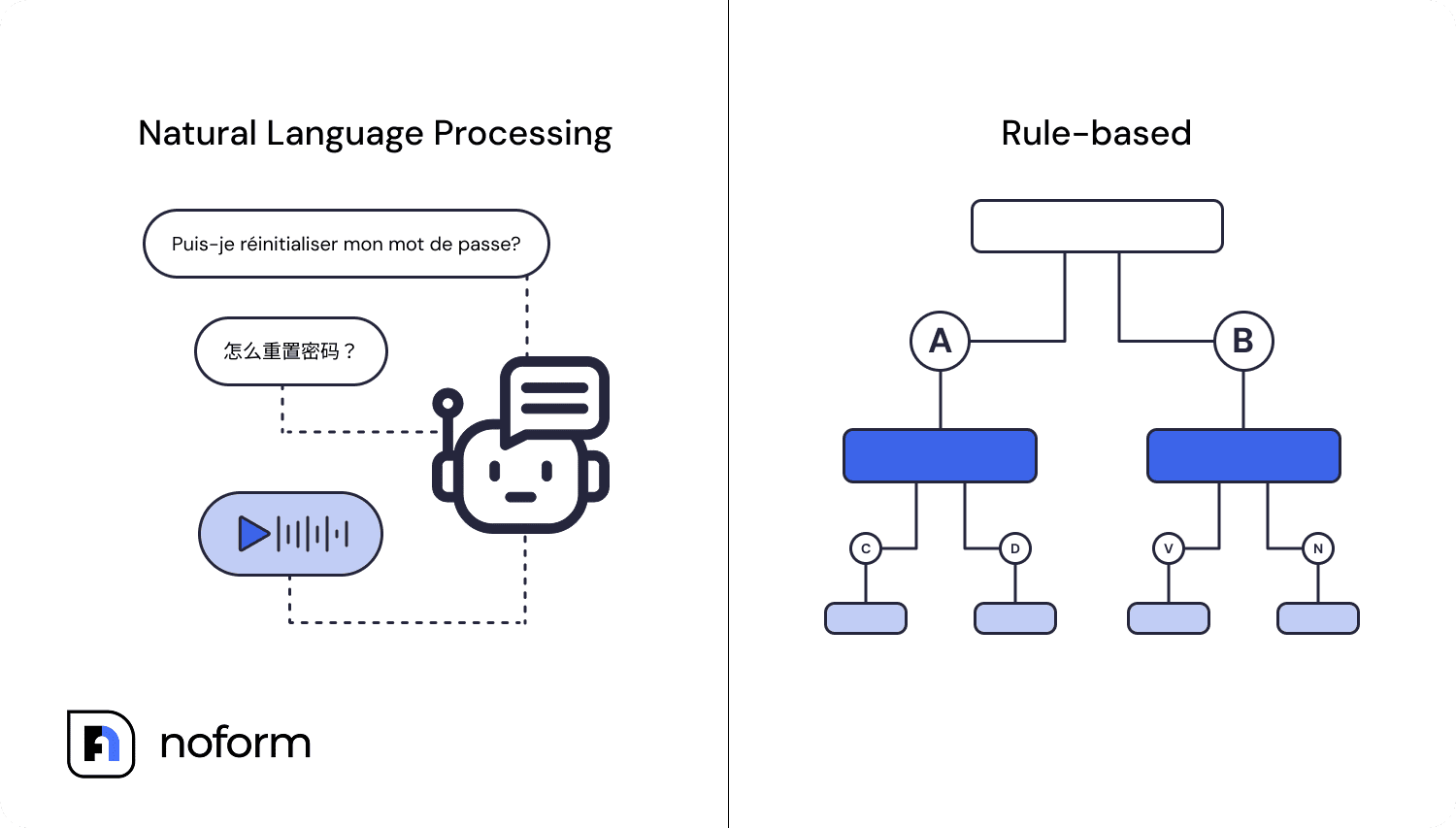
A rule-based chatbot is a scripted bot built on fixed chat flows. This type of chatbot technology runs on a decision tree: user inputs—like keywords or button clicks—trigger predefined responses. Every reply depends on matching a specific condition. If the input falls outside the expected flow, the bot stalls, loops, or shuts down the conversation entirely.
These traditional chatbots are also known as rule-based chatbots because their behavior depends on predefined rules and conditions.
Back in 2016 or so, this was a breakthrough. Rule-based bots made websites feel more interactive and saved companies from drowning in basic user queries. But in 2025, as more customers expect a human conversation, not just an endless loop of “select an option from the list,” they’re no longer meeting the mark. Here’s why:
- They break easily when users go off-script
- They can’t reference previous interaction history, treating every customer query as if it’s the first time it’s being asked
- They can’t scale effectively when dealing with nuance, emotion, or layered intent
- They deliver a flat, mechanical user experience that users don’t tolerate anymore
That’s where NLP in chatbot technology comes in. Unlike rule-based chatbots, intelligent chatbots don’t wait for exact phrasing. Instead, they use NLP to understand what the user means, no matter how the question is worded. And when conversations go off track, they don’t break—they adapt, as human agents would.
With AI chatbot features like sentiment analysis, personalization, and contextual learning, AI NLP chatbots analyze intent, factor in previous interactions, and tailor responses that feel natural and on point.
This difference is at the heart of traditional chatbots vs. NLP chatbots: traditional chatbots depend on predefined flows, while NLP chatbots use language understanding to interpret a wider range of requests.
Feature | Rule-based chatbots | NLP chatbots | LLM chatbot / AI agent |
Understanding | Keyword-dependent | Deep intent recognition using NLP | Broad language understanding from a large pretrained model |
Flexibility | Fixed scripts only | Dynamic, natural language conversations | Very high; handles open-ended, multi-topic dialogue |
Learning capability | Zero | Improves with every user interaction | Pretrained; improves through prompt and knowledge-base updates |
Setup complexity | Simple (but limited) | Moderate to advanced | Low to moderate on no-code platforms; higher for custom-built agents |
User experience | Rigid and easily broken | Human-like and context-aware | Fluid and conversational |
Supported queries | Only specific, pre-defined ones | Broad range, including ambiguous phrasing | Very broad; needs guardrails to stay on-topic |
Industry fit | Limited use cases | Scalable across industries and workflows | Scalable across industries and workflows |
Response customization | One-size-fits-all | Personalized based on user preferences and data | Personalized; shaped by instructions and grounding content |
Handling ambiguity | Poor | High — detects nuance, misspellings, slang | High; may need guardrails against confident but wrong answers |
Multilingual support | Very limited | Strong support via NLP language models | Strong support via language models |
What are the different types of NLP chatbots?
NLP chatbots aren’t a single category — they fall into three distinct architectures, each built for different use cases and levels of complexity.
There are several types of natural language processing artificial intelligence systems, but for chatbots, the main architectures are retrieval-based, generative, and hybrid.
Retrieval-based NLP chatbots pull answers from a predefined knowledge base using intent recognition and entity extraction. They’re highly accurate within their domain and easy to audit, making them a natural fit for customer support and lead qualification. The tradeoff: they can’t answer questions outside their training data.
Generative NLP chatbots use large language models (LLMs) like GPT-4 to create novel responses from scratch. They handle open-ended, unpredictable conversations more flexibly — but they can hallucinate or go off-brand without guardrails in place.
Hybrid NLP chatbots combine both approaches: retrieval for structured queries where accuracy matters, generative for open-ended dialogue where flexibility does. Most enterprise-grade platforms today use a hybrid architecture.
Type | How It Works | Best For | Limitation |
|---|---|---|---|
Retrieval-based | Matches intent to stored responses | Support FAQs, lead qualification | Can’t handle out-of-scope questions |
Generative | LLM creates responses in real time | Open-ended dialogue, creative use cases | Risk of inaccurate or off-brand replies |
Hybrid | Combines retrieval + generation | Complex workflows needing accuracy + flexibility | More complex to configure |
For most small and mid-sized businesses, a retrieval-based or hybrid NLP chatbot trained on your own content delivers the best results: accurate, on-brand, and quick to deploy.
Benefits of NLP Chatbots for Businesses
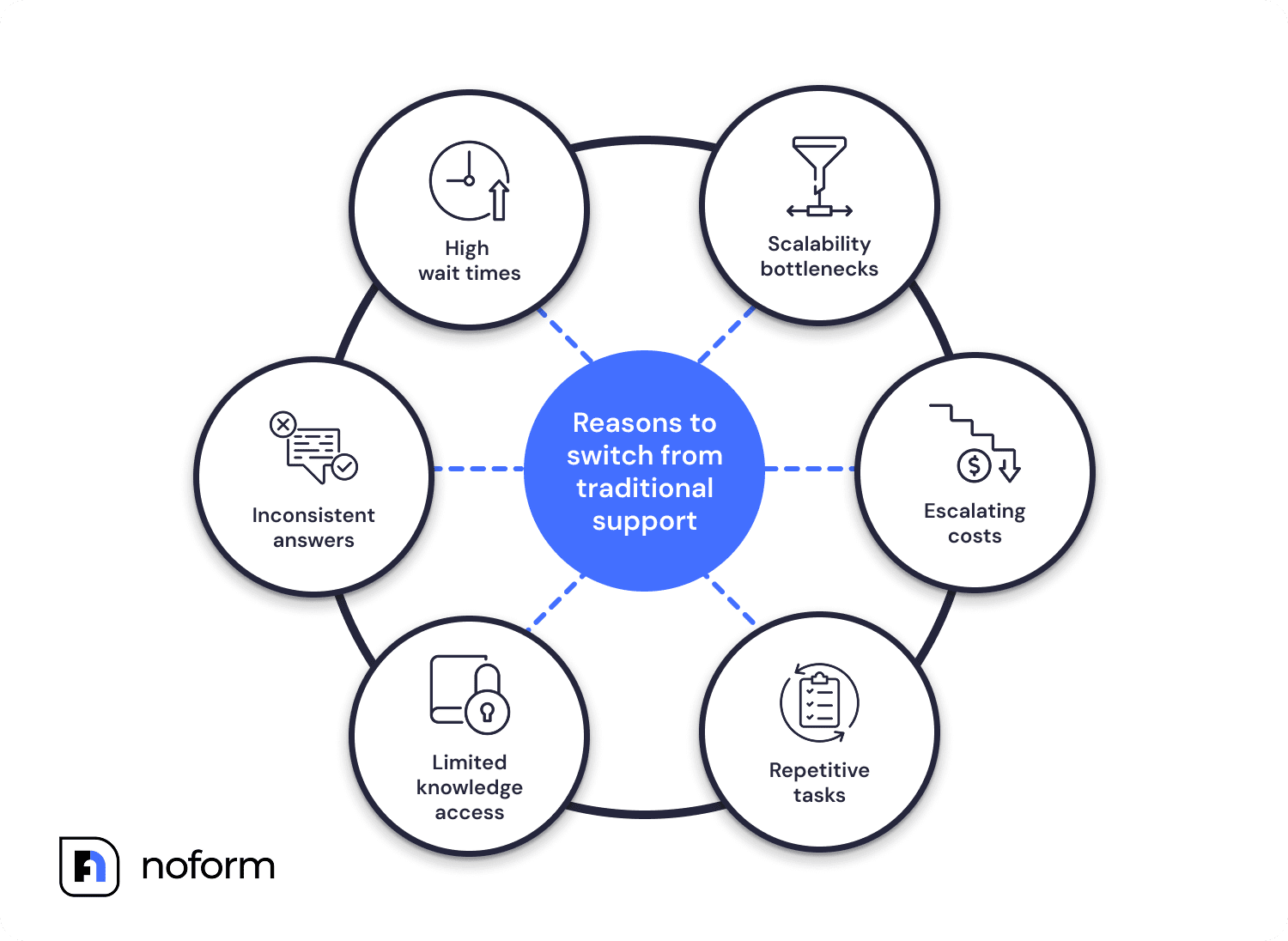
Traditional customer service is stretched thin. Long wait times, inconsistent answers, and repetitive queries frustrate users and slow down critical business processes.
Natural language processing chatbots fix what human-stretched teams can’t. By shifting frontline support to NLP-powered AI agents, companies scale faster, respond smarter, and reduce costs—without tanking user experience.
Here’s what still goes wrong, and why managers of companies are turning to NLP solutions and choosing to use NLP chatbots:
- High wait times: 66% of customers expect a response within 5 minutes. Any longer, and churn risk spikes. Natural language chatbots reply instantly, 24/7.
- Inconsistent answers: Human agents vary from one interaction to the next. A well-trained NLP bot delivers consistent, reliable, and fully on-brand responses every time.
- Limited knowledge access: Agents can’t recall every detail. AI NLP chatbots can search massive internal databases in seconds, instantly providing customers with an accurate response.
- Repetitive tasks waste human time: 70% of support conversations are routine—password resets, order updates, and FAQs. AI-powered chatbots handle them all without breaking a sweat, saving businesses up to 2.5 billion working hours.
- Escalating costs: Hiring and training customer service teams is expensive. IBM estimates NLP chatbots can save up to 30% in support costs.
- Scalability bottlenecks: Human teams can’t talk to 1,000 people at once, but for NLP bots, high request volumes aren’t a problem. Some handle up to 90% of incoming queries alone.
With nearly 1 billion people already interacting with AI chatbots (and 25% of companies planning to make them central to their support strategies by 2027), the shift is already in full swing.
Conversational AI chatbots are quickly becoming the smarter, faster, cheaper backbone of modern customer service.
Insights and analytics
Beyond conversations, chatbot natural language processing systems quietly gather data that matters—trends in user intent, feedback on services, drop-off points, and friction moments in the journey.
This insight doesn’t just live in a dashboard. It feeds back into operations, product, and marketing campaigns to help teams make better, faster decisions.
Scalability and reach
The beauty of NLP for chatbots is that they don’t slow down as volume grows. Need to handle 10,000 conversations this week? No problem. Want every one of those interactions to feel personal and localized—even in different languages? Also possible.
With NLP chatbots, you stay focused on your business goals while the tech keeps pace effortlessly.
How do NLP chatbots work?
You don’t need to be an engineer to understand how chatbots and natural language processing technology work. But if you’re evaluating one for your business, it helps to know what’s under the hood.
If you’re asking what natural language processing is, it is the technology that enables software to work with human language. Understanding the workings of NLP helps explain how a chatbot can understand a message, identify its meaning, and generate an appropriate response.
Core components of an NLP chatbot
At the heart of every smart chatbot are NLP technologies and NLP techniques, the foundational systems that enable it to understand, interpret, and respond like a human.
Natural Language Understanding (NLU)
This is how the bot understands user input. It involves:
- Lexical analysis: Breaking text into parts (verbs, nouns, etc.)
- Syntactic analysis: Understanding grammar and structure
- Semantic analysis: Interpreting meaning
- Pragmatic analysis: Detecting intent, tone, and implied context
This layered process helps the bot form a deep understanding of every message.
Intent recognition and entity extraction
The bot identifies what the user wants (intent) and what key info they’ve provided (entities).
For example: “What’s your return policy for electronics?” → Intent: ask about return policy; Entity: product category (electronics).
This makes replies accurate and relevant from the first message.
Contextual memory
Unlike rule-based bots, NLP chatbots track conversations with users over time. If someone says, “That last one didn’t work,” the bot knows what “last one” refers to. This enables fluid, human conversation threads.
In other words, a chatbot using NLP will keep track of relevant information from the conversation, helping it avoid repeating questions and maintain context.
Natural Language Generation (NLG)
Once the chatbot with NLP understands the input, generative AI modules turn data into a natural reply to create a personal, responsive conversational experience. NLG is responsible for forming a clear, natural-language response after the system has identified the intent, the context, and the relevant information. It’s the step that turns “order status: shipped, arrives Friday” into a sentence a person would actually say.
This allows the system to understand and generate language in a natural and human-like way, rather than simply returning a predefined message.
How an NLP chatbot processes a message step by step
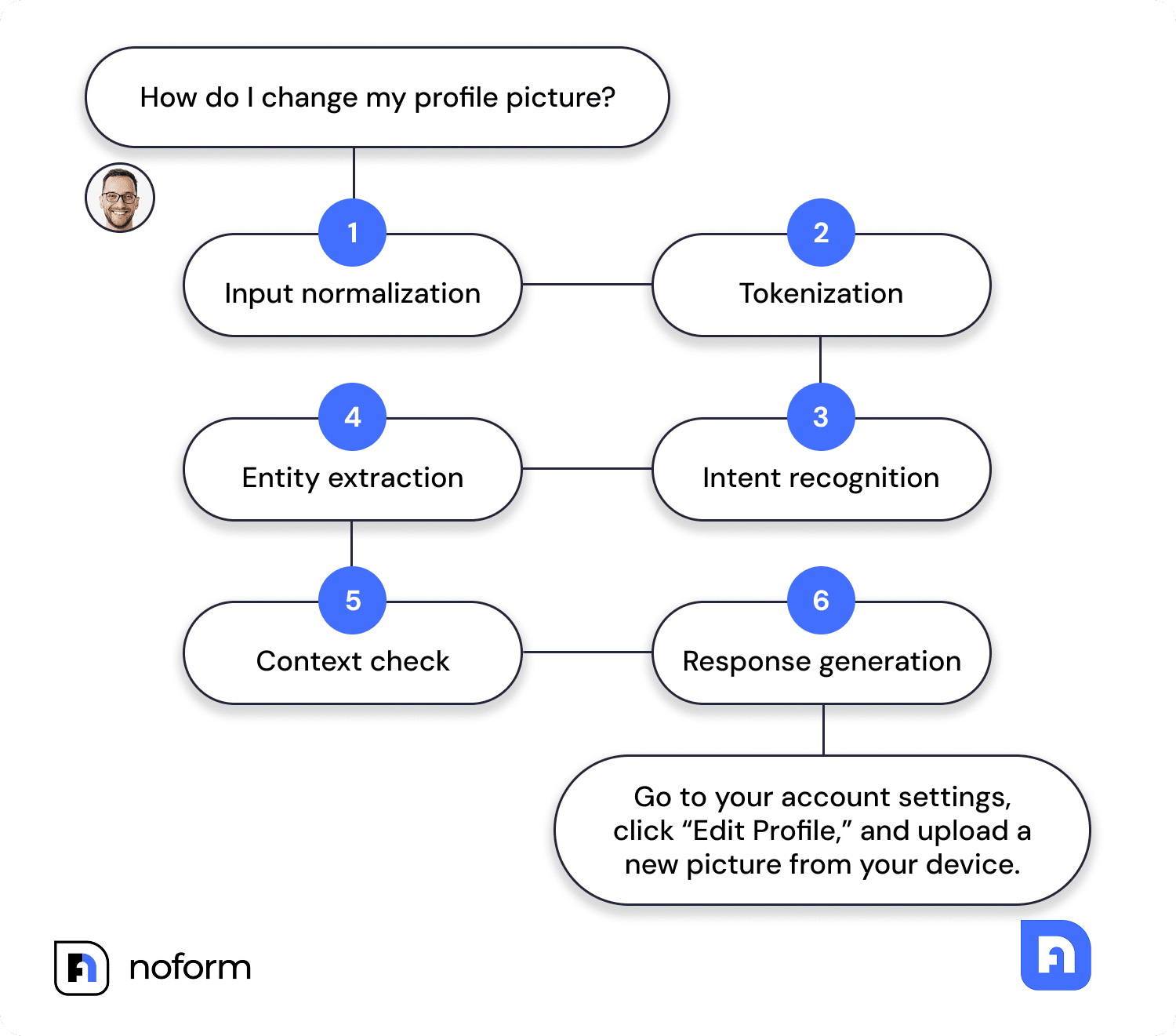
Here’s how a typical NLP chatbot processes a message—step by step:
- Input normalization: The bot cleans up the text by lowercasing it, removing extra spaces or odd characters.
- Tokenization: It splits the sentence into smaller parts (called tokens) to analyze structure and meaning.
- Intent recognition: Using machine learning algorithms, the bot identifies what the user wants.
- Entity extraction: It picks out key info like names, IDs, dates, or product details.
- Context check: It references the ongoing conversation to maintain flow and avoid repeating questions.
- Response generation: Based on everything above, it crafts an appropriate response that fits.
NLP chatbot use cases and examples
NLP chatbots deliver measurable business results across customer engagement, lead generation, sales, and operations — with companies reporting cost reductions of 20–30% and conversion lifts of up to 67%.
By combining natural language processing, machine learning, and real-time context handling, NLP chatbots use AI to power a new standard in business operations across a wide range of industries, from SaaS to logistics to e-commerce.
Here’s how they’re making a measurable difference.
Customer support and FAQ automation
Customer engagement starts with availability and ends with relevance. AI chatbots that use natural language deliver both: responding 24/7, eliminating friction, and guiding users toward what matters.
Unlike static pages or forms, a chatbot using NLP initiates and maintains personalized customer interactions that feel seamless and human. Beyond reactively answering questions, they proactively direct the conversation flow, surfaces useful content, offer suggestions, and tailor replies based on user behavior and previous inputs.
Cheqmark put this into practice with NoForm AI. After adding an NLP-powered assistant to help users find checklist templates faster, the platform saw a 67% increase in unique page views, 90% more clicks, and 56% higher homepage traffic.
The chatbot didn’t just support users—it kept them engaged, exploring, and converting!
Lead qualification and sales conversations
Stronger customer engagement sets the stage for better lead generation. While a user explores your site, an AI agent can step in, spark a conversation, and guide them toward conversion without waiting for them to make the first move.
From the first visit, the chatbot greets the user and, using natural language and intent recognition, asks focused questions: what they’re looking for, their role, company size, or pain points. It interprets the responses in real time to qualify the lead.
It can also adapt each follow-up question to the user’s previous answer. A visitor who says they’re buying for a team of 200 gets different next questions than one who says they’re just researching.
If the visitor is sales-ready, the bot can collect contact info, qualify them based on preset criteria, and route them directly to your team. If they’re not quite there yet, it can keep the conversation going—answering additional questions, offering resources, and capturing useful details for future follow-up.
As a result, by using these types of chatbots built for lead generation and qualification, you don’t just grow your pipeline but improve its quality by filling it with the right leads.
Sales enablement
Chatbot NLP tools streamline early sales interactions with speed and precision, supporting human communication at scale and freeing reps to focus on closing. In fact, 35% of business leaders say Artificial Intelligence-powered chatbots have helped them close deals—delivering conversion lifts of up to 67%.
Sales enablement differs from lead qualification. Qualification decides who a potential customer is. Sales enablement helps move that customer forward through the buying journey. While a prospect compares options and makes a decision, the chatbot can explain how plans differ, answer feature and pricing questions, address objections, and suggest a sensible next step, such as a demo or a quote. It supports the decision itself, not just the collection of a contact.
Here’s how chat bot NLP tools help:
- Qualify leads instantly using targeted questions on needs, timelines, and budget ranges
- Handle objections, responding to common concerns about pricing, features, or implementation (ideal for selling complex solutions)
- Capture and organize lead data for smarter follow-up
- Stay active 24/7, reducing delays that lead to drop-off
- Lower CAC through automation
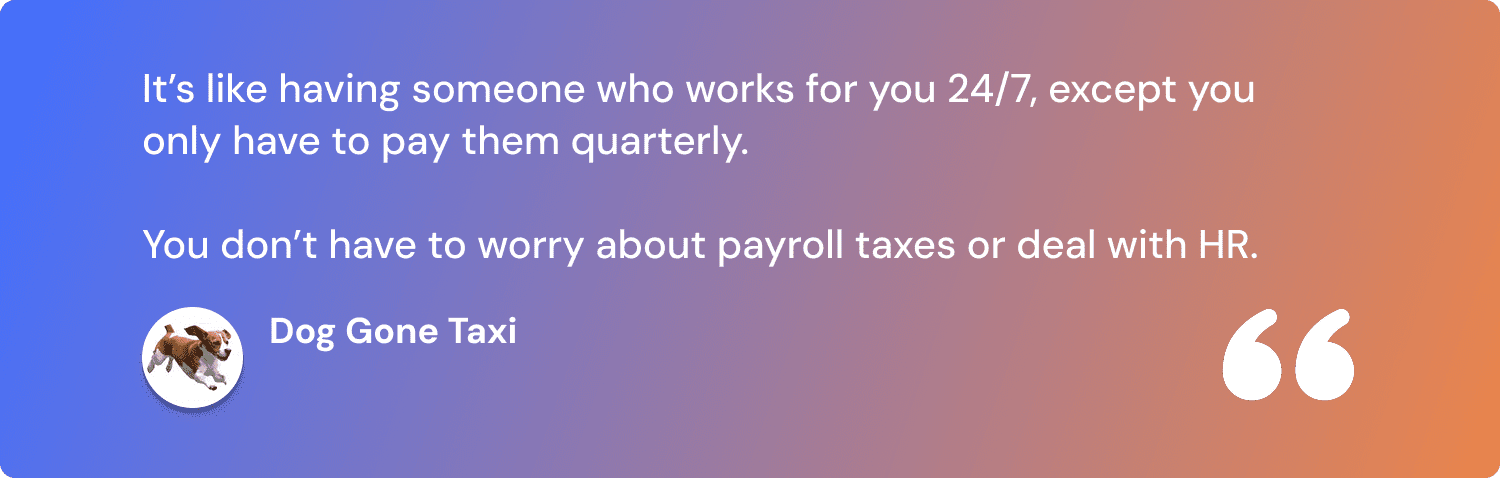
Dog Gone Taxi is a great example. After implementing NoForm AI’s chatbot to guide users through the booking flow and answer common questions, they saw a 37% increase in visitor-to-lead conversion—just by making the process smoother and faster for potential customers.
Internal knowledge assistance
Repetitive tickets, missed inquiries, inefficient workflows—NLP bots solve all three. For ops teams, they mean fewer escalations, less manual entry, and lower support overhead. For users, they mean faster answers and better customer satisfaction.
NLP chatbots also work inside the company. An employee can ask, “What is our refund policy for enterprise customers?” or “How do I request equipment for a new employee?” The chatbot searches the internal knowledge base, documentation, or policy files and puts together a direct answer, so people don’t have to dig through folders or wait for a colleague to reply.
Dog Gone Taxi again provides a perfect use case. Their AI chatbot handled over 1,100 conversations and 3,300 queries, automating support without sacrificing quality. This allowed them to cut two roles—reception and data entry—while providing instant, round-the-clock assistance.
Real NLP chatbot results from NoForm AI customers
Company | Use case | Result | Source |
Cheqmark | NLP-powered assistant helping users find checklist templates faster | 67% increase in unique page views, 90% more clicks, 56% higher homepage traffic | https://noform.ai/case-studies/how-cheqmark-transformed-user-experience-with-ai-powered-assistance/ |
Dog Gone Taxi | Guiding users through the booking flow and answering common questions | 37% increase in visitor-to-lead conversion; 1,100+ conversations and 3,300 queries handled, with reception and data-entry roles cut |
What are the limitations of NLP chatbots?
Human language is unpredictable—and so is business. From decoding intent to meeting compliance standards, NLP chatbots must navigate more than just text. Here are the main challenges of NLP and how to reduce each risk.
Limitation | Why it happens | How to reduce the risk |
Tone, intent, slang, and ambiguity | Users don’t speak in clean commands, and one phrase can mean several things | Use advanced parsing and contextual memory; review real chats and fix the misreads |
Multilingual, global use | Businesses serve diverse audiences, and quality varies by language | Choose models with strong multilingual support; test key languages before launch |
Scalability and learning | High query volume can strain rigid systems, and the bot only improves if someone acts on what it gets wrong | Choose a platform built to handle volume; update sources and instructions based on real conversations |
User trust and resistance | Skepticism toward bots is real, and people dislike robotic replies | Deliver fast, relevant answers and make it easy to reach a person |
Data privacy and compliance | As usage grows, so do risks around personal data | Use encryption, access controls, and region-specific compliance; don’t feed the bot confidential content |
Hallucinations | Generative models can produce fluent answers that are wrong or invented | Ground answers in your own content, set clear behavior rules, and test edge cases before going live |
Context limits | A model can only hold so much of a conversation in view, so long or multi-topic chats can lose earlier details | Keep answers focused, store key details in structured fields, and hand off long or complex cases |
How to get started with NLP chatbots in your business: Step-by-step guide
You don’t need to be technical—or start from zero—to launch an NLP chatbot that delivers real business results.
Identify areas where customer interaction can be enhanced or automated
Start by identifying where customer interactions are slowing your team down or creating friction for users. Common areas include:
- Overloaded live chats
- Delayed responses
- Form drop-offs
- Missed follow-ups
- High exit rates on product and pricing pages
Dig into support tickets, sales inquiries, CRM logs, and customer feedback to spot recurring questions and bottlenecks. These are the areas where automation can step in, deliver faster responses, and improve consistency without adding headcount.
2. Define clear goals for implementation
Before deploying an NLP chatbot, define what success looks like. For example: aim to reduce chat response time from 10 minutes to 6, increase lead qualification by 25% within the first quarter, or resolve half of repetitive support queries without human involvement in 60 days.
Setting specific benchmarks like these keeps your bot building focused, measurable, and aligned with real business outcomes.
3. Choose the right chatbot platform
You don’t need to build a chatbot from scratch (and let’s be honest, your IT team probably has bigger fires to put out).
One of the most popular choices among professional customers, a ready-made platform like NoForm gives you access to a conversational AI engine trained for seamless customer engagement:
- Secure and compliant: End-to-end encryption for peace of mind.
- Tailored to your business: Trained on your content, not someone else’s.
- No coding needed: Set it up in minutes without touching a single line of code.
- Fully customizable: Adjust behavior, branding, and responses freely.
- Fast deployment: Live in under 3 minutes.

➡️ Learn how to create a chatbot in our guide.
4. Train and deploy your NLP chatbot
Use real, relevant data from your business—help docs, past chats, FAQs, product details, support logs—to train your chatbot.
For effective results, balance quality and quantity of training data: enough to cover core topics without overwhelming the model. As new questions come in, update continuously.
5. Monitor and optimize performance
Once your NLP chatbot is live, set a schedule to check its key performance indicators. Review chat engagement rates and lead conversions to understand how effectively your Al assistant is performing.
Use this insight to tweak tone, tighten flows, or update content to ensure sharper responses, fewer handoffs, better outcomes.
How to choose an NLP chatbot platform
The right NLP chatbot platform should do more than understand user questions. It should provide accurate answers, connect with your existing tools, handle conversations safely, and support the business outcomes you want to improve.
Use this checklist to evaluate any option:
- Knowledge grounding: Does it answer from your own content (website, documents) rather than generic internet data?
- Integrations: Can it send leads and conversation data to the tools you already use, such as your CRM?
- Analytics: Can you see conversations, leads, and engagement rates, and review real chats to improve the bot?
- Human handoff: How does it get a person involved when the bot shouldn’t answer?
- Security: Does it offer encryption and compliance with the privacy rules that apply to you?
- Customization: Can you control the bot’s name, look, tone, and behavior?
- Deployment: Does it work with your website platform without developer help?
- Multilingual support: Can it serve visitors in the languages your audience speaks?
Here’s how NoForm AI measures up:
Criterion | How NoForm AI addresses it |
Knowledge grounding | Trains automatically from your website URL, plus uploaded documents (.doc, .docx, .txt, .pdf, up to 10 MB each) |
Integrations | Connects to CRMs and other tools via Zapier, Make, or webhooks, with chat summaries synced along with the lead |
Analytics | Dashboard with Insights, Chats, and Leads tabs: visitors, chats, leads, conversion rates, and a country breakdown |
Human handoff | No built-in live agent takeover. The assistant can be configured to acknowledge gaps and collect contact details so your team follows up, with an AI-generated summary sent by email |
Security | GDPR and CCPA compliant, with encryption for stored visitor data |
Customization | Assistant name, logo, brand colors, bubble shape and position, plus a structured prompt for role, tone, and behavior |
Deployment | No-code install via WordPress plugin or an embed code for Wix, Squarespace, Webflow, Framer, Shopify, and custom HTML sites |
Multilingual support | Detects the visitor’s language automatically and replies in it; language-specific assistants are available for localized pages |
NLP chatbots: key takeaway
If you’re serious about scaling support, accelerating sales, or improving the way your team communicates with customers, adopting an NLP chatbot is no longer just a smart move. It’s a necessary one.
The benefits of an NLP chatbot can include faster responses, more consistent answers, better access to information, greater scalability, and more natural customer conversations.
But like any powerful tool, it demands clarity, care, and respect for your users’ trust. A secure setup, well-defined goals, and continuous improvement are what make the difference between something that functions—and something that drives real results.
Whether you’re looking to streamline operations, boost conversions, or free your team from repetitive tasks, now’s the time to act.
Build your AI assistant today, or book a live demo to see how NoForm can fit your goals.
Frequently Asked Questions about NLP chatbots
What is an NLP chatbot?
An NLP chatbot is an intelligent virtual assistant that uses Natural Language Processing (NLP) to understand, interpret, and respond to human language naturally, rather than following a rigid script. Unlike traditional chatbots that rely on pre-set buttons, NLP chatbots utilize technologies like Natural Language Understanding (NLU) and Machine Learning to detect user intent, handle slang or typos, and adapt to context in real time.
What is the difference between NLP chatbots and rule-based chatbots?
The main difference is flexibility: a rule-based chatbot operates on a fixed decision tree where specific keywords trigger pre-written responses, often failing if a user goes “off-script.” In contrast, an NLP-based chatbot uses deep learning to understand the meaning behind the words, allowing it to handle complex, open-ended conversations, remember context from previous messages, and improve its accuracy over time.
How do NLP chatbots reduce customer support costs?
NLP chatbots reduce support costs by automating up to 90% of routine inquiries, such as password resets, which allows businesses to scale without hiring more staff. According to IBM data cited in the industry, these bots can lower customer service costs by up to 30% while eliminating wait times and ensuring 24/7 availability for users globally.
How does Natural Language Understanding (NLU) work in chatbots?
Natural Language Understanding (NLU) is the specific subset of AI that allows a chatbot to decode what a user means. It functions by breaking down text through Intent Recognition (identifying the user’s goal, like “schedule a property viewing”) and Entity Extraction (pulling specific details, like “3-bedroom house” or “downtown area”). This ensures the bot provides an accurate answer even if the user types in incomplete sentences or uses casual phrasing.
How does an NLP chatbot work for lead generation?
Yes, NLP chatbots significantly boost lead generation by engaging visitors proactively and qualifying them through natural conversation. For example, the company Dog Gone Taxi used NoForm AI’s NLP chatbot to increase their visitor-to-lead conversion rate by 37%. The bot asks qualifying questions about needs and budget in real time, then either captures the lead or routes high-value prospects directly to human sales agents.
Is it difficult to set up an NLP chatbot?
No, modern platforms like NoForm AI have made setting up NLP solutions accessible via no-code solutions. These platforms allow businesses to deploy AI-powered agents in minutes by training them on existing company data (like FAQs and help docs), eliminating the need for a dedicated engineering team or complex coding.
Is ChatGPT an NLP chatbot?
Yes — ChatGPT is an NLP chatbot, and one of the most widely known examples. It uses a large language model (a type of advanced NLP architecture) to generate human-like responses. The key difference from business-focused NLP chatbots is scope: ChatGPT is a general-purpose assistant, while purpose-built NLP chatbots like NoForm AI are trained on your specific business content and optimized for a defined goal — qualifying leads, answering product questions, or capturing contact information.
What are the main types of NLP chatbots?
The three main types are retrieval-based, generative, and hybrid. Retrieval-based NLP bots pull answers from a predefined knowledge base — accurate and auditable, ideal for support and lead qualification. Generative NLP bots use large language models to create novel responses — more flexible, but harder to control. Hybrid bots combine both: retrieval for structured queries where accuracy matters, generative for open-ended dialogue. Most modern business platforms use a hybrid approach.