
A homeowner finds hail damage on the roof Saturday morning. They open a browser, search for a local roofer, and click the first result. Does the site answer their questions, or does it hand them a contact form and go quiet until Monday?
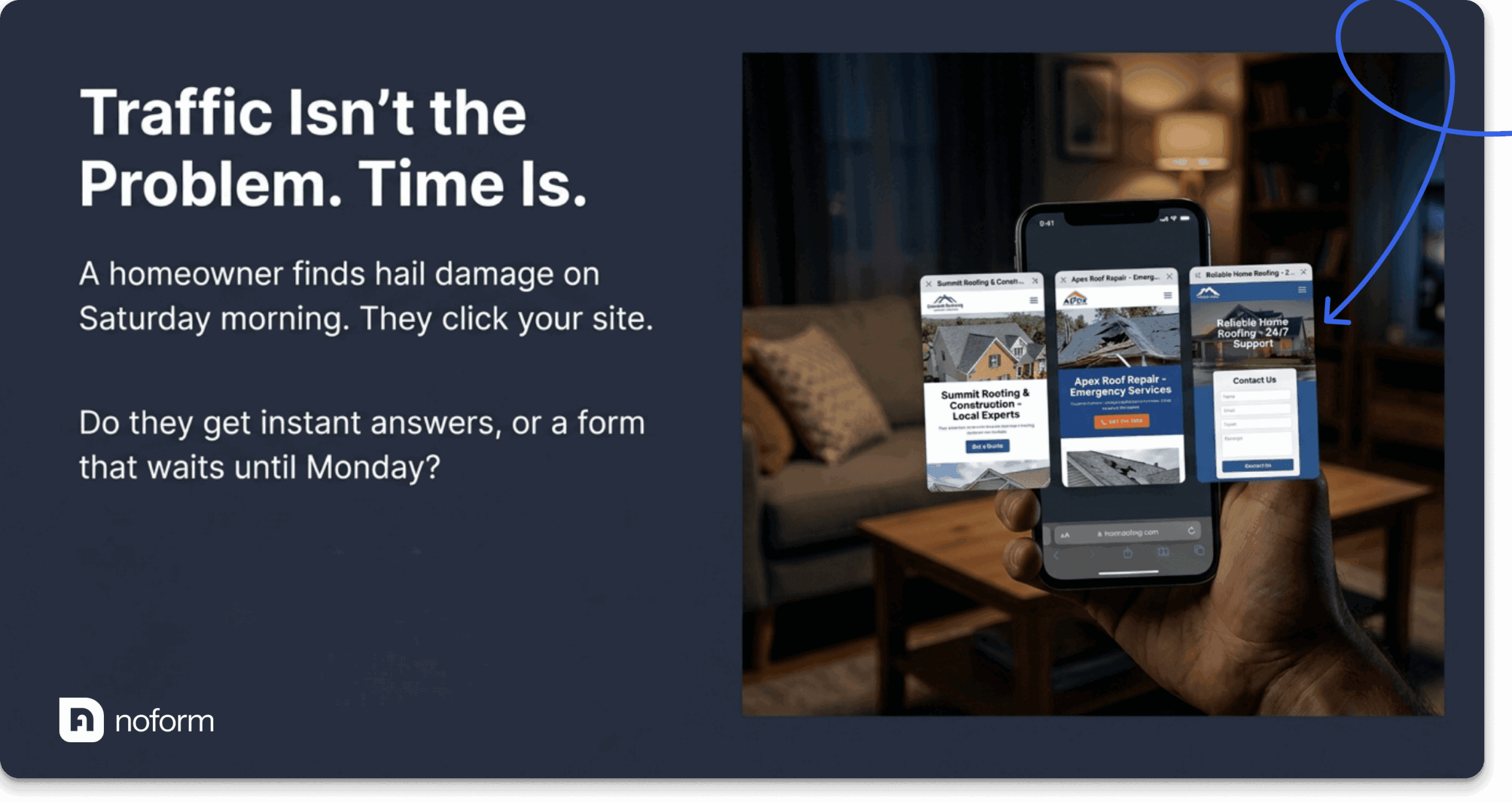
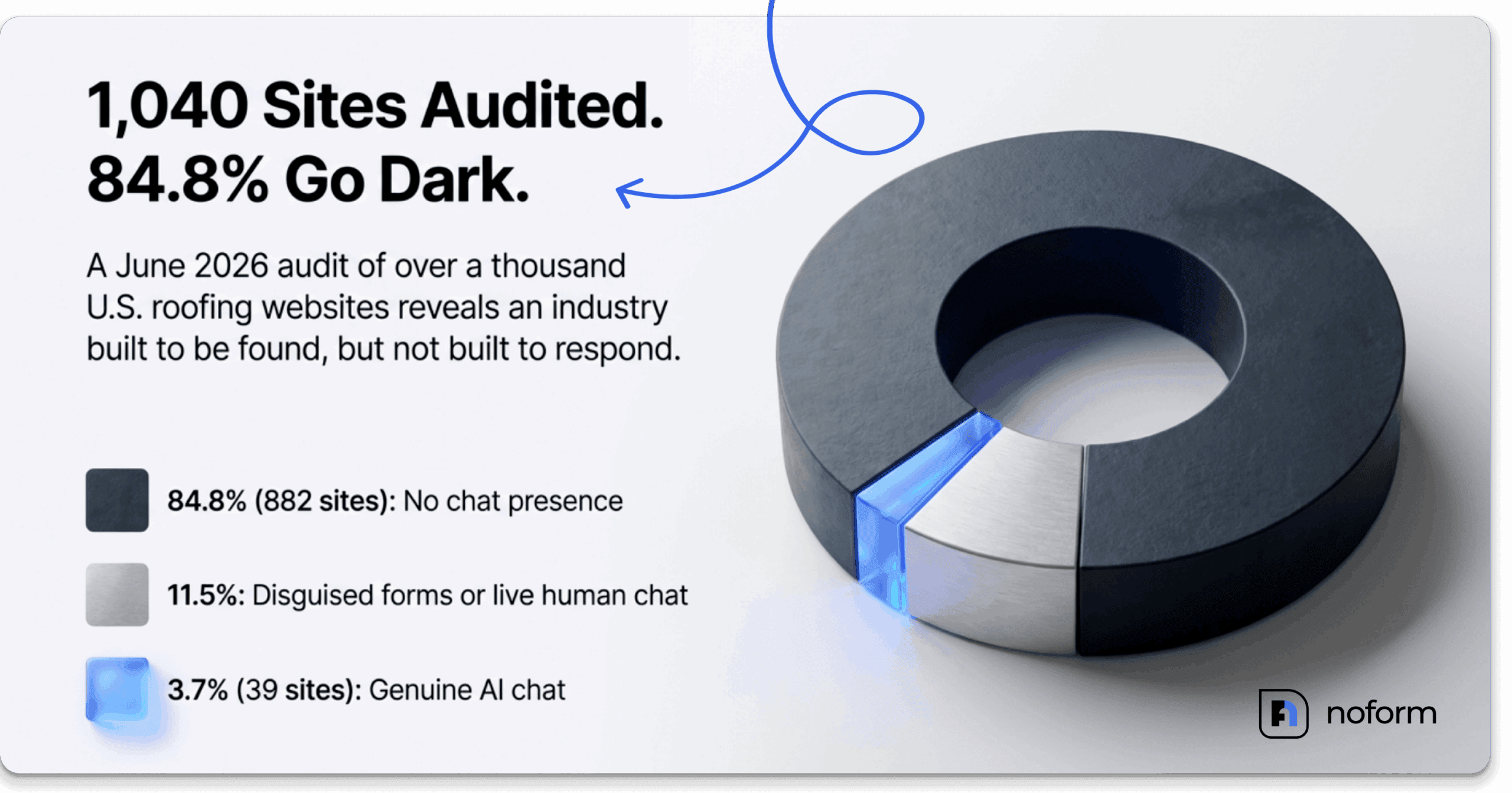
That question sits behind every number in this report. NoForm AI audited 1,040 U.S. roofing websites in June 2026 and found that 84.8% offer no chat at all, and just 3.7% run AI capable of holding an actual conversation. We paired that primary research with verified public data on roofing industry size, workforce, marketing spend, and lead response, plus broader chatbot-adoption benchmarks, to build the most complete picture available of where roofing stands on customer engagement technology going into the second half of 2026.
How many roofing websites have a chatbot in 2026?
Most don’t. NoForm AI reviewed 1,040 roofing company websites across seven states, checking each one by hand for any kind of real-time chat option and submitting a free-text question wherever a widget appeared, to separate genuine AI from forms and fixed-menu bots wearing a disguise.
Category | Sites | Share of all 1,040 |
|---|---|---|
Sites audited | 1,040 | 100% |
No chat at all | 882 | 84.8% |
Any chat present | 158 | 15.2% |
Genuine AI chat | 39 | 3.7% |
Roughly six out of every seven roofing websites offer nothing beyond “call us” or “fill this out and we’ll be in touch.” That leaves 1,001 of the 1,040 sites audited with no way to hold a contextual conversation the moment a visitor is ready to buy. A homeowner who lands on one of those sites at 9 PM on a Saturday, hail still melting on the driveway, gets exactly two options: wait for a callback that might not come until Monday, or open a new tab and try the next search result.
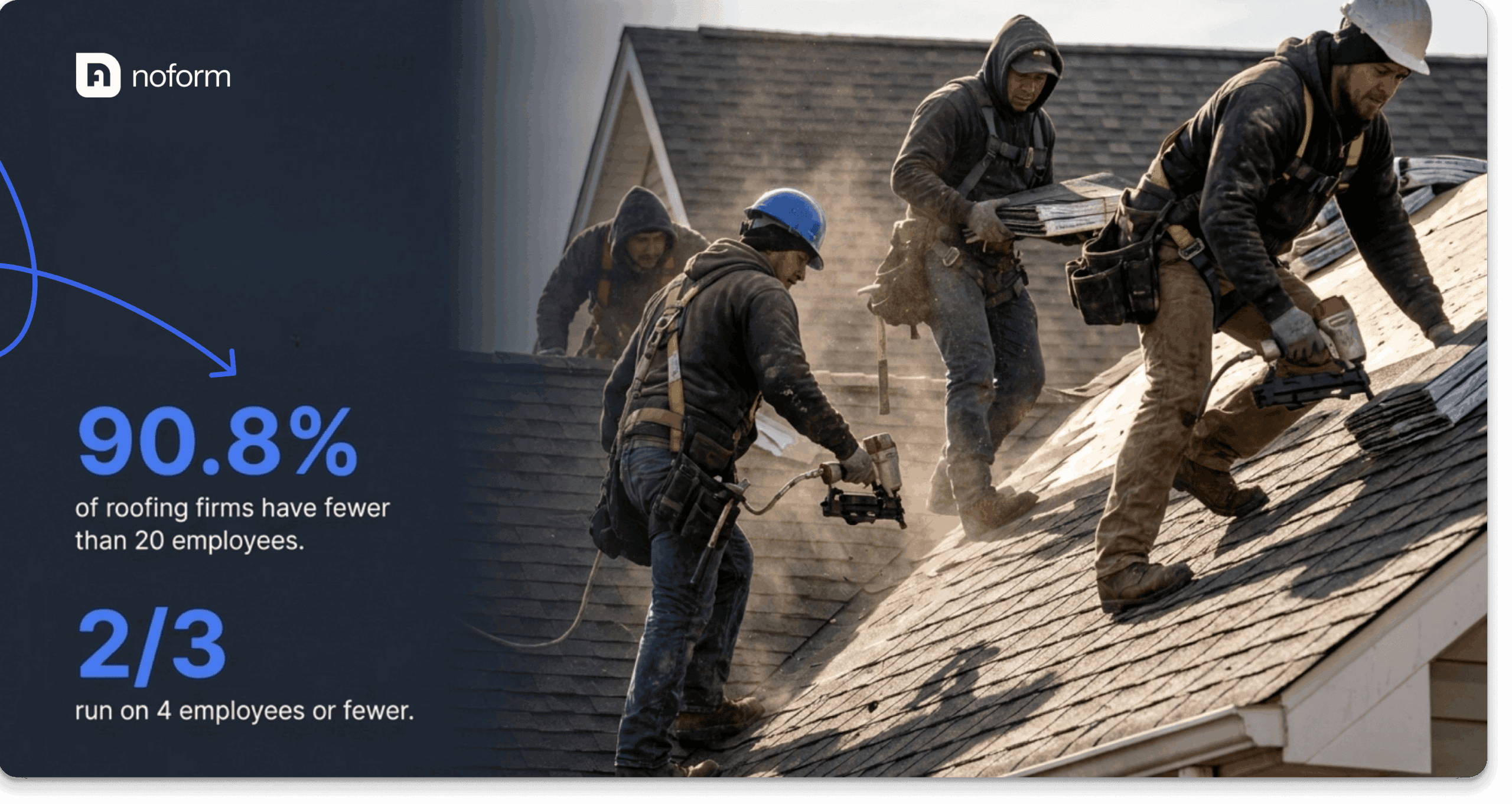
Why so many? The roofing industry is unusually fragmented. U.S. Census Bureau data put 90.8% of employer roofing firms at fewer than 20 employees, and two-thirds run on four employees or fewer. A four-person crew doesn’t have a marketing department comparing chat vendors. It has an owner who answers the phone between jobs. Adding software, even simple software, competes directly with payroll and materials for the same limited hours in the week.
What percentage of roofing sites run real AI chat?
Just 3.7%, or 39 of the 1,040 sites in the sample. NoForm AI defined “AI chat” as a widget where you can type an actual question and get a real answer back, powered by NLP and LLMs, the kind of AI behind tools like ChatGPT, not a fixed button menu or a chat-shaped form. That’s a narrow bar, and almost no one in roofing clears it yet.
Among the 158 sites that had some form of chat, the split looked like this:
Chat type | Sites | Share of chat sites | Share of all 1,040 |
|---|---|---|---|
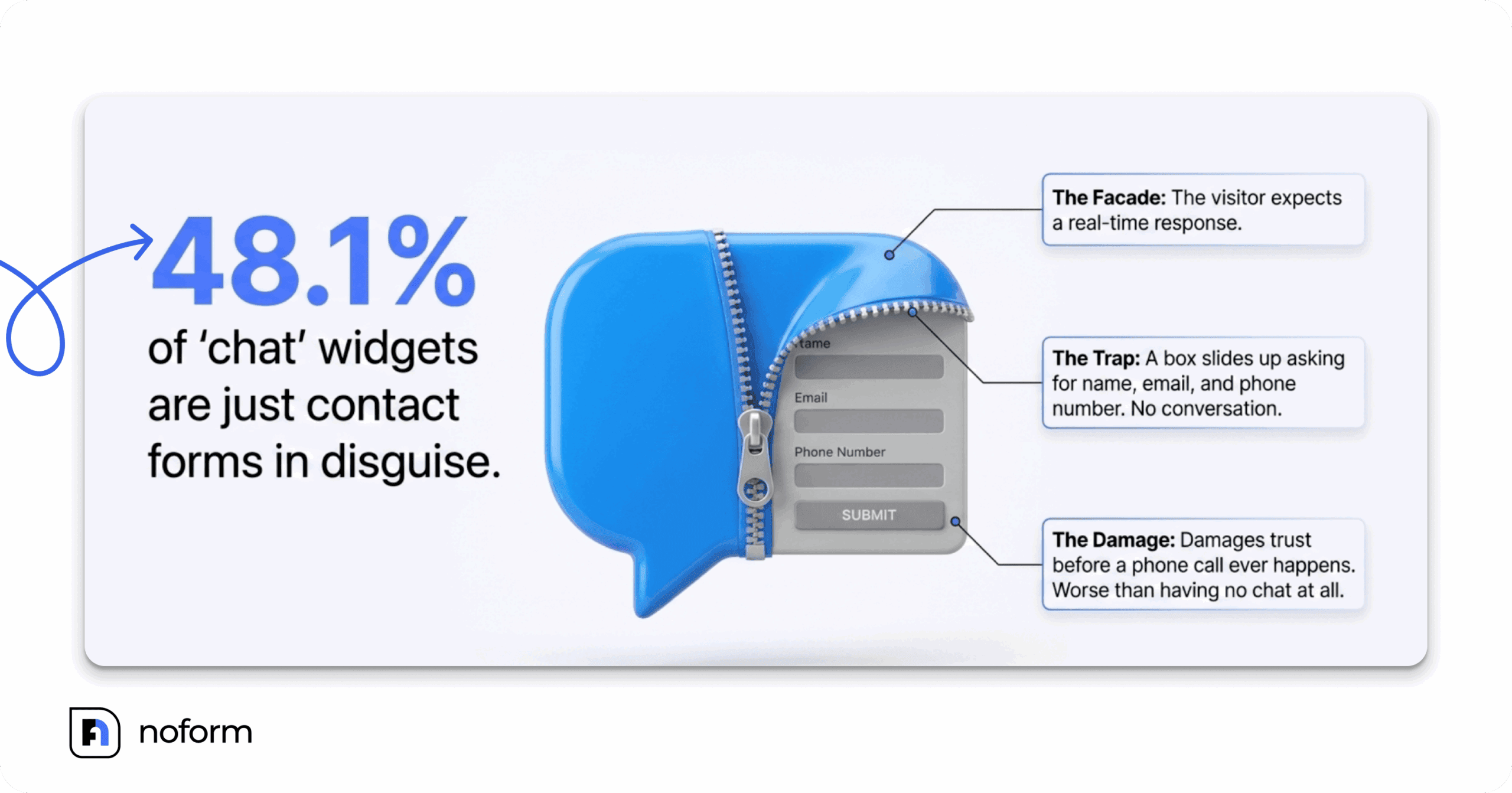
Contact form disguised as chat | 76 | 48.1% | 7.3% |
Genuine AI chat | 39 | 24.6% | 3.7% |
Rule-based / button bot | 13 | 8.2% | 1.2% |
WhatsApp / Messenger | 13 | 8.2% | 1.2% |
Hybrid / mixed | 9 | 5.6% | 0.8% |
Live human chat | 8 | 5.0% | 0.8% |
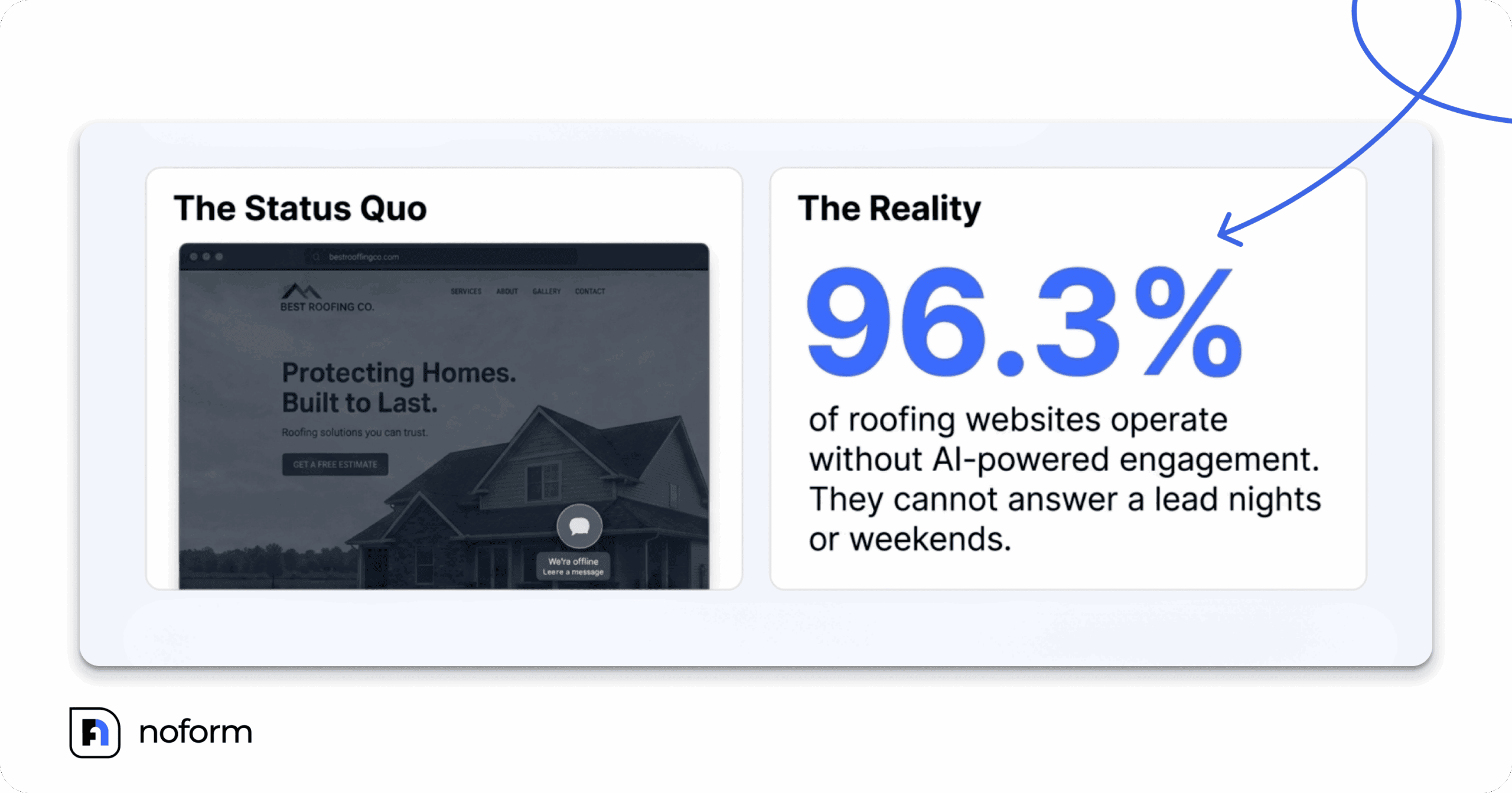
Put another way, 96.3% of roofing websites still operate with no AI-powered visitor engagement, or about 1 in 26 companies. That low number isn’t proof AI chat doesn’t fit home services. It’s mostly a sign that roofing built its playbook on referrals and phone calls long before a website was expected to do any selling on its own, and a fragmented industry of small operators tends to adopt new categories of software slowly, whatever that software is.
Why nearly half of roofing “chat” widgets aren’t chat at all
A contact form wearing a speech-bubble icon isn’t chat, and homeowners notice the difference fast. Click “Chat with us” on one of these sites and a box slides up asking for name, email, and phone number. Submit it, and you’re back to waiting. That’s the entire interaction.
Contact-form chat outnumbers real AI chat by nearly two to one, 76 sites versus 39. Arguably, that’s worse than having no chat icon at all. A visitor who sees a chat bubble expects a real-time answer. When the widget breaks that expectation, it doesn’t just fail to help; it costs the company trust before a phone call ever happens.
Why does the fake version win out? It’s the path of least resistance. Most small roofing sites run on the same handful of website builders, and a chat-styled contact form ships as a default widget, sometimes turned on by an installer who never asked whether it should answer questions.
A genuine AI assistant takes deliberate setup: training it on the company’s services, service area, and pricing logic. A form takes none. For an owner-operator with no in-house tech help, the version that requires zero decisions usually wins, even when it’s the worse product for the homeowner on the other end.
And the questions homeowners actually have before they’ll pick up the phone are rarely complicated.
- Do you service my ZIP code?
- Do you work with insurance claims?
- Can you replace just part of a roof, or does it have to be the whole thing?
- How long does an inspection take?
- Do you offer financing?
A form can’t answer any of that. It just collects a name and goes quiet. When those questions go unanswered, a lot of homeowners don’t call to ask — they open another tab and keep comparing contractors instead.
Does AI chat adoption vary by state?
Yes, though the broader pattern holds everywhere: almost no roofing company runs real AI chat. NoForm AI’s sample spanned Texas, Florida, Colorado, North Carolina, Georgia, New York, and Illinois. Three states showed distinct patterns.
Colorado posted the highest relative AI adoption in the sample, at roughly 4.5% of sites. That’s still a small slice of the market, but it puts Colorado ahead of every other state audited.
Texas markets lean heavily on WhatsApp compared to the rest of the sample. That creates a false sense of coverage. WhatsApp costs nothing to turn on and requires no technical setup, which likely explains why so many contractors default to it. But a message sent at 10 PM goes to an unmonitored phone, not an AI that can actually respond.
Florida shows more live-chat attempts than most states, likely a byproduct of storm-season urgency. The catch is that live chat needs a person behind it. Once 5 PM passes, those widgets go dark right along with the office.
Where adoption sits near zero, a single roofing company that deploys real AI chat today could be the only one in its region offering an instant, always-on answer. That kind of local edge doesn’t last. As more contractors catch up, the gap closes.
Roofing website statistics: what homeowners actually do before they call
Chat adoption is one piece of a bigger pattern: roofing websites, on the whole, are built to be found, not to convert once someone arrives.
Homeowners research before they ever pick up the phone. A Roofing Contractor homeowner survey found word-of-mouth still drives the largest share of contractor discovery at 74%, followed by online search engines at 54% and repeat business at 62%, with social media trailing at 25%. Digital research hasn’t replaced reputation. It sits alongside it, which means a roofing website has to earn trust with the same visitor who also just asked a neighbor for a recommendation.
Search behavior has shifted hard toward mobile and “near me.” Industry data compiled by Sir Marketer shows “roofer near me” searches have climbed roughly 500% since 2020, and more than 80% of roofer-related searches now happen on a phone. A site that loads slowly or buries its phone number below the fold loses that visitor before she finishes scrolling.
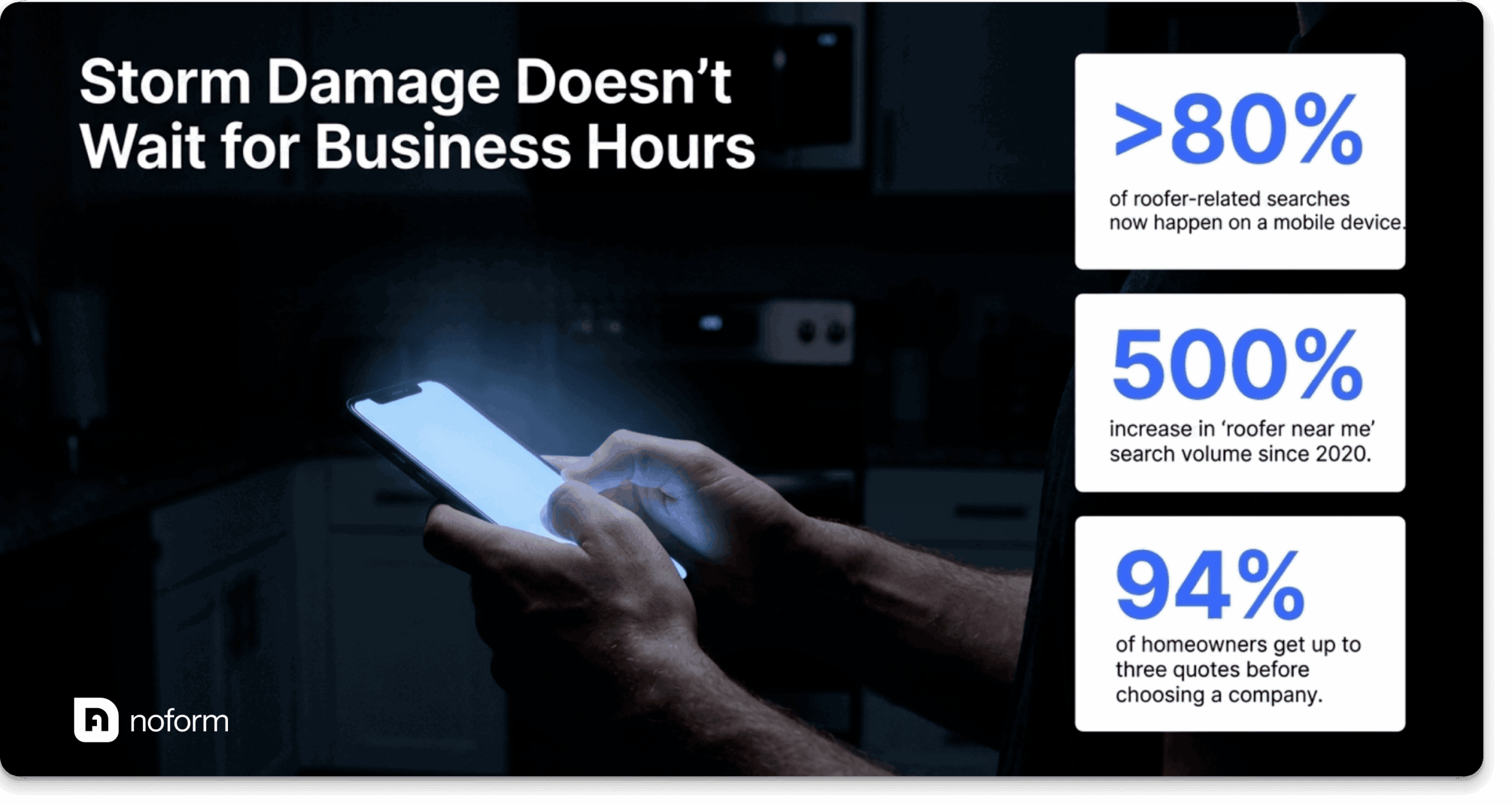
Homeowners compare multiple companies before committing. A Roofing Contractor research study found that 94% of homeowners get up to three quotes before choosing a roofing company. When three roofers are competing for the same call, the one who answers first and looks most credible online usually wins the job, regardless of who does the best work.
Most websites still assume a visitor will pick up the phone. Outside of the small AI-chat minority, roofing sites overwhelmingly rely on a header phone number, a contact page, and an “estimate request” form. That model works when office staff is at their desks. It stops working the moment a homeowner searches at 9 PM on a Friday, which, per the after-hours data below, is close to when a lot of roofing searches actually happen.
How much does after-hours response speed actually matter?
More than most roofing companies plan for. Storm damage doesn’t wait for business hours, and neither do the homeowners looking for someone to fix it. Yet 96% of the roofing sites in NoForm’s audit go dark the moment the office closes.
NoForm’s report captured this timeline from a real comparison between two competing sites:
Time | Event |
|---|---|
10:14 PM | Visitor submits a contact form |
10:15 PM | A competitor’s AI chat responds instantly |
8:03 AM | The first site’s team opens the form |
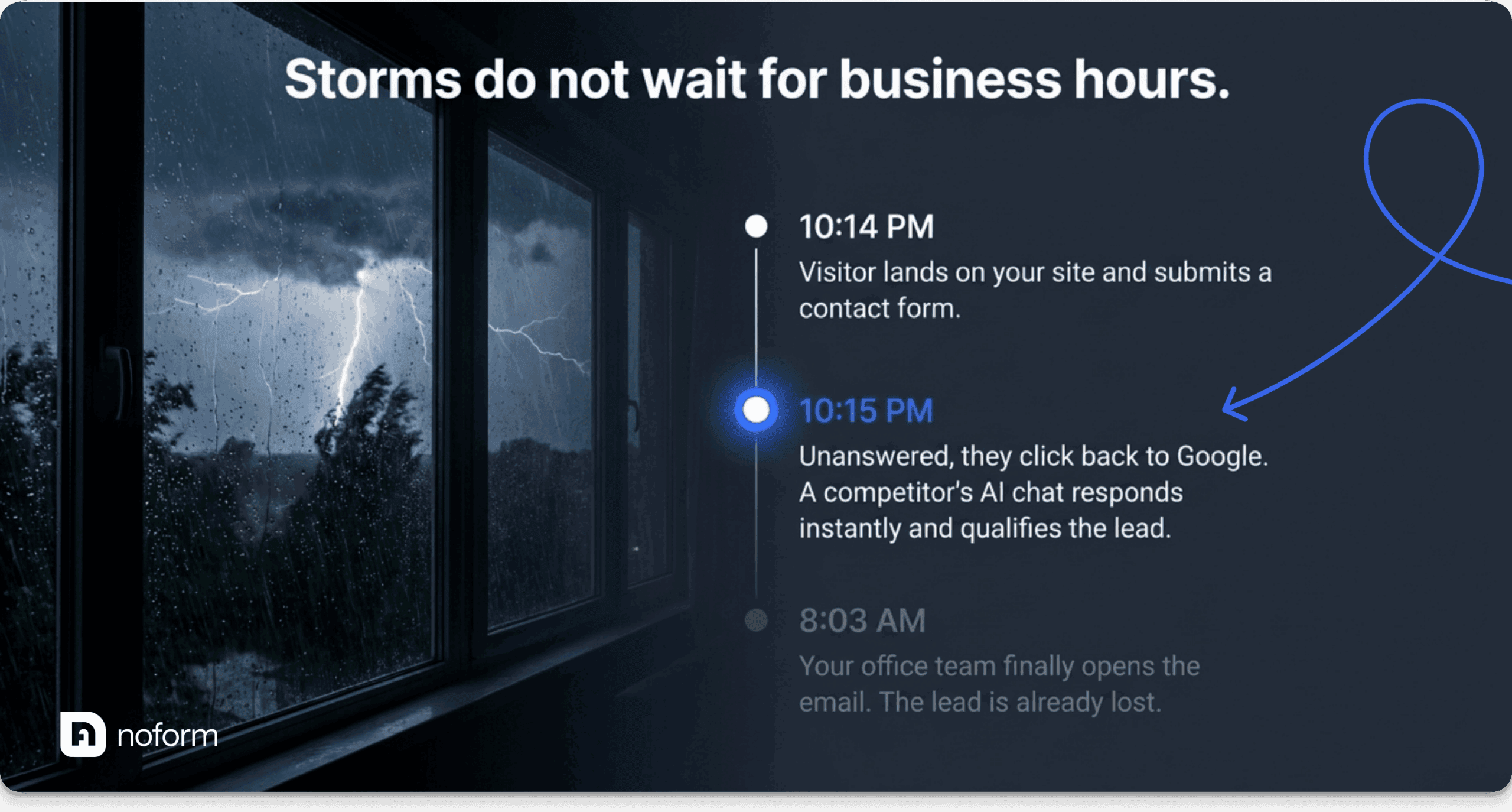
Speed decides more jobs than reputation does. Widely cited research puts the number at 78%: the share of customers who hire the first company to respond, not the highest-rated and not the cheapest. A joint MIT and Kellogg School of Management study of more than 15,000 leads and 100,000 call attempts found that the odds of qualifying a lead drop 21 times when contact happens at 30 minutes instead of five. The odds of making contact at all drop by a factor of 100 over that same window.
Roofing-specific data backs this up at the industry level. SearchLight’s Q1 2026 roofing benchmarking data put the industry-average time to first contact at 47 hours, a figure that lines up with broader research on how long other service businesses take to call back a lead. Hitting a five-minute window outside business hours is close to impossible without some form of automation. Someone has to be awake, at a desk, watching for a form submission the second it lands, and that’s not a realistic staffing plan for most roofing companies, especially the 90.8% that employ fewer than 20 people.
Roofing marketing statistics: the cost of waiting
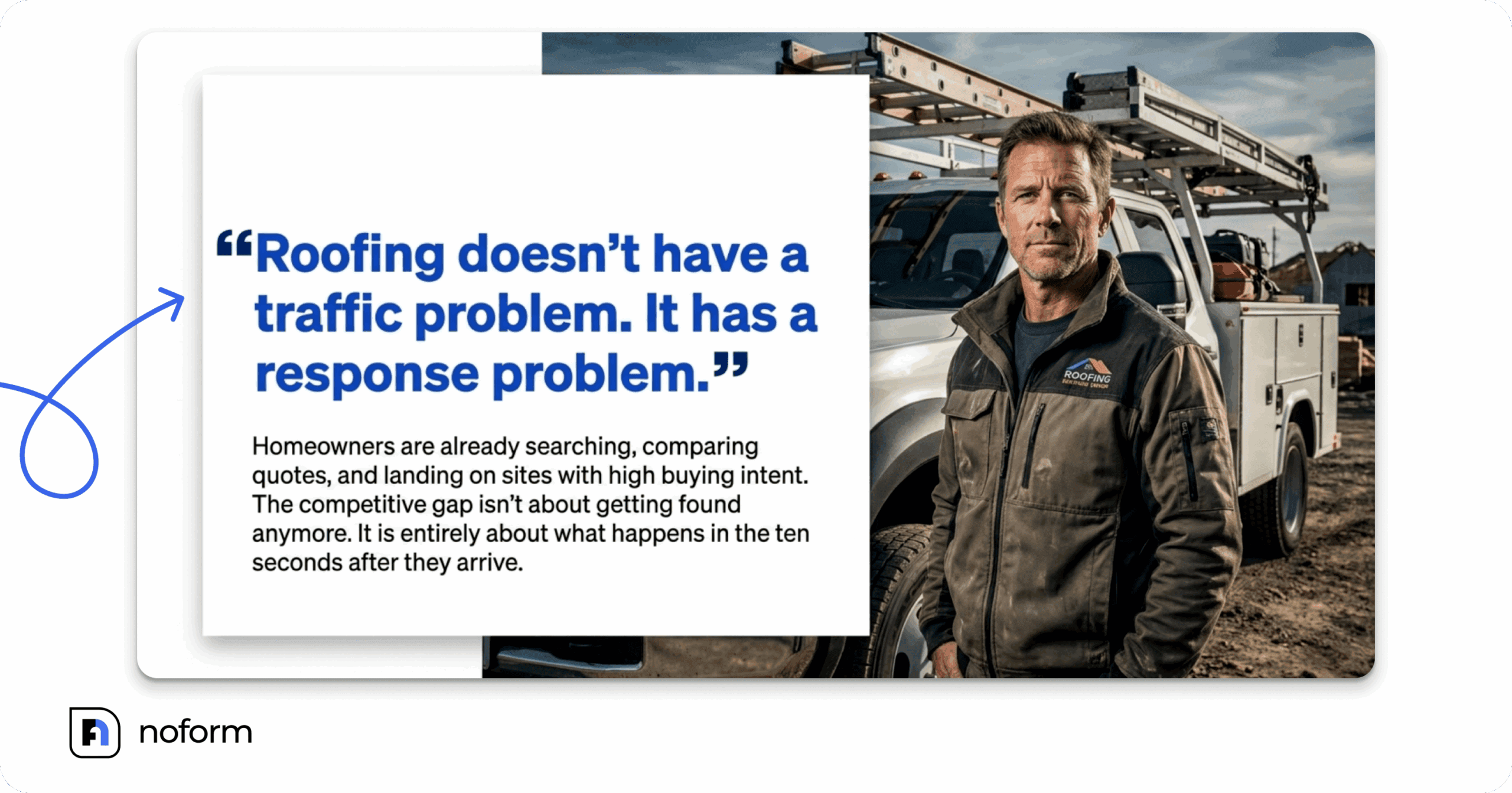
Roofing doesn’t have a lead generation problem. It has a lead response problem, and the marketing numbers make that hard to argue with.
Start with where the money already goes. Roofers are spending on marketing, and most of them don’t think it’s working: RoofingWebmasters’ research found roughly 70% of roofing companies are unhappy with their SEO provider, and that 98% of the content on roofing websites gets zero organic traffic. That’s not a sign roofers are ignoring marketing. It’s a sign that visibility alone isn’t the bottleneck it’s often sold as.
Search and mobile dominate discovery. Blue Aspen Marketing’s analysis found that 60% to 90% of roofing leads come from the Google Maps Pack, and the large majority of those searches happen on a phone. That puts local search results, not the homepage, as the real front door for most roofing companies.
Referrals still carry the industry, even in a digital-first market. Roofr’s 2025 Roofing by the Numbers report, based on a survey of U.S. roofing business owners, found that 71% of roofers rely primarily on word-of-mouth referrals from past customers. Reputation and digital visibility aren’t competing channels. A homeowner who gets a neighbor’s recommendation still checks the website before calling.
Paid acquisition is getting more expensive. SearchLight’s Q1 2026 data puts the average Google Ads cost-per-lead in roofing at $124 on non-branded search and $64 on Performance Max campaigns. Pay that much for a click, then take 47 hours to call back, and the lead you bought is often gone before anyone dials the phone.
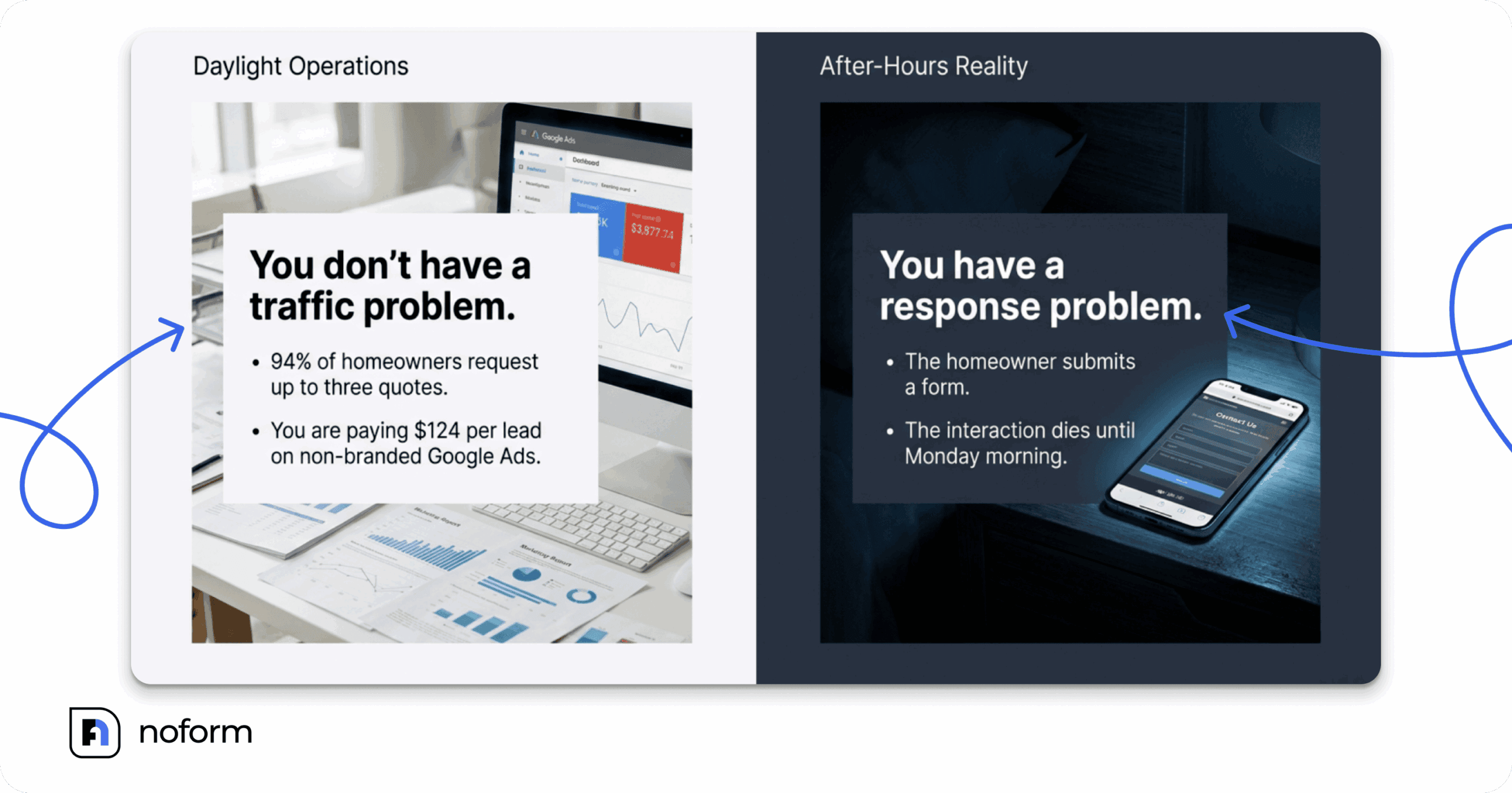
The roofers who do close that gap see it pay off. Roofr’s 2025 report found 89% of roofers who invested in digital marketing saw more leads, but only 28% run any kind of CRM to actually track them, and the roofers who paired a CRM with marketing automation roughly doubled their year-over-year leads compared to the ones who didn’t. Ads bring the traffic. What happens after someone clicks is the part most companies still leave to chance.
Margins are thin, which raises the stakes on every lead. Average net margins in roofing sit around 5.3%, according to Ignite Digital’s 2026 search analysis, squeezed by labor, materials, subcontractor costs, and insurance. When margin is that tight, a single lead lost to a slower competitor isn’t a rounding error. It’s a real chunk of a job’s profit, gone before the crew even shows up.
There’s a simpler way to see why that matters for where the next marketing dollar goes. A roofing company that doubles its website conversion rate without spending a cent more on ads gets roughly double the leads from the traffic it’s already paying for. Getting there through cheaper clicks alone is hard in a market where cost-per-lead keeps climbing. Getting there by fixing what happens after someone lands on the site is, for a lot of roofers, the more available lever.
Roofing industry statistics: size, structure & growth
The chatbot and marketing gaps above sit inside an industry that’s large, fragmented, and growing.
How big is the roofing market, exactly? It depends which count you use, and the difference matters. The U.S. Census Bureau’s Statistics of U.S. Businesses puts the industry at 24,044 employer firms generating $68.8 billion in receipts as of 2022, a figure that only counts businesses with paid employees. Broader market-research estimates that include non-employer, owner-operator businesses put the industry closer to 101,000 to 106,000 total companies and $92 billion to $99.8 billion in overall revenue, according to IBISWorld. Neither number is wrong. They’re measuring different things: registered employer businesses versus the full universe of active roofing operators, including solo contractors with no payroll.
The industry is dominated by small operators, and that’s the real reason AI adoption lags. Under the Census count, 90.8% of employer roofing firms have fewer than 20 employees, and those small firms account for just 39% of total industry employment. Two-thirds of firms employ four or fewer people. At the other end, just 234 firms with 100 or more employees, under 1% of the industry by firm count, employ nearly as many roofers as the roughly 19,500 smallest firms combined. A chat widget that takes a week of setup is a rounding error for one of those 234 firms and a real cost for the other 90.8%.
Demand is structurally resilient. Roughly 80% of roofing revenue now comes from re-roofing and renovation rather than new construction, according to industry estimates, which makes the category less exposed to swings in new-home building. Demand is driven by aging housing stock, severe weather events, insurance-funded repairs, and ordinary wear, none of which pause when interest rates or housing starts do.
How fast is chatbot adoption growing outside roofing?
Fast, and roofing is falling further behind every quarter it waits. Grand View Research put the global chatbot market at $9.6 billion in 2025, growing to $11.8 billion in 2026 and a projected $41.2 billion by 2033, a 19.6% compound annual growth rate. Customer service remains the single largest use case, accounting for 31.33% of the market.
Consumer expectations have shifted right along with it. Zendesk’s 2026 CX Trends research, published in late 2025, found 74% of consumers now expect customer service to be available 24/7, and 88% say they expect a faster response than they did just a year earlier. Zendesk’s 2025 edition found something similar from a different angle: 67% of consumers said they were ready to hand off simple tasks, like tracking an order, to an AI assistant. On the business side, chatbot deployment correlates with real conversion gains: industry data shows conversion lifts of 20% or more from AI chat, climbing to 40% with proactive triggers, while Gartner’s 2022 forecast for this year projects conversational AI will cut contact-center labor costs by $80 billion in 2026 alone.
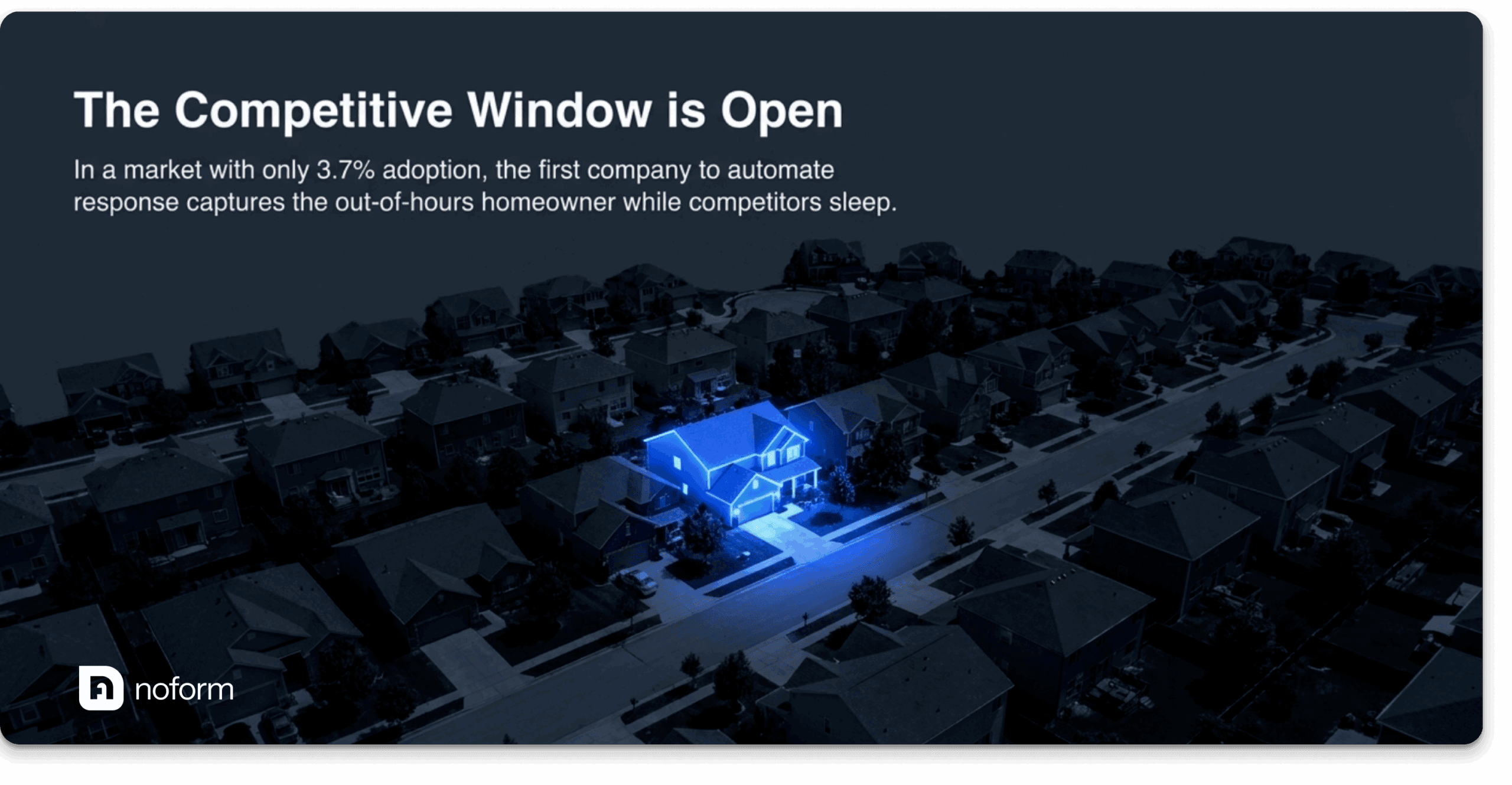
Set that against roofing’s 3.7% AI chat adoption rate, and the picture gets clear fast. Most industries have already moved past the early-adopter stage. Roofing hasn’t started yet.
What happens when roofing companies add AI-powered lead capture?
The pattern holds across the businesses already using it: instant answers convert better than a promise to call back. Without any engagement layer, close to 98% of website visitors leave a site without taking any action at all. That’s the baseline roofing companies are working against every single day.
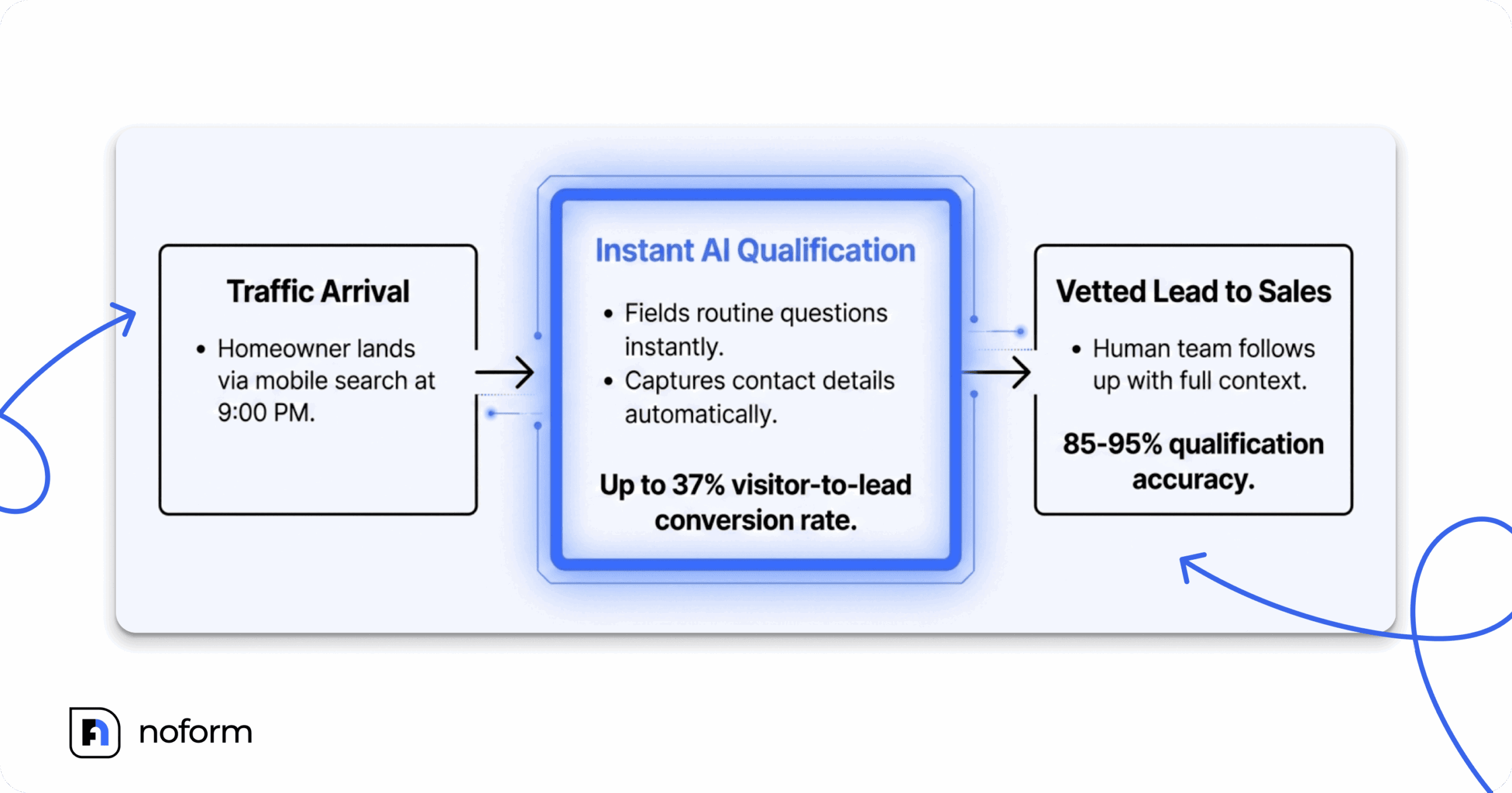
Where AI-powered chat replaces a static contact form, a few consistent patterns show up in conversational AI data:
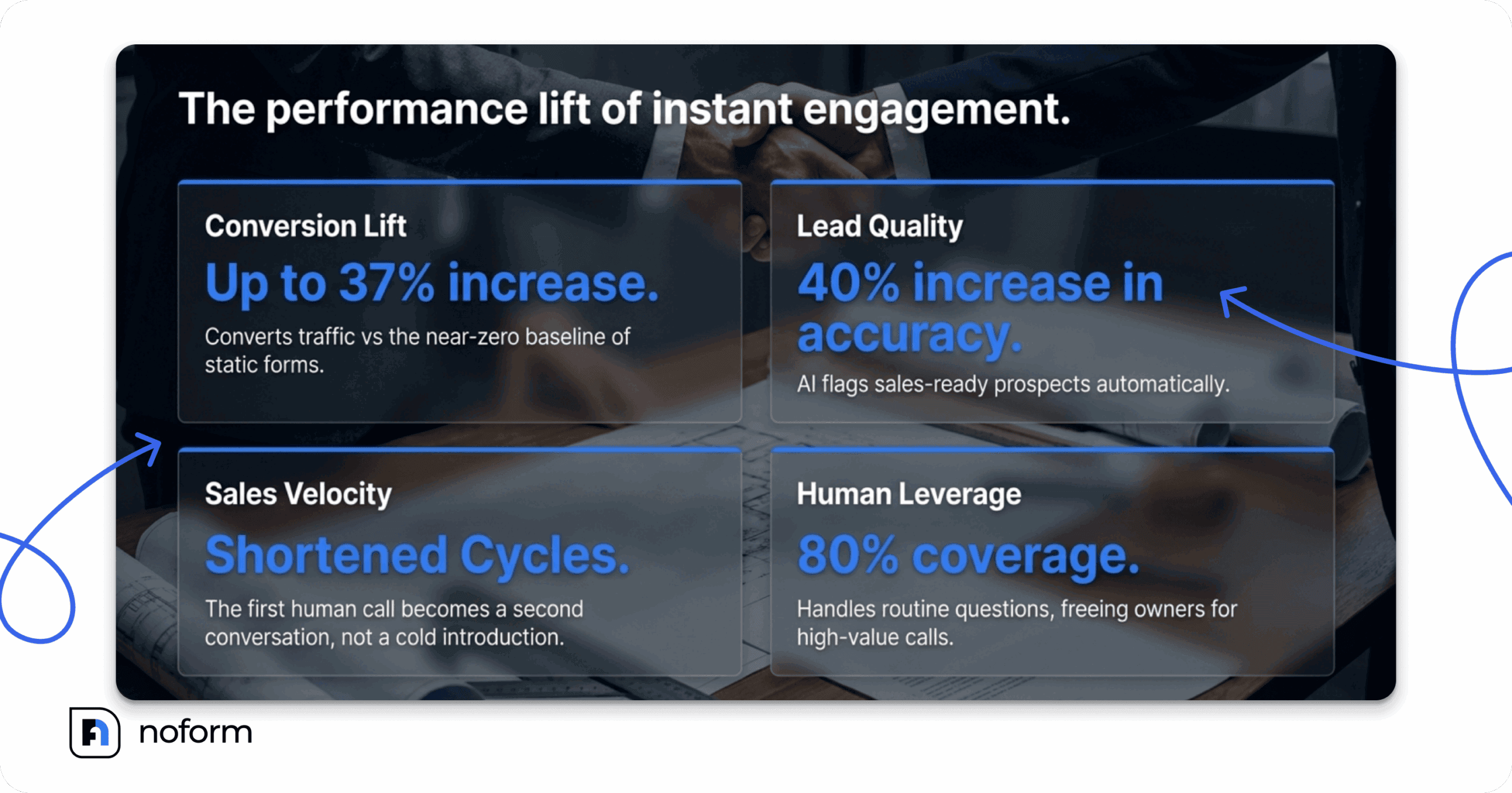
- Conversion lift. Businesses running AI-powered assistants can convert up to 37% of visitors into leads, versus the near-zero baseline of a static form, and see roughly 3x more conversions than forms alone.
- Lead quality. A 2026 Landbase analysis found conversational AI improves conversion rates by 25% to 35% and gets noticeably better at telling a serious buyer from someone just browsing, catching the right prospects 85% to 95% of the time when it’s set up well.
- Speed to close. LinkedIn research found AI-assisted lead handling shortens sales cycles by about a week on average, mostly because the sales team’s first call becomes a second conversation instead of a cold introduction.
- Coverage. A well-configured AI assistant can field up to 80% of routine customer questions on its own, which frees the team up for the calls that actually need a human.
None of this guarantees a specific result for every roofing company. Results vary by market, site traffic, and how well the assistant is trained on the company’s own content. But the pattern in the data holds: businesses that answer instantly outperform businesses that make homeowners wait.
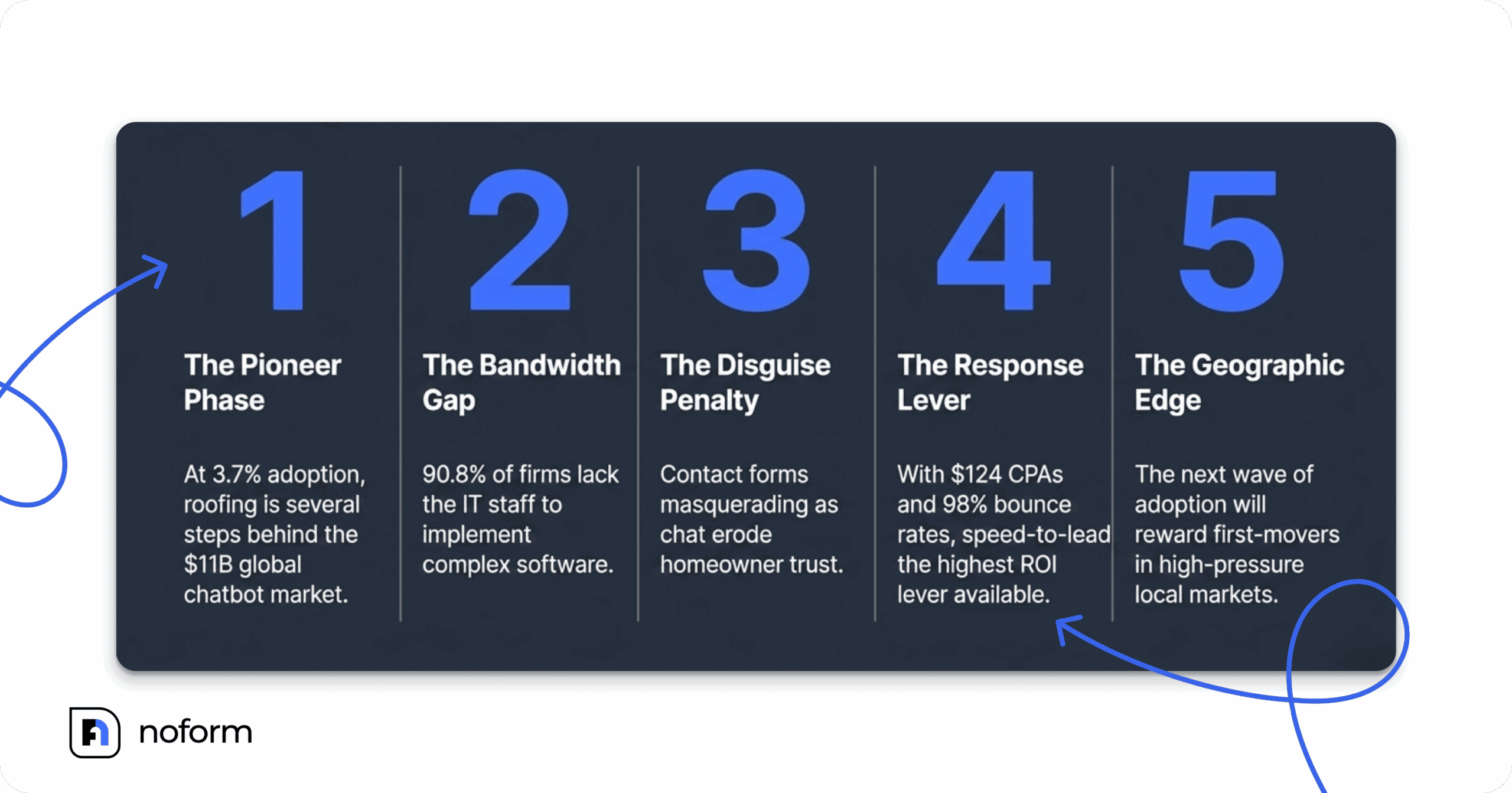
Five insights from the data
- Roofing is still in the AI pioneer phase, not the early-adopter phase. At 3.7% adoption against a chatbot market growing past $11 billion and two-thirds of consumers already comfortable handing routine tasks to AI, roofing hasn’t reached the point where most industries sit today. It’s several steps behind.
- The gap is structural, not a failure of imagination. Roofing’s fragmentation, 90.8% of firms under 20 employees, two-thirds under five, is the same fragmentation that makes it a private-equity roll-up target. It’s also exactly what’s kept AI adoption low: most roofing companies don’t have anyone whose job it is to evaluate new software.
- Contact forms are creating a false sense of coverage. Nearly half of the “chat” on roofing sites is a form wearing a costume. A visitor who clicks a chat bubble expecting a real-time answer and gets a static form loses trust in a way that a plain “Contact Us” link never would have cost the company.
- Speed-to-lead, not more traffic, is the more available lever. Roofers are already spending on SEO, Google Ads, and referral programs. RoofingWebmasters found 98% of roofing website content earns zero organic traffic, and 70% of roofers aren’t happy with their SEO results, while Roofr found the roofers actually running a CRM convert roughly twice as many leads as those without one. The unclaimed advantage sits after the click, not before it.
- Adoption will likely spread unevenly before it spreads widely. Colorado’s hailstorm-driven competition, Texas’s improvised reliance on WhatsApp, and Florida’s storm-season live-chat attempts all point the same direction: local market pressure, not national trend-following, is what pushes an individual roofing company to try AI chat first. The next wave of adoption will probably follow the same pattern, market by market, rather than arriving everywhere at once.
What should roofing companies do with this data?
Roofing doesn’t have a traffic problem. It has a response problem. Homeowners are already searching, already comparing three or four contractors in the same sitting, already landing on sites with real buying intent. The gap isn’t getting found. It’s what happens in the ten seconds after someone arrives.
Technology adoption tends to follow a predictable curve: innovators, then early adopters, then the mainstream. Roofing’s conversational-AI adoption sits at the very start of that curve, below 4% by every measure in this report, for reasons that trace directly back to how small and thinly staffed most roofing companies are. Businesses implementing AI assistants today won’t stand out forever. But while adoption stays this low, they’re competing in a market that’s close to empty rather than one that’s already crowded.
The data suggests roofing companies don’t necessarily need more traffic. They need to make better use of the traffic they already earn. With AI adoption still below 4%, the industry is in an unusually early stage of digital transformation, one where a four-person crew and a 200-person regional firm are, for the moment, competing on nearly even footing when it comes to conversational AI. Contractors who improve response speed and website engagement today may get a meaningful competitive window before conversational AI becomes standard practice instead of a point of difference.

NoForm AI is a no-code AI sales assistant built for roofing, HVAC, and other home service companies. It trains itself on your website’s existing content, answers visitor questions in natural conversation, and flags a lead the moment a visitor shares an email or phone number, all without adding staff. See how it would work on your site at noform.ai.
Frequently Asked Questions
What percentage of roofing websites have a chatbot?
About 15.2% of roofing websites have some form of chat widget, based on a 2026 audit of 1,040 U.S. roofing sites. Most of that 15.2% isn’t real AI chat, though. Only 3.7% of all roofing sites run a chatbot capable of answering a free-text question.
How many roofing companies use real AI chat versus a contact form disguised as chat?
Among roofing sites with any chat widget, 48.1% are contact forms styled to look like chat, while 24.6% run genuine AI chat. In raw numbers, that’s 76 form-disguised widgets versus 39 real AI chat implementations, out of 158 sites with any chat at all.
What’s the difference between a chat widget and real AI chat?
A chat widget with no AI behind it usually opens a static form asking for name, email, and phone number, with no ability to answer a question. Real AI chat accepts free-text input and gives contextual answers pulled from the business’s own content, closer to a conversation than a form.
Which states have the highest adoption of roofing chatbots?
Colorado posted the highest relative AI chat adoption in NoForm AI’s 2026 audit, at roughly 4.5% of sites. Texas markets lean more on WhatsApp, and Florida shows more live-chat attempts tied to storm-season urgency, though those widgets typically stop responding after business hours.
How many roofing companies are there in the United States?
It depends on the count. The U.S. Census Bureau’s Statistics of U.S. Businesses puts the number at 24,044 employer roofing firms in 2022, counting only businesses with paid staff. Broader market-research estimates that include non-employer, owner-operator businesses put the total closer to 101,000 to 106,000 companies.
Why does the roofing industry lag on technology adoption generally?
Mostly structure. Census data show 90.8% of employer roofing firms have fewer than 20 employees and two-thirds have four or fewer. Small, owner-operated businesses without dedicated marketing or IT staff tend to adopt new software categories slowly, and conversational AI is no exception.
Is the roofing industry growing?
Yes. Roughly 80% of roofing revenue now comes from re-roofing and renovation rather than new construction, which insulates demand from housing-market swings. Growth continues to be driven by aging homes, severe weather events, insurance-funded repairs, and the ordinary need for maintenance and replacement.
How much revenue do roofing companies lose from slow lead response?
Research widely cited by Lead Connect found that 78% of customers hire the first company to respond to their inquiry, not the cheapest or highest-rated. A joint MIT and Kellogg School of Management study found that a lead contacted within five minutes is roughly 21 times more likely to qualify than one reached after 30 minutes, and roofing’s own industry-average response time sits around 47 hours.
Is chatbot adoption growing in the roofing industry?
It’s growing slowly. Only 3.7% of roofing websites currently run real AI chat, compared to a global chatbot market that reached $11.78 billion in 2026 and continues expanding at close to 20% annually, according to Grand View Research. Roofing lags well behind broader business adoption trends.
What counts as a “qualified lead” when using an AI chat assistant?
In most AI-powered sales assistants, a conversation counts as a qualified lead the moment a visitor shares an email address or a phone number. It’s a specific technical trigger, not a subjective score, which means every qualified lead includes at least one verified way to follow up.
How much does local SEO matter for roofing companies?
A significant amount. Industry analysis found that 60% to 90% of roofing leads originate from the Google Maps Pack, and roughly 70% of local roofing companies now actively invest in local SEO. More than 70% of local roofing searches happen on mobile devices, making mobile-friendly, fast-loading sites a requirement rather than a nice-to-have.
Does adding AI chat replace the need for a sales team?
No. AI chat automates the first, repetitive part of the job: answering questions, qualifying visitors, and capturing contact details around the clock. Closing the sale still depends on a human follow-up. What changes is that the follow-up starts with context instead of a cold, blank inquiry.
Where can I see the roofing chatbot statistics report methodology?
NoForm AI audited 1,040 roofing company websites across Texas, Florida, Colorado, North Carolina, Georgia, New York, and Illinois in June 2026, identified through Google Maps search results and local directory listings. Each site was reviewed by hand, with a free-text question submitted to any chat widget found to confirm whether it was genuine AI, a form, or a fixed-menu bot.
Methodology & sources
Primary data source: NoForm AI, The State of Roofing Website Chat 2026 (June 2026). Sample of 1,040 U.S. roofing company websites across Texas, Florida, Colorado, North Carolina, Georgia, New York, and Illinois. Not a statistically representative census of the full U.S. roofing industry, but a broad cross-section of active, publicly listed businesses with indexed websites. Each site was reviewed manually; where a chat widget was present, researchers submitted a free-text question to distinguish genuine AI from form wrappers and fixed-menu bots. After-hours behavior of live chat and WhatsApp widgets was not systematically tested at every hour.
Additional public sources cited in this article:
- NoForm AI, The State of Roofing Website Chat 2026, June 2026. https://noform.ai/roofing-website-chat-report/
- NoForm AI, How Dog Gone Taxi automates pet move quotes & enhances customer experience with AI. https://noform.ai/case-studies/dog-gone-taxi/
- U.S. Census Bureau, Statistics of U.S. Businesses (SUSB), 2022 Annual Data Tables, NAICS 238160, released April 10, 2025. https://www.census.gov/data/tables/2022/econ/susb/2022-susb-annual.html
- Roofr, 2025 Roofing by the Numbers Industry Report. https://roofr.com/gated-content/soti-2025
- Roofing Contractor homeowner and industry surveys, 2025-2026. https://www.roofingcontractor.com/articles/101643-2026-state-of-the-roofing-industry-report
- RoofingWebmasters, 2026 Roofing Marketing Statistics. https://www.roofingwebmasters.com/marketing-statistics/
- MIT and Kellogg School of Management, “Lead Response Management Study.” https://25649.fs1.hubspotusercontent-na2.net/hub/25649/file-13535879-pdf/docs/mit_study.pdf
- Zendesk, CX Trends 2026 Report. https://cxtrends.zendesk.com/
- Grand View Research, Chatbot Market Size, Share & Growth Report, 2026-2033. https://www.grandviewresearch.com/industry-analysis/chatbot-market
- Zendesk, 2025 CX Trends Report. https://www.zendesk.com/newsroom/articles/2025-cx-trends-report/
- U.S. Bureau of Labor Statistics, Occupational Outlook Handbook, Roofers, 2024. https://www.bls.gov/ooh/construction-and-extraction/roofers.htm
- CPWR, The Center for Construction Research and Training, The Construction Chart Book, 7th edition, 2025. https://www.cpwr.com/wp-content/uploads/CPWR_Construction_Chart_Book-7th.pdf
- Data USA, Roofers occupation profile, U.S. Census ACS PUMS, 2024. https://datausa.io/profile/soc/roofers
- IBISWorld, U.S. roofing contractors industry estimates, 2026. https://www.ibisworld.com/united-states/industry/roofing-contractors/198/
- Gartner, conversational AI and contact-center cost estimates. https://www.gartner.com/en/newsroom/press-releases/2022-08-31-gartner-predicts-conversational-ai-will-reduce-contac
- Blue Aspen Marketing’s 2026 analysis. https://blueaspenmarketing.com/roofing-marketing-agency-secrets-how-roofing-companies-grow-seo-in-2025/
- Sir Marketer, Digital Marketing for Roofers. https://sirmarketer.com/digital-marketing-for-roofers-complete-2026-guide/