Most articles about how to generate roofing leads recommend the same strategies: optimize your Google Business Profile, invest in local SEO, run Google Ads, ask for referrals, and stay active on social media.
Those channels still work. But after analyzing 1,040 roofing company websites, we found that most contractors aren’t losing leads because they’re using the wrong marketing channels. They’re losing them because their websites aren’t converting interested visitors into customers.
Roofing leads come from the same handful of places they always have. What’s changed is what happens after that effort lands someone on your website. We tested 1,040 roofing company sites and found that 84.8% give a visitor nothing more than a phone number or a contact form.
In this guide, we’ll cover the eight lead generation channels every roofing company should invest in, and explain why improving your website’s conversion rate may be the fastest way to generate more leads in 2026.
Why roofing lead generation is changing
A homeowner finds hail damage on a Saturday morning. They don’t call one roofer and wait by the phone. They open their browser, search, and click through three or four sites in the same sitting, comparing them the way they’d compare flights before booking a trip. Whoever answers first gets the conversation. Everyone else gets ignored, no matter how good their work is.
Every other part of their day already trained them to expect a fast answer: tracking a package, checking a bank balance, booking a table. A roofing site that promises to “get back to you soon” is competing against that standard, and losing.
Most roofing companies haven’t caught up. The industry still runs on the same static contact form it used a decade ago, and the audit numbers prove it.
What we found after auditing 1,040 roofing websites
We audited 1,040 roofing company websites across seven states: Texas, Florida, Colorado, North Carolina, Georgia, New York, and Illinois. We tested each site by hand.
85% of roofing websites have no chat at all
Category | Sites | Share |
Sites audited | 1,040 | 100% |
No chat at all | 882 | 84.8% |
Any chat present | 158 | 15.2% |
Genuine AI chat | 39 | 3.7% |
Roughly six of every seven sites we tested gave a visitor exactly two options: call or fill out a form and wait. For a homeowner who needs an answer now, that’s the difference between getting a quote today and clicking to the next search result.
Among the 158 sites with some form of chat, the breakdown looked like this:
Chat type | Share of all 1,040 sites |
No chat | 84.8% |
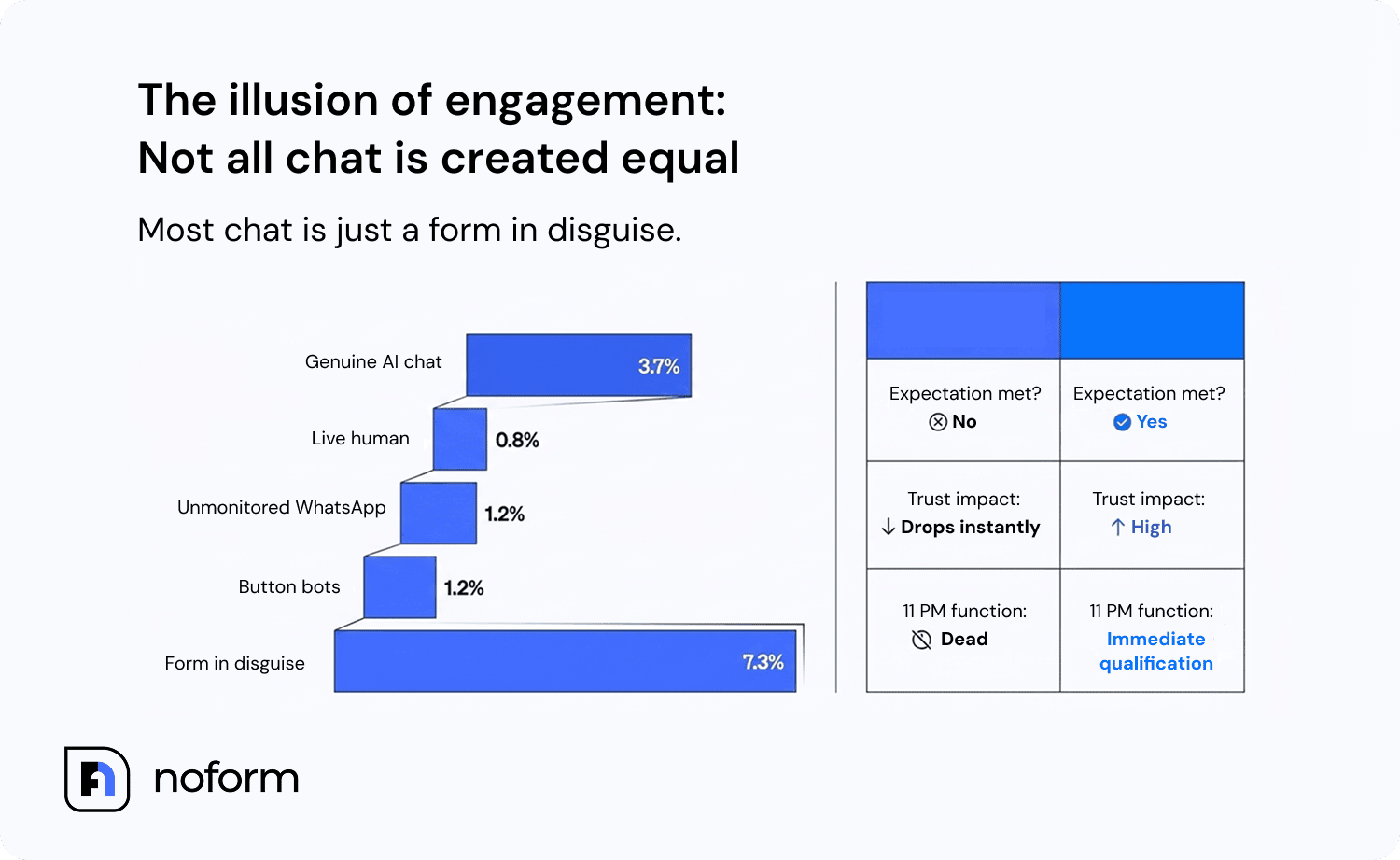
Contact form disguised as chat | 7.3% |
Genuine AI chat | 3.7% |
Rule-based / button bot | 1.2% |
WhatsApp / Messenger | 1.2% |
Live human chat | 0.8% |
Hybrid / mixed | 0.8% |
Rule-based bots respond only to preset buttons or a fixed menu. They can’t handle an open-ended question the way genuine AI chat can.
A contact form disguised as chat beats genuine AI chat by nearly two to one, which arguably makes it worse than having no chat at all. A visitor who clicks a speech-bubble icon expects a real answer, and when the box only asks for a name and phone number, trust drops before a call ever happens.
Only 3.7% run real AI chat
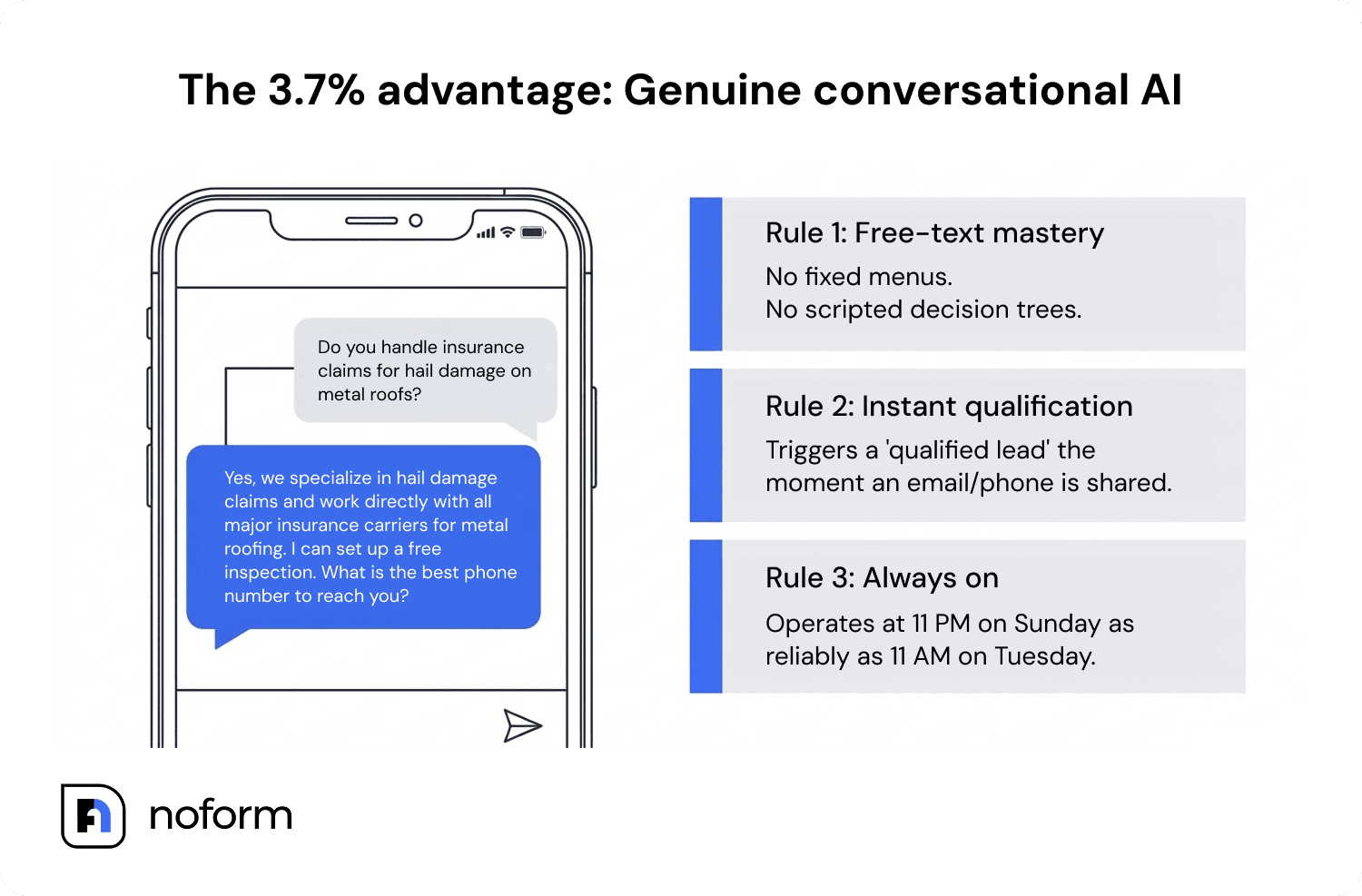
We counted a site as running genuine AI chat only if it could handle a free-text question with a contextual answer, not a fixed menu of buttons and not a scripted decision tree. By that bar, 39 of the 1,040 sites qualified. That’s about 1 in 26.
Adoption also varies by region. Colorado leads at close to 4.5%, still low by any measure, but ahead of everywhere else checked. Texas markets lean heavily on WhatsApp instead, which routes a 10 PM message to an unmonitored phone rather than anyone or anything that can respond. Florida shows more live-chat attempts, likely storm-season urgency, but live chat needs a person on the other end, and those widgets go dark once the office closes.
Most contractors haven’t tried AI chat yet, or assume it takes more setup than it does. The handful already running it are capturing leads at 11 PM on a Sunday that competitors don’t even know they missed.
Why response time decides who gets the roofing lead
Speed beats reputation more often than most roofing companies want to admit. 78% of customers hire the first company to respond, not the cheapest and not the highest-rated. The research building on Harvard Business Review’s original lead-response study found that a lead reached within five minutes is roughly 21 times more likely to qualify than one reached after thirty. Estimates vary by source and market, but the direction never does: waiting costs jobs.
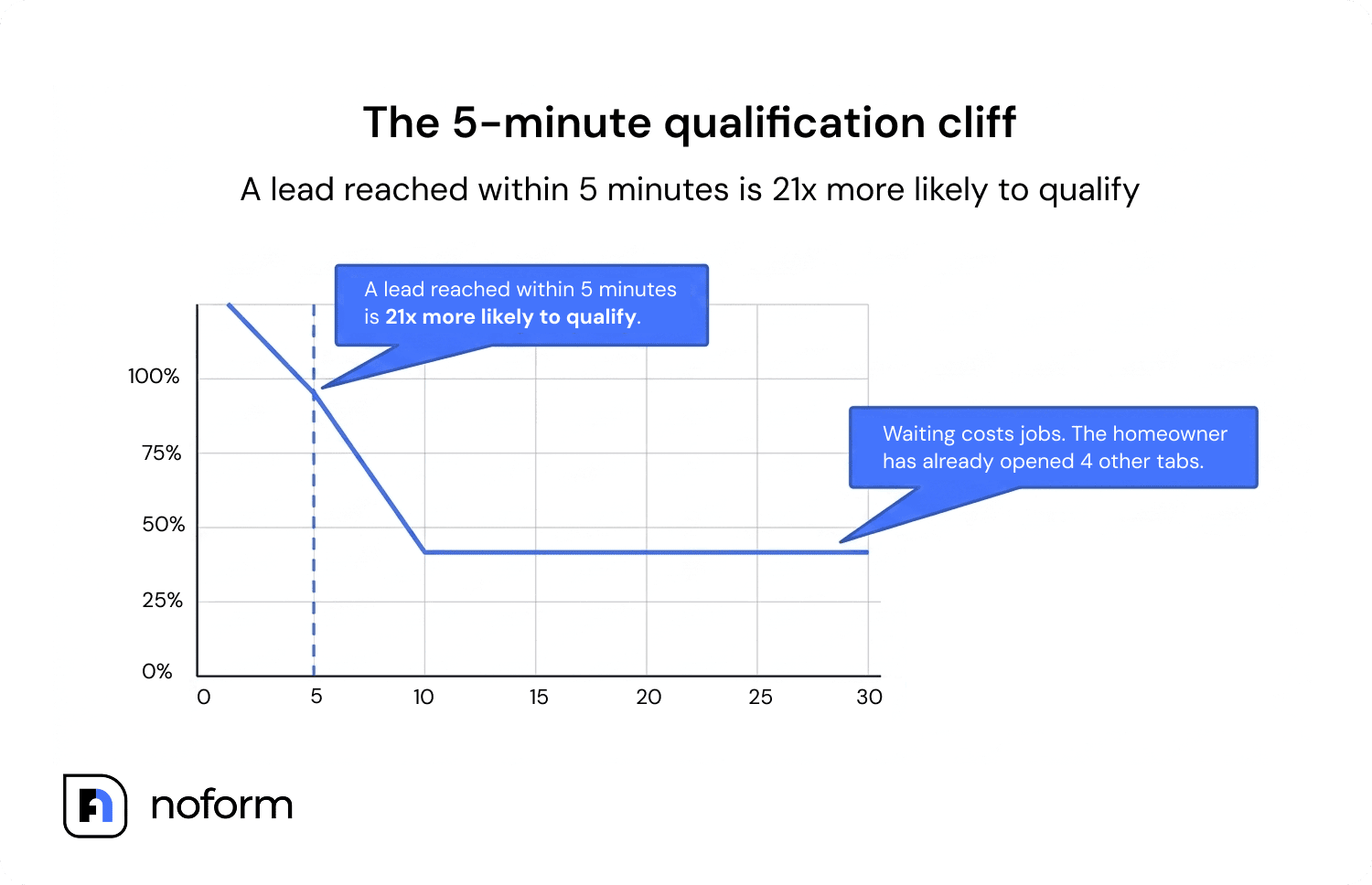
Hitting a five-minute response window during business hours is doable with a motivated team. Hitting it at 11 PM on a Saturday, right after a storm, when three other contractors just got the same form submission, is a different problem — one only automation reliably solves. LinkedIn-sourced research suggests AI-assisted follow-up can shave about a week off the average sales cycle, simply by cutting the wait.
Every roofing lead is worth more when someone can respond to it while the homeowner is still comparing contractors, not after they’ve already booked one.
8 proven ways to generate roofing leads in 2026
None of these channels are new. The fine print behind each one has changed, and so has the gap between contractors getting real results and the ones just checking a box.
1. Google Business Profile and the Local Map Pack
Ranking in Google’s map results remains one of the highest-return channels available, mostly because it costs nothing but time. Most homeowners never type a company name into Google — they search “roof repair near me,” and the map pack (the cluster of business listings and pins above the regular results) loads before a single website does.
Getting into that map pack comes down to a few basics:
- Fill out every field in your Google Business Profile.
- Choose the correct service categories.
- Keep your hours accurate and add real service areas.
- Upload new project photos on a regular schedule, not just once at setup.
Reviews matter more than almost anything else here, and timing is everything. Ask right after the final walkthrough, while the homeowner is still standing in front of a finished roof, not three weeks later in an invoice email nobody reads closely. Then put those reviews, along with before-and-after photos and certifications, on the website itself, so a visitor sees the same trust signal twice.
2. Local SEO built around real homeowner questions
Local SEO keeps paying off long after the work is done, which separates it from every paid channel on this list. Rankings don’t switch off the moment you stop spending.
The bar has moved, though. A handful of near-identical city pages with the town name swapped out doesn’t do much anymore; Google has gotten better at recognizing thin, duplicated content for what it is. What still works is content built around the specific questions homeowners ask before they hire someone:
- what a roof replacement runs in a given city,
- whether insurance covers hail damage,
- how asphalt and metal compare in a storm-heavy climate.
Answer those well, tied to a real location with real project photos, and the authority compounds in a way a templated page never will.
3. Google Local Services Ads
Local Services Ads run on a pay-per-lead model instead of pay-per-click: you’re charged when a homeowner calls through the ad, not for a click, which makes budgeting more predictable. Industry benchmarks put close rates around 20% to 30%, and the leads tend to skew toward people already comparing quotes rather than casual browsers.
Getting the most out of this channel means finishing Google Guaranteed verification (Google’s background and license check for contractors) and responding to every inquiry fast. That’s not optional advice — Google’s own ranking within Local Services Ads factors in response rate, so a slow team loses future visibility, not just one lead.
4. Referral programs you actually run
Ask most roofing companies where their best customers come from, and you’ll hear “word of mouth” almost every time. Left to chance, referrals stay occasional instead of predictable.
Asking right at the moment of peak satisfaction, not three weeks later buried in an invoice email, and backing that ask with a real incentive (a cash bonus, a service credit, a donation in the customer’s name) changes the math. Close rates on referral leads run high, often cited in the 30% to 50% range, well above most cold channels. Removing friction on the referring side matters just as much: a QR code or a one-click link beats asking someone to “just tell your friends.”
5. Meta (Facebook and Instagram) Ads
Nobody scrolls Instagram because they suddenly decided they need a new roof. Meta earns its budget by reaching homeowners right before or after a major weather event, and by reminding people who already visited your site to come back.
Storm-damage awareness campaigns targeted by ZIP code, paired with an in-app lead form, put you in front of a homeowner before they’ve opened a search engine at all. Retargeting previous visitors tends to outperform cold prospecting here, since you’re reminding someone who’s already shown interest. Photos and short video of finished work do more than any promotional graphic will.
6. Direct mail and storm-targeted mailers
Direct mail hasn’t faded in this trade the way it has in most others. Response rates on well-targeted mail — aging roofs, neighborhoods that took storm damage recently — can run several times higher than a typical cold email, and cost per lead stays low since there’s no click to bid on.
Targeting matters more than the creative. A postcard sent to an entire ZIP code performs worse than one sent to homes with roofs old enough to need attention, or streets where you already completed a job last month.
7. Door-to-door canvassing and job-site signage
Under normal conditions, canvassing converts about one appointment for every ten to fifteen doors. After a hail or wind event, that rate climbs sharply. The pitch that works isn’t really a pitch: mentioning the neighbor’s roof you just finished, then offering a free look while you’re already in the area, lands better than a cold script ever will.
A yard sign at a job already underway stretches that same effort further at almost no added cost.
8. Real-time website engagement
This is the channel most roofing companies skip, and it’s the one the rest of this guide focuses on. Every channel above sends a homeowner to your website. The next sixty seconds decide whether that visit turns into a roofing lead or just a closed tab.
How the 8 channels compare
Channel | Speed to results | Cost | Long-term ROI |
Google Business Profile | Fast | Low | High |
Local SEO | Slow | Medium | Very High |
Local Services Ads | Fast | High | Medium |
Referral Program | Medium | Low | High |
Meta Ads | Fast | Medium | Medium |
Direct Mail | Medium | Medium | Medium |
Door-to-Door Canvassing | Medium | Low | Medium |
Website / Real-Time Chat | Immediate | Low | Very High |
Why your website is the biggest opportunity for more roofing sales leads
The clearest pattern in the data isn’t a marketing problem. Most of the sites we reviewed were already spending real money on Google ads, Meta campaigns, and lead services. The gap shows up after the click, on a page that goes silent the moment someone wants to ask a question.
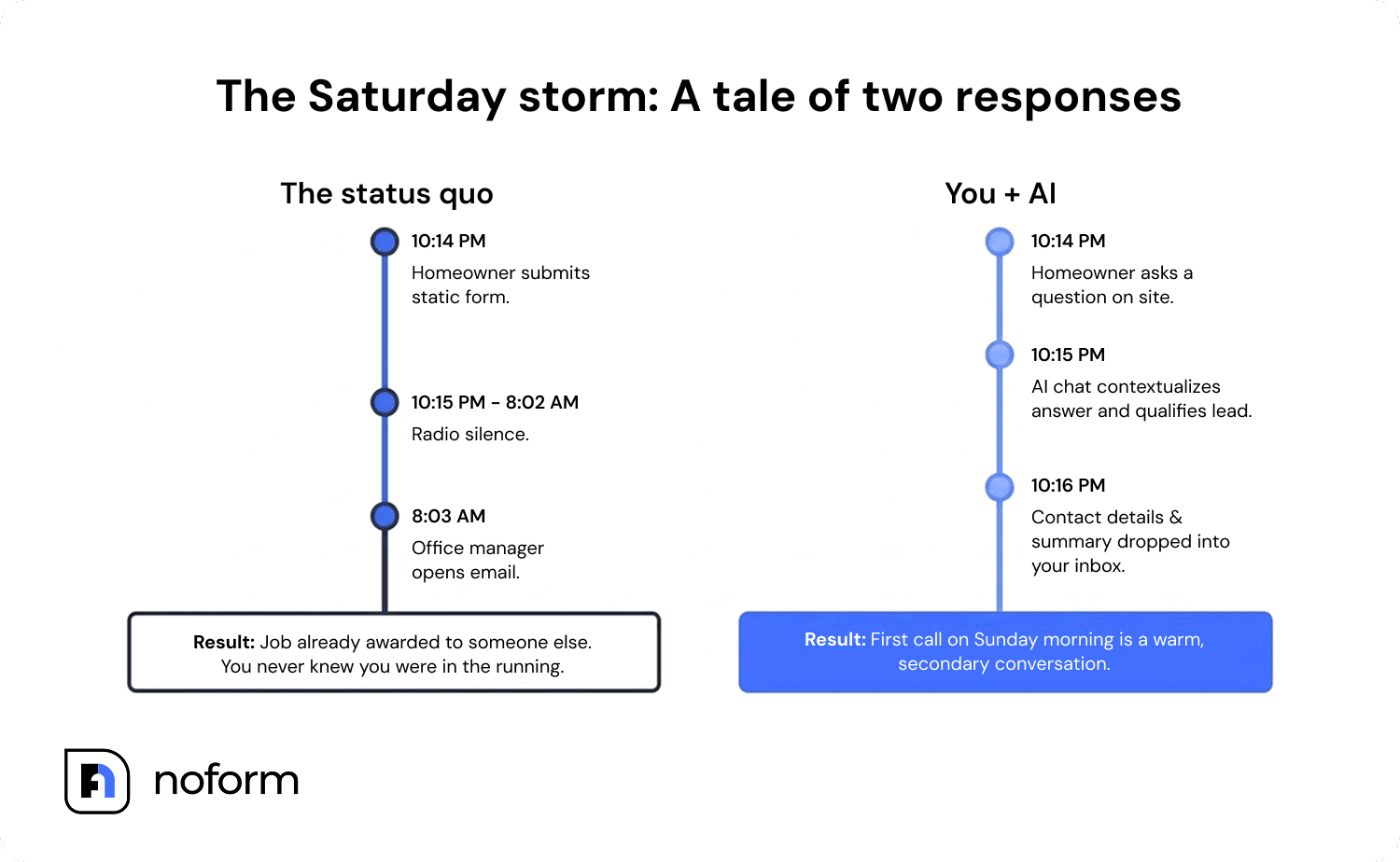
Roofing demand doesn’t run on business hours. Storm damage gets noticed at night and on weekends, exactly when most of the sites we tested go dark. Picture a visitor submitting a form at 10:14 PM. A competitor’s AI chat responds by 10:15. Your team opens the form at 8:03 the next morning. The job is already gone, and you never knew you were in the running.
This is also why the regional gap matters. In markets where AI chat adoption sits near zero, one roofing company turning it on today could be the only business in the area offering an instant, always-on response. That edge won’t last forever, but right now it’s still wide open.
Before increasing next month’s ad spend, it’s worth checking something simpler: how many people are already landing on your site and leaving without ever speaking to anyone.
See what an always-on AI assistant looks like on a roofing site
One way companies are closing this gap is with AI sales assistants such as NoForm AI, built for exactly this problem.
Point it at your existing website, and it trains on your own content: services, service areas, financing and insurance answers, FAQs. From there, it talks to visitors in real time, answers what they’re asking, and flags the conversation as a qualified lead the moment someone shares an email address or phone number, at 11 PM on a Sunday as reliably as at 11 AM on a Tuesday. Your team gets an email with the contact details, the visitor’s location, and a short AI-generated summary of what the homeowner needs, so the first call back is a second conversation instead of a cold one.
Setup doesn’t require a developer or a rebuild of your site. Enter your URL, let it train on your existing pages, adjust the design to match your brand, and go live. Set up your AI assistant today.
The same fundamentals apply if you’re searching more broadly for how to get contractor leads, not just roofing-specific ones. NoForm AI works the same way for HVAC companies, plumbers, and other home service businesses that run into the identical after-hours gap.
Putting your roofing lead generation strategy together
After going through 1,040 roofing websites, one thing stood out. The companies generating the most leads aren’t always the ones spending the most. They’re the ones that make it easiest for a homeowner to take the next step.
Each channel above does a different job. Google Business Profile captures homeowners ready to hire today. Local SEO builds visibility that keeps working after you stop paying for it. Local Services Ads and paid social create demand on command. Referrals bring in leads that already trust you. Direct mail and canvassing keep working in neighborhoods that just took storm damage. And your website decides whether all of that spend turns into a booked inspection.
The mistake is hunting for one “best” channel. More traffic pointed at a site with a weak conversion rate just means paying to lose leads faster. Fix what happens after the click first, and every dollar spent on the channels above starts working harder.
The future of roofing lead generation
Roofing marketing gets more competitive every year. More companies are investing in SEO. More contractors are running paid ads. More businesses are chasing the same homeowners.
That makes differentiation matter more, not less. The next real advantage in this industry won’t just be who ranks first in Google. It will be who gives homeowners the best experience after they click. Right now, with 84.8% of roofing websites offering no live chat and only 3.7% using AI to talk with visitors, that opportunity is still wide open. It won’t stay that way. As more contractors adopt conversational AI and tighten response times, homeowners will start expecting instant answers everywhere, not just from the few companies offering it today. The contractors who turn on real-time chat now get a head start most of their competitors won’t have for another year or two.
Frequently Asked Questions
What’s the best way to get roofing leads?
There isn’t one single best way. The roofing companies with the steadiest pipelines run several channels at once, typically Google Business Profile, local SEO, Local Services Ads, a referral program, and a website that responds to visitors right away instead of asking them to wait for a callback.
How do I get more roofing leads without raising my budget?
Start with conversion, not spend. Most roofing sites convert a small share of the traffic they already have. Improving that rate, through faster response times, a clearer mobile experience, and real answers instead of a static form, often produces more leads than adding another dollar to your ad account.
How do I get leads for roofing without buying them from a marketplace?
Build owned channels that compound: an optimized Google Business Profile, a structured referral program with a real incentive, and content on your own site that answers what homeowners are already searching. None of these are free in terms of time, but none carry a per-lead price tag the way purchased leads do.
How do I find roofing leads outside of paid ads?
Referrals, Google Business Profile, and organic local SEO all generate leads without paying per click. Direct mail and door-to-door canvassing, especially after storm events, also work well and don’t depend on ad auctions at all.
What counts as a qualified roofing lead?
A conversation counts as a qualified roofing lead the moment a visitor shares an email address or a phone number. That’s the technical trigger many lead-qualification tools use, including NoForm AI. That’s a concrete action you can verify, not a guess or a score assigned by an algorithm.
How much do roofing sales leads typically cost?
Cost varies a lot by channel. Local Services Ads run on a pay-per-lead basis, shared lead marketplaces tend to be cheaper upfront but convert at a lower rate, and self-generated leads from SEO, referrals, or your own website cost more time initially but convert noticeably better over the long run.
Do these tactics work for other kinds of contractor leads?
Yes. The channels and the response-time math in this guide apply to most home service trades, not just roofing. HVAC companies, plumbers, and other contractors chasing this same question, how to get contractor leads more broadly, run into the identical gap: plenty of traffic, not enough conversation after the click.