
What are chatbots and how do they work?
Chatbots are software programs that interact with users through text (or voice) to answer questions, guide decisions, and handle everyday customer inquiries.
You’ve seen them: on websites, inside apps, even in smart home devices. They sit between your business and the user, handling customer service and reducing pressure on support teams.
At a basic level, a chatbot takes user prompts, processes them, and returns a response. Sounds straightforward, right? The real difference (and the reason the chatbot vs conversational AI debate exists) comes down to how smart that response actually is.
There are two main types of chatbots used across business operations today:
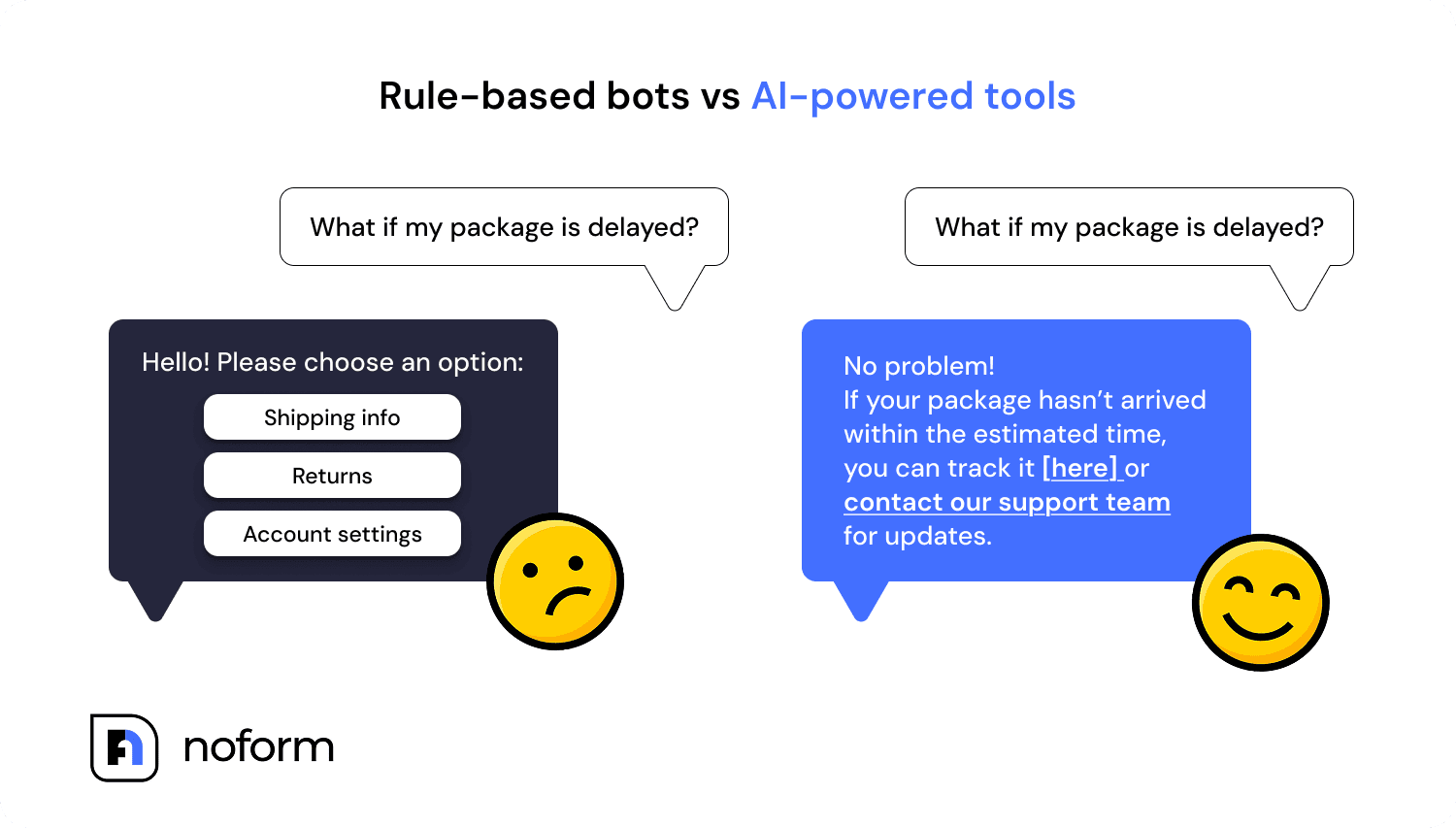
- Rule-based chatbots: These follow predefined decision trees and structured conversation flows. They match user queries to set responses stored in a knowledge base. If the input fits the script, they work well. If not, things get awkward fast.

Example: You ask a shipping chatbot, “Where’s my order?” It replies with buttons like “Track order” or “Contact support.” Click the right path, and you’re fine. Ask, “Why is it delayed again?” and it loops back to the same options. |
- AI-powered chatbots: These rely on Artificial Intelligence, including natural language processing, machine learning, and deep learning algorithms. They interpret user intent, adapt to context, and improve with training data. This is where conversational chatbots, AI assistants, and virtual assistants start to overlap.
Example: You type, “I ordered shoes a few days ago but want to send them back. Am I still within the return window?” The system understands the request, explains the return policy in plain terms, and guides you on what to do next without forcing you through preset options. |
👉🏻 Want a deeper breakdown of chatbot types, along with their pros, cons, and real-world use cases? Check out our article about different types of chatbots.
Before we go further, a quick note on terminology. To keep things clear, we’ll use “traditional chatbots” for rule-based systems and “conversational AI” for intelligent, learning systems. In discussions around conversational AI vs chatbot differences, you might also see terms like conversational chatbots or AI chatbot solutions. They’re referring to the same thing.
What is conversational AI, and what powers it?
Now that we’ve separated basic chatbots from smarter automated messaging systems, the next step is understanding what actually powers the latter.
Conversational AI is a set of AI technologies that allows machines to understand, process, and respond to human language in a natural, flexible way. Instead of following rigid scripts, it interprets meaning, handles variation in phrasing, and adjusts responses based on context.
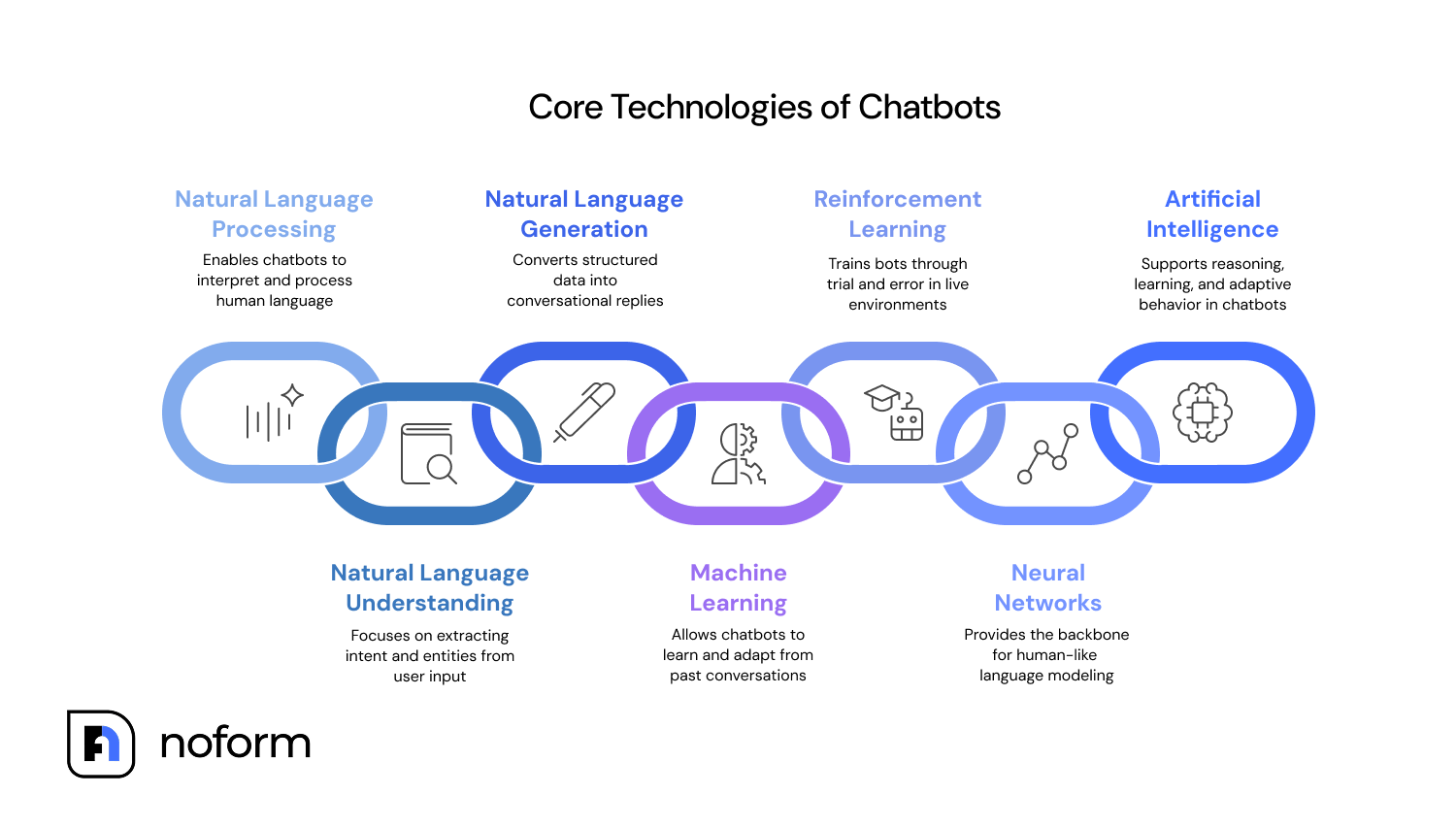
Under the hood, several technologies work together to make that possible:
- Natural language processing (NLP): Breaks down language, identifies intent, and makes sense of how people actually write or speak—not how systems expect them to.
- Machine learning and deep learning: Using training data and deep learning algorithms, the system improves over time, learning from past interactions instead of relying only on predefined rules.
- Contextual awareness: Keeps track of conversation history, so responses stay relevant across multiple messages instead of resetting after each input.
- Sentiment analysis and Emotional Intelligence: Detects tone (frustration, urgency, hesitation) and adjusts responses accordingly, which directly impacts customer experience and customer satisfaction.
- Generative artificial intelligence: Enables the system to produce responses dynamically, rather than pulling from a fixed set of answers. This is what makes interactions feel less scripted and more human.
👉🏻Learn more about how chatbots work in our guide that breaks it down step-by-step, technology-by-technology.
Key differences: Chatbots vs conversational AI
Now that the definitions are clear, the real question is how these systems perform side by side. This is where the chatbot vs conversational AI differences become obvious—and where most business decisions are made.
Technology & intelligence
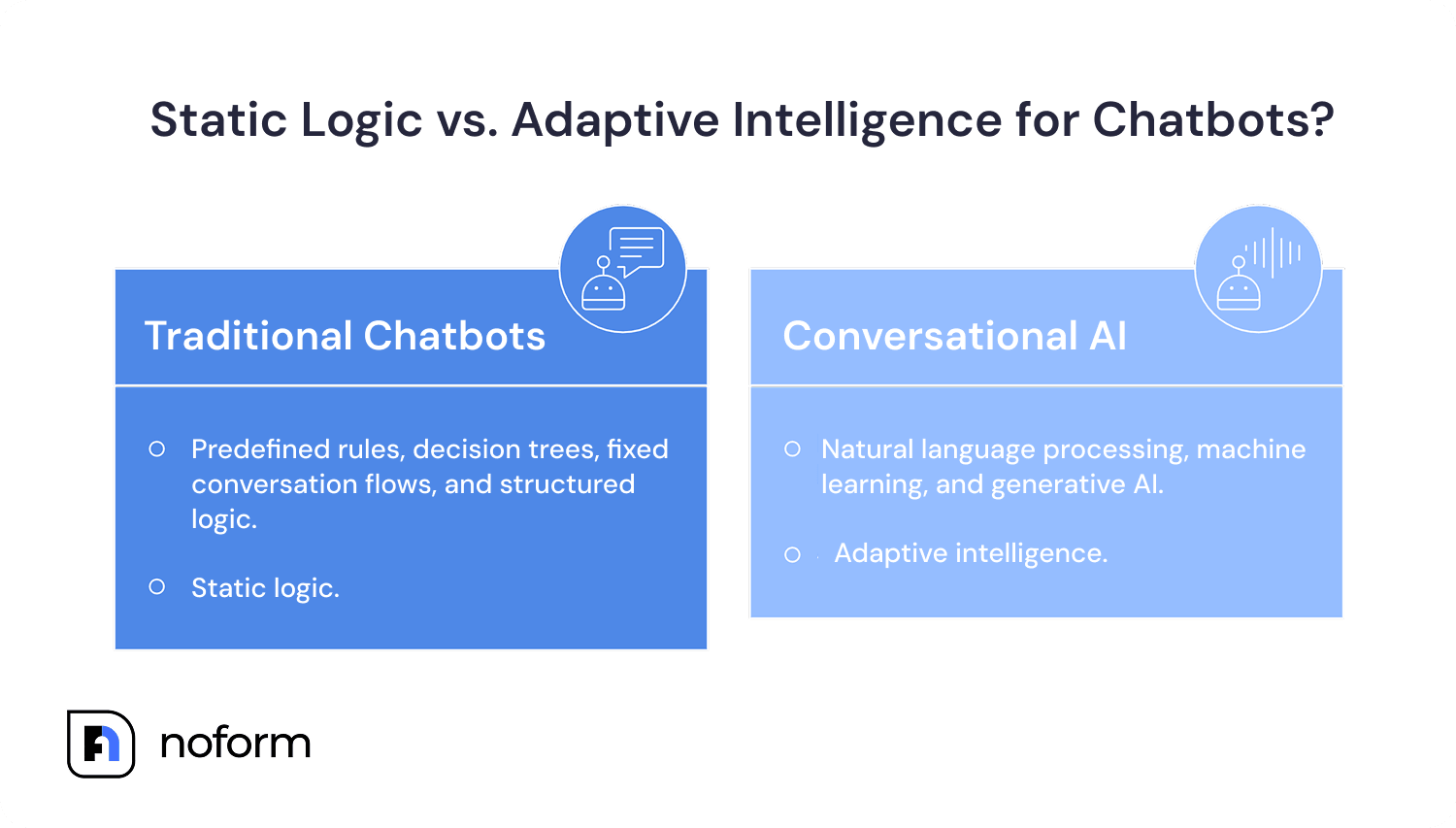
Traditional chatbots run on predefined rules, like decision trees, fixed conversation flows, and structured logic. They match inputs to expected outputs, nothing more.
Conversational AI operates on natural language processing, machine learning, and generative AI. It interprets intent, processes unstructured input, and generates responses dynamically.
This is the core divide in chatbot vs. conversational AI: static logic versus adaptive intelligence.
Flexibility & adaptability
Rule-based chatbots don’t evolve unless someone updates them. Every new scenario requires manual input, which slows down iteration and limits scalability.
Conversational AI improves over time. With more user interactions and training data, it adapts to new phrasing, edge cases, and behaviors without constant intervention.
Context understanding
Chatbots treat each query as a standalone request. Ask a follow-up question, and the system often resets, missing the connection.
Conversational AI uses contextual awareness to track conversation history. It understands references, follow-ups, and intent across multiple turns—making interactions feel continuous rather than fragmented.
Use case complexity
Use case complexity is where the gap in conversational AI vs. chatbot becomes operational, not theoretical:
- Traditional chatbots are best suited for structured tasks, like FAQs, simple transactions, appointment booking, and basic customer inquiries.
- Conversational AI handles layered interactions: complex queries, personalized recommendations, and nuanced customer support scenarios where intent isn’t always explicit.
User experience & conversions
With chatbots, interactions tend to feel rigid. Users follow predefined paths, which can lead to friction and drop-offs when expectations aren’t met.
Conversational AI creates a more natural flow. It adjusts responses in real time, improves customer engagement, and supports higher-quality lead generation by keeping users in the conversation longer.
Lead qualification
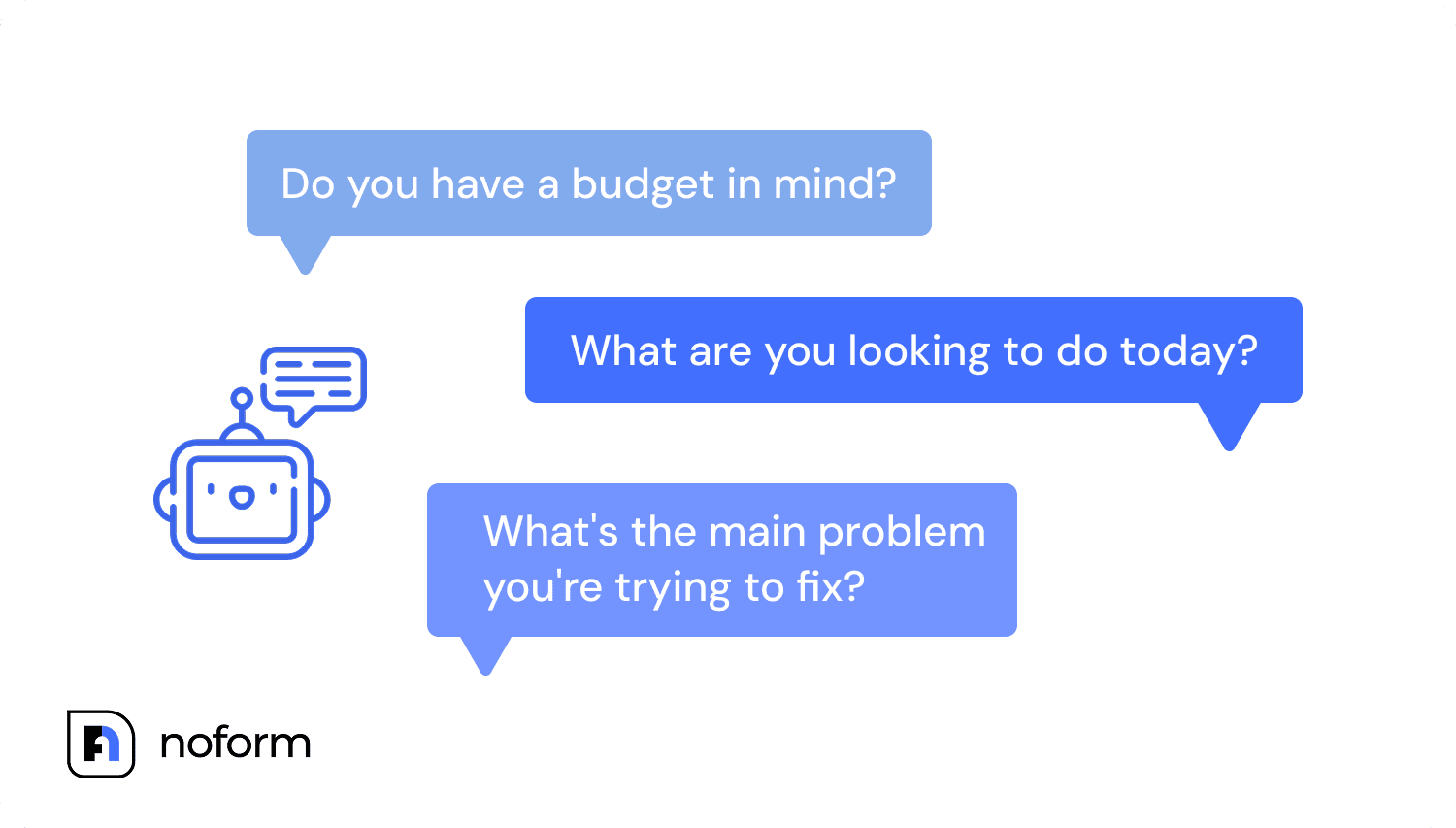
Chatbots typically rely on static forms or scripted question sequences to collect information.
Conversational AI approaches this differently. It qualifies leads through dialogue, gathers data conversationally, and adapts follow-up questions based on responses—resulting in stronger client engagement and more accurate qualification.
Implementation & cost
Chatbots are faster to deploy and more affordable upfront. Many chatbot frameworks allow quick setup with minimal technical overhead.
Conversational AI requires a higher initial investment. Both in technology and setup.
However, when comparing conversational AI platforms vs. chatbot platforms, the added capabilities often offset the cost through improved efficiency, automation, and conversion rates.
Chatbot vs conversational AI: At-a-glance comparison
Aspect | Traditional chatbots | Conversational AI |
Technology | Rule-based logic, decision trees | NLP, ML, generative AI |
Adaptability | Static, manual updates required | Learns and improves continuously |
Context handling | Limited to a single query | Tracks conversation context |
Use cases | FAQs, simple tasks | Complex queries, personalized support |
User experience | Structured, sometimes rigid | Natural, dynamic interactions |
Lead qualification | Forms, scripted flows | Conversational, adaptive qualification |
Implementation | Lower cost, faster setup | Higher investment, greater capability |
Learning ability | No learning | Continuous improvement |
Multilingual support | Limited, manual translation required |
Why conversational AI outperforms traditional chatbots
The comparison table shows the technical differences, but here’s what this means for your business outcomes. At the end of the day, the gap between conversational AI vs. chatbot shows up quickly once these systems are put into real workflows!
It meets modern customer expectations
Customer expectations have shifted. People don’t want to “figure out” how to talk to a bot; they expect it to understand them instantly.
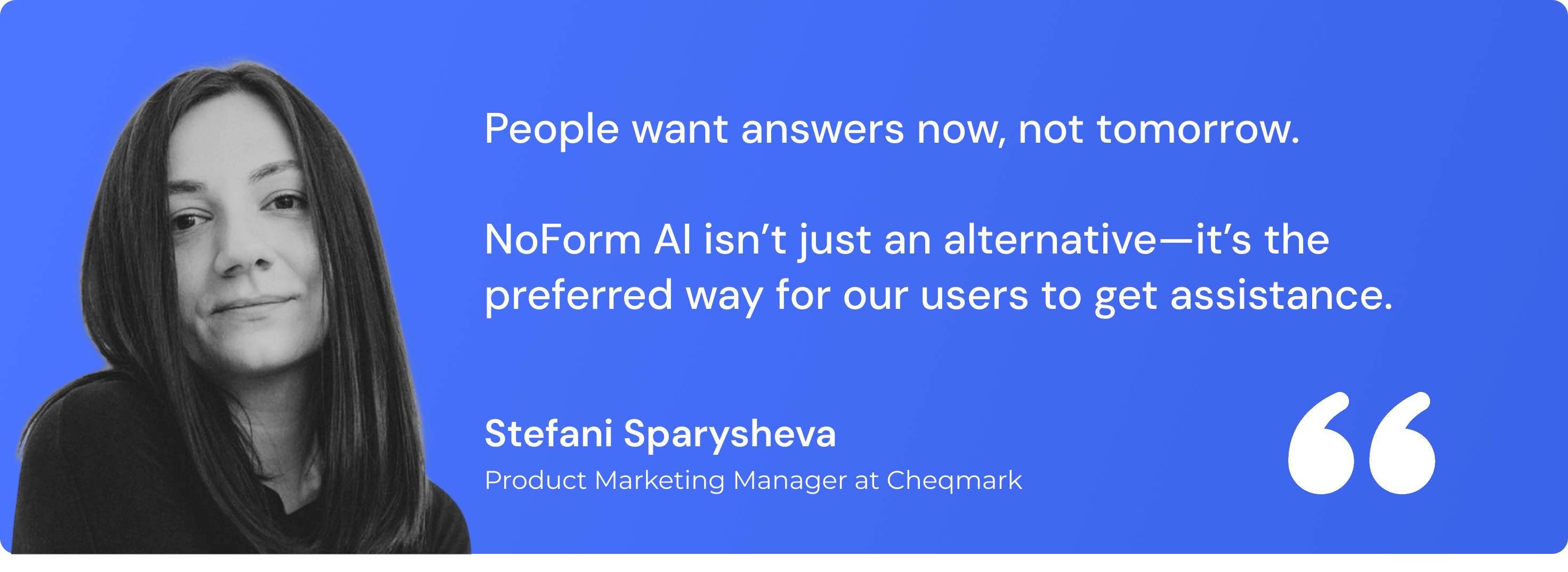
Data backs this up: 82% of consumers are willing to try a chatbot instead of waiting for a human agent, and 96% believe companies should use AI agents or chatbots in place of traditional support models.
The catch? They expect it to work.
Traditional chatbots rely on exact phrasing and predefined paths. Miss the keyword, and the experience breaks—this is where drop-offs happen.
Conversational AI handles varied languages, recognizes intent, and keeps interactions moving, resulting in a stronger customer experience and higher customer satisfaction.
It reduces support costs without sacrificing quality
Let’s face it: modern support teams (always on, fast, and accurate) are expensive to scale. Traditional chatbots help, but only at the surface level.
They handle simple queries, while anything outside predefined paths gets pushed to human agents. Conversational AI takes on a broader range of customer inquiries, reducing the volume of support requests that require escalation.
That shift lowers costs and frees teams to focus on complex cases where human judgment actually matters—creating a more efficient support organization without cutting corners.
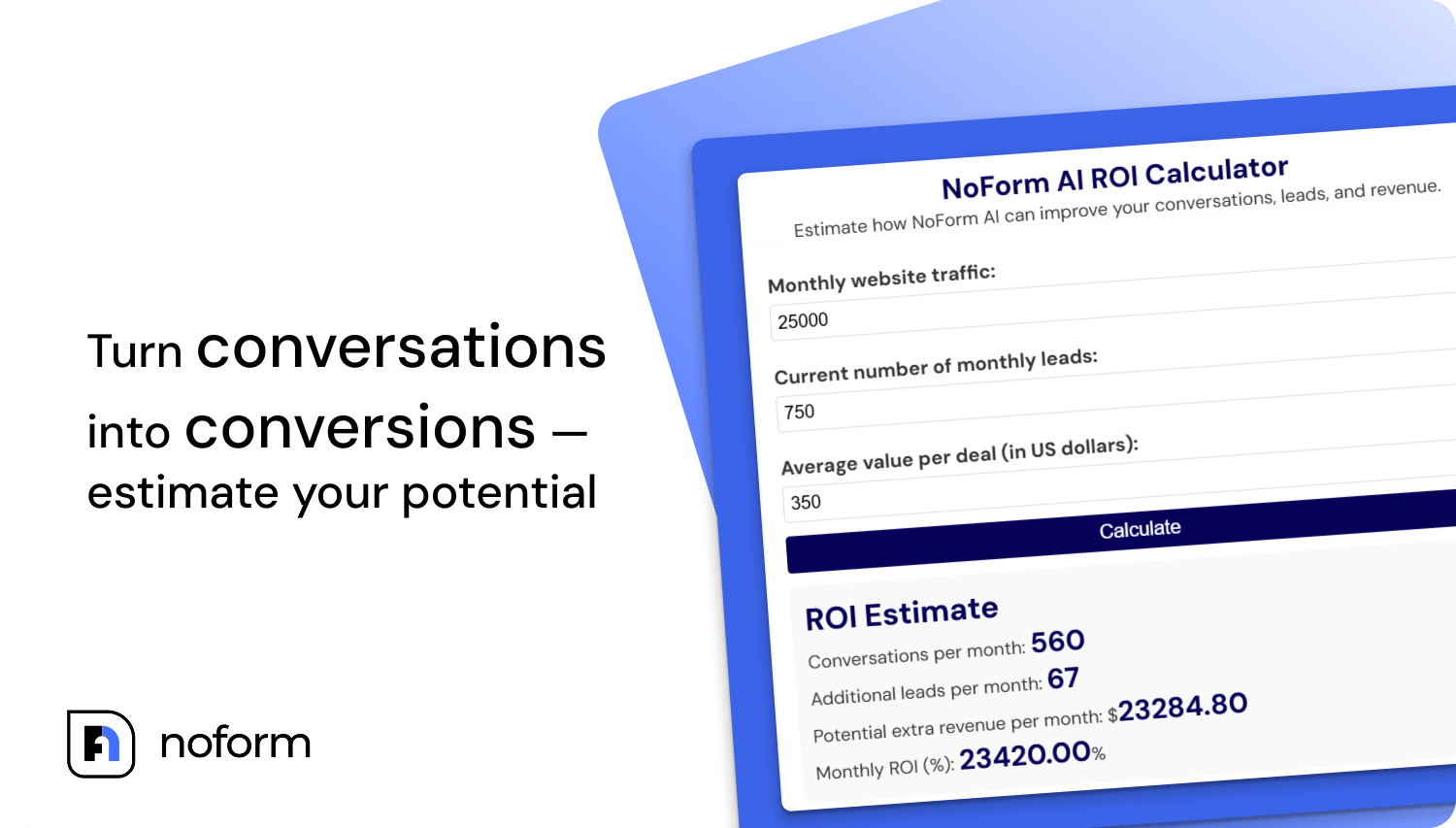
👉🏻 Estimate how an AI bot can improve your conversions, leads, and revenue with our AI chatbot ROI calculator.
It generates better-quality leads, not just more volume
Capturing emails isn’t the same as generating leads that convert.
Traditional chatbots typically collect basic contact details through static flows. There’s little understanding of who the user is or what they actually want.
Conversational AI approaches lead generation differently. It interprets intent, asks relevant follow-up questions, and adapts the conversation in real time. That leads to better qualification and stronger customer engagement.
The impact is measurable: 55% of companies using chatbots report an increase in high-quality leads.
It enables global reach without global hiring
Before conversational AI, expanding into new markets used to mean hiring native-speaking support teams for every region.
AI bots remove that bottleneck. Conversational AI can handle multilingual conversations at scale, making global customer support and client engagement feasible without building large, distributed teams.
For growing companies, this shifts international expansion from a resource-heavy project to a manageable step.
It turns conversations into actionable business data
Finally, handling conversations is only part of the equation. The real value comes from what you can do with them.
Conversational AI connects with CRMs, analytics tools, and internal systems. It enriches lead profiles with conversation context, tracks patterns across user interactions, and surfaces insights teams can act on.
Instead of isolated chats, you get structured data that feeds into product management, marketing, and sales—turning conversations into decisions.
When should you use a traditional chatbot vs conversational AI?
Conversational AI clearly outperforms across most parameters, but it’s not the right fit for every scenario. In quite a lot of cases, traditional chatbots are still more than enough.
Choose traditional chatbots if:
- You handle repetitive FAQs (hours, policies, basic pricing)
- Your workflows are fixed (appointment booking, simple forms)
- You need a fast, low-cost deployment
- Your support requests are predictable and structured
✅ Benefits of traditional chatbots | ❌ Limitations of traditional chatbots |
|
|
Ideal if: Your use cases are simple, predictable, and stable.
Choose conversational AI if:
- You need intelligent lead generation and qualification
- You offer personalized recommendations
- Your product requires onboarding or guidance (e.g., SaaS)
- You support multiple languages at scale
- You manage high-volume customer support
- You deal with complex or open-ended questions
It’s also a strong fit for promotions. 38% of consumers expect brands to use AI chatbots for deals, coupons, and similar offers, where conversational systems handle nuance better than scripted flows.
✅ Benefits of conversational AI | ❌ Limitations of conversational AI |
|
|
Ideal if: Personalization is critical, queries are complex, and reducing manual workload is a priority — especially in industries that require nuance, such as SaaS, healthcare, finance, and e-commerce.
NoForm AI: Conversational AI built for business results
Until recently, adopting conversational AI meant high costs and complex setup. Platforms like NoForm change that, making AI chatbot solutions practical for everyday business use.

- 24/7 lead capture without extra cost: NoForm AI runs around the clock, handling inquiries anytime. In the Dog Gone Taxi case, this led to more quote requests and consistent lead flow across time zones—without adding headcount
- Higher-quality leads through context: Using contextual awareness, it understands intent, asks relevant follow-ups, and captures richer data—so sales teams get leads worth pursuing.
- Stronger conversion rates: Better conversations drive results. Dog Gone Taxi saw a 37% lift in visitor-to-lead conversions, while businesses report up to 67% higher sales with AI chatbot-driven workflows.
- Scales with traffic, not costs: Whether traffic spikes or grows steadily, the system handles volume without increasing operational overhead.
- Multi-page awareness: Conversations aren’t isolated. The AI adapts based on user behavior across the site, keeping interactions relevant and focused.
- Integration-ready: Connects with CRM, analytics, and other tools via Zapier, Make, or webhooks—turning conversations into actionable data.
- Reduced workload for support teams: Handles a large share of customer inquiries, lowering the volume of support requests that reach human agents.
Conclusion
Chatbots and conversational AI are closely related. But the difference matters once you put them to work. One follows rules; the other understands, adapts, and drives outcomes.
As expectations rise, businesses need systems that don’t just respond, but convert. That’s where modern solutions like NoForm AI come in—capturing leads, automating workflows, and improving customer experience without adding overhead.
Ready to see it in action? Build your AI chatbot or book a demo to explore what it can do for your business.
Frequently Asked Questions
What is the main difference between a chatbot and conversational AI?
A chatbot follows predefined scripts and decision trees — it can only respond to inputs it was explicitly programmed to handle. Conversational AI uses NLP and machine learning to understand intent, retain context across a conversation, and improve over time. The core distinction is static logic versus adaptive intelligence.
Is Siri a chatbot or conversational AI?
Siri is an example of conversational AI. It uses natural language processing and machine learning to interpret voice commands, handle follow-up questions, and perform actions across the device — capabilities that go far beyond what a rule-based chatbot can do. Most modern virtual assistants (Siri, Google Assistant, Alexa) fall in the conversational AI category.
Can a traditional chatbot become conversational AI?
Not by simply updating its script. Converting a rule-based chatbot into a conversational AI system requires replacing its underlying architecture — from static decision trees to NLP models trained on real conversation data. Some modern platforms offer hybrid approaches, but meaningful conversational ability requires intentional AI infrastructure.
What is the difference between conversational AI and generative AI?
Generative AI is one component within a conversational AI system. Conversational AI is the broader framework — it includes NLP, context tracking, and sentiment analysis.
Generative AI specifically refers to the model’s ability to produce original, dynamic responses rather than pulling from a fixed answer bank. Most modern conversational AI platforms use generative AI as their response engine.
Which industries benefit most from conversational AI?
Retail and e-commerce lead all industries in conversational AI adoption, holding 21.2% of market share, followed by healthcare, finance, and SaaS. Any industry with high customer interaction volume and variable query complexity sees the strongest ROI from conversational AI over rule-based bots.
Is conversational AI better for lead generation than a traditional chatbot?
Yes, significantly. Traditional chatbots collect lead data through static forms, with no ability to adapt based on what a user says. Conversational AI qualifies leads through dialogue — interpreting intent, asking contextual follow-up questions, and enriching lead profiles in real time. Companies using AI chatbot workflows report 55% more high-quality leads and up to 67% higher sales compared to form-driven approaches.
What does it mean for a chatbot to ‘understand context’?
Context understanding means the system remembers what was said earlier in a conversation and uses that information to interpret follow-up messages. A rule-based chatbot treats every message as a fresh, isolated input. A conversational AI system tracks the thread — so if you say “I want to return it” after discussing a recent purchase, the AI knows what “it” refers to without requiring you to restate the item.
How long does it take to implement conversational AI?
Implementation time varies significantly by platform and complexity. No-code conversational AI platforms like NoForm AI can be deployed in minutes. Enterprise-grade implementations with deep CRM integration, custom NLP training, and multilingual support typically take 4–12 weeks. Rule-based chatbots can be deployed faster (days to a week) but require ongoing manual maintenance as chatbot use cases evolve.