
Before we move on to the main article, let’s imagine a scenario. A policyholder calls to report a minor car accident. However, it’s not that simple: first, they wait on hold for about an hour, and then they’re transferred three times. Finally, they fill out a form and email it to a folder that’s unlikely to be checked by anyone before Monday. And several weeks later, they’re still waiting for an update on the case. Sound familiar? For a lot of insurers, that’s just Tuesday.
Every unresolved claim day has a real cost. McKinsey research shows that customer satisfaction drops up to 30% for each additional day a claim remains unresolved. And here’s the competitive pressure that makes this urgent now: policyholders are switching more than they used to. When the barrier to leaving is a five-minute app download, a bad claims experience doesn’t just hurt your NPS – it walks out the door.
Why You Need to Streamline Insurance Claim Processing Today
Most insurers realize that their claims settlement process leaves much to be desired. The question is how bad it is – whether it’s enough to justify radical measures to fix it. Spoiler: It’s almost always so bad that the cost of delay turns out to be higher than most teams realize. And the longer you wait, the more that gap between your operation and customer expectations quietly widens.
The Hidden Cost of Legacy Claims Operations
Legacy systems create problems that stack on each other. It starts at intake – re-keying data, chasing missing documents, fielding “what’s the status?” calls – and compounds from there. Claims handlers end up buried in routine tasks that shouldn’t require human intervention at all, while complex claims that require real judgment sit in the queue.
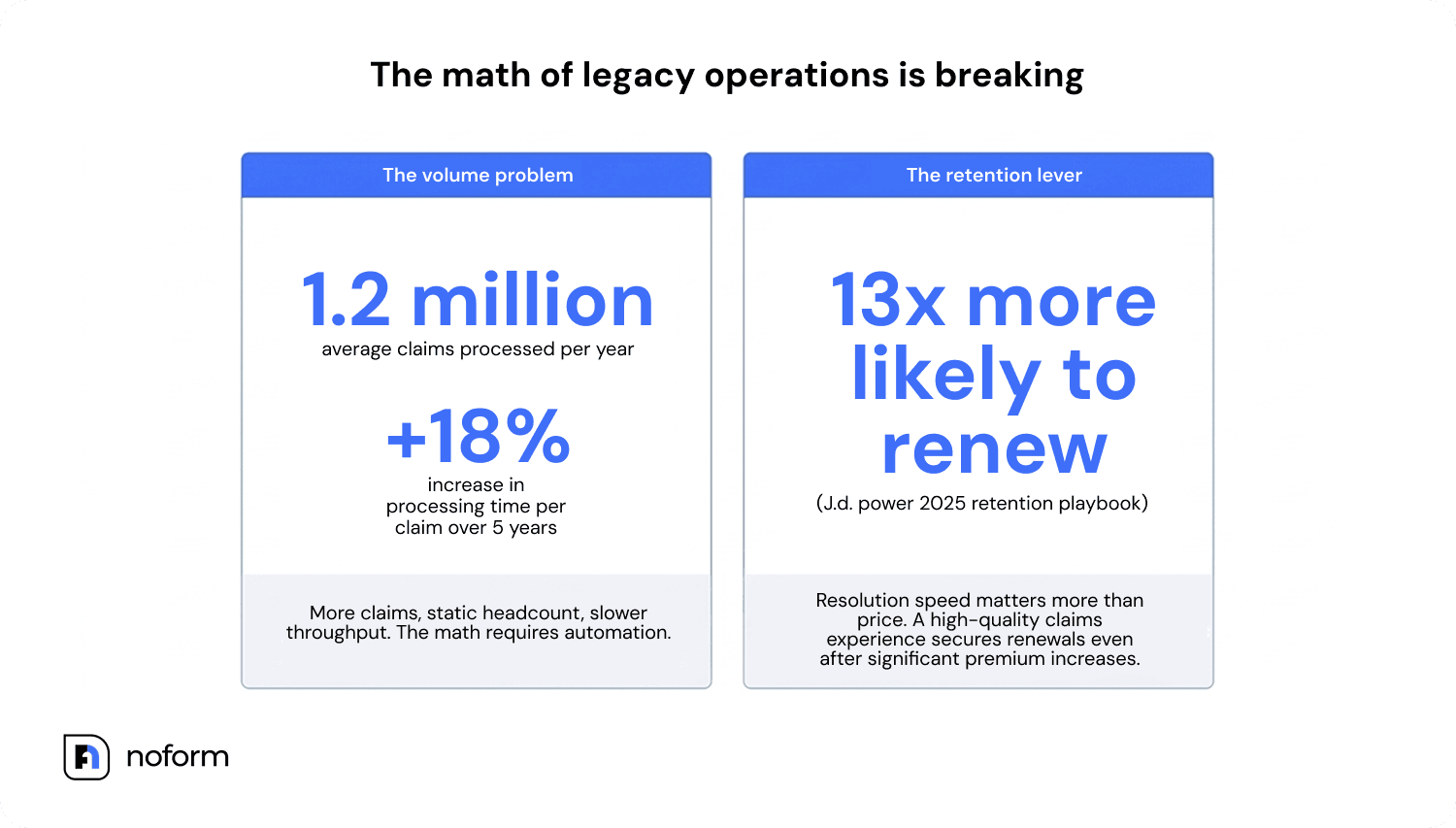
The volume side isn’t getting easier either. Insurance companies process around 1.2 million claims per year on average, and processing time per claim has grown 18% over five years. More claims, same headcount, slower throughput – without automation, that math doesn’t work.
How Claim Resolution Speed Drives Policyholder Loyalty
Here’s something worth putting on the agenda for your next leadership meeting: resolution speed matters more to policyholders than price. According to the 2025 J.D. Power Retention Playbook, a high-quality claims experience makes a customer 13x more likely to renew – even after a significant price increase. Slow claims don’t just create a negative customer experience – they drive churn, bad reviews, and rising acquisition costs that quietly erode margins.
7 Ways to Improve Claims Processing and Service Quality
Some of these can be implemented as early as this quarter. Others require more careful planning. In any case, the point isn’t to tackle all seven items at once, but to identify what’s holding you back the most and address that first. Most teams that have honestly analyzed their situation find the answer in one of the first two points. You may find yourself among them.
# 1 Automate Routine Tasks Starting With Intake
The fastest win in most claims operations is pulling manual work out of the intake phase. Acknowledgement emails, document request follow-ups, basic FAQ responses – these don’t need a claims handler. Process automation handles them in seconds, at scale, without anyone dropping the ball. Digital-first intake also means structured data from the start.
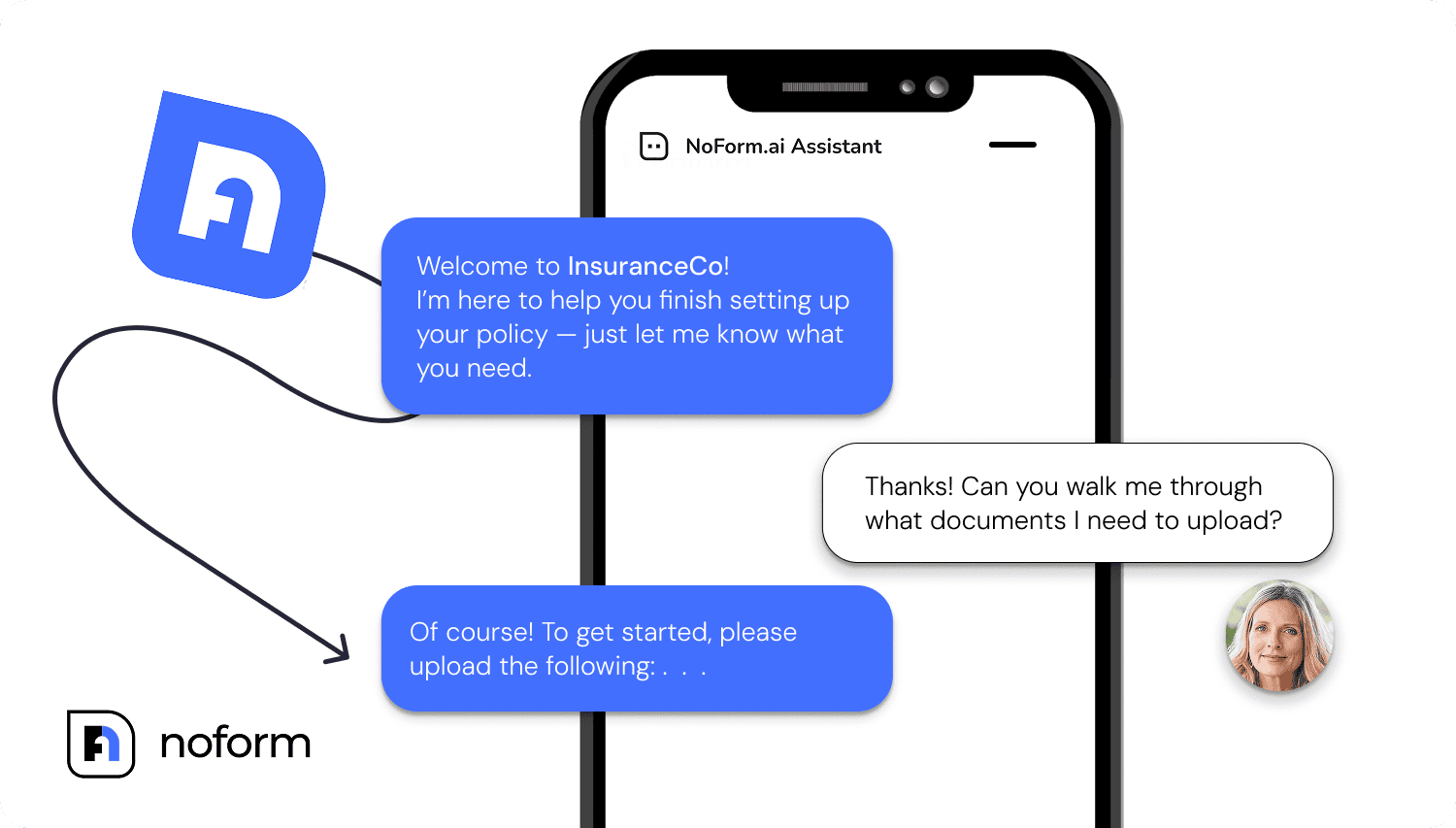
Tools like NoForm AI replace static forms with conversational AI that collects information step by step, validates it in real time, and pushes structured output straight into your claims system – freeing handlers to focus on work that actually requires their judgment. This approach is explained in NoForm AI’s guide to insurance claims chatbots, including 24/7 FNOL intake and human handoff.
# 2 Digitize FNOL to Remove the First Bottleneck
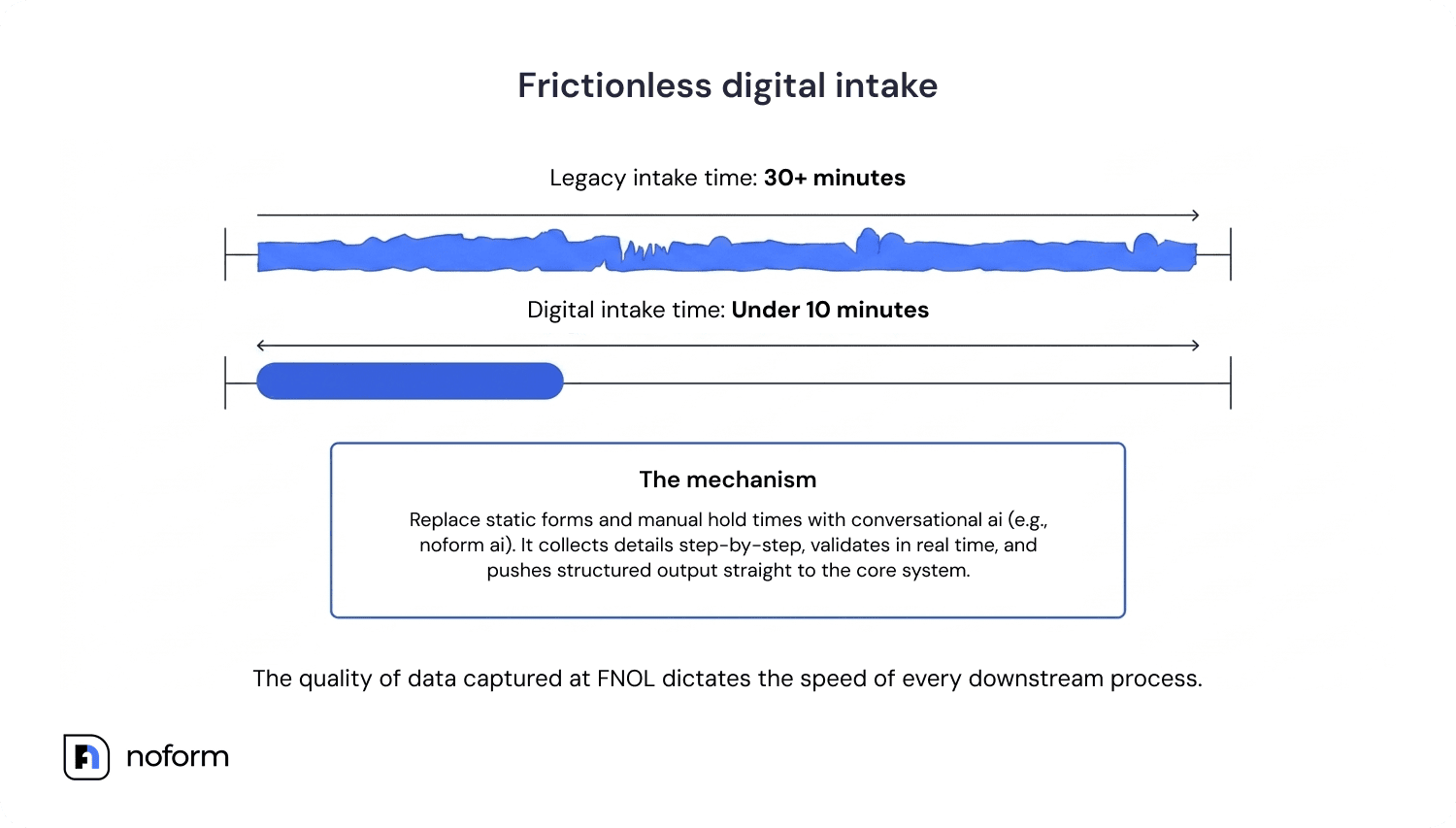
First Notice of Loss is where claims go sideways, or don’t. The quality of data you capture at FNOL dictates how clean everything downstream looks. Legacy FNOL (business-hours calls with agents writing notes by hand) creates missing fields, delays triage, and frustrates claimants before the process even really begins.
Digital FNOL changes that. Web, mobile, or chat submission means 24/7 intake, no hold times, no incomplete fields. AI-powered FNOL goes further: it collects details conversationally, validates as it goes, and routes automatically. Research shows that digital FNOL reduces intake time from 30+ minutes to under 10 minutes. That’s not a rounding error – it’s a structural improvement in the claims experience at the very first touchpoint.
# 3 Use Claims Data to Identify Where Time Gets Lost
Most insurers have data. Not many use it to run their operations proactively. If you’re not tracking cycle time by claim type, touch time per claim, and reopened claim rates, you’re managing a process you can only half-see. When you know a certain claim type consistently gets reworked, or that three handlers are carrying 70% of your complex volume, you can actually fix it. Routing decisions become data-driven rather than queue-based. That’s the shift that separates reactive case management from genuine claims process improvement.
# 4 Build a Triage System That Matches Complexity to Capability
Not all claims belong in the same queue. A straightforward windshield claim handled by the same workflow as a multi-party liability dispute means someone’s waiting too long, and someone else isn’t getting the attention their case needs. Segment by complexity, dollar value, and fraud risk.
AI triage scores incoming claims in real time, flags potential issues, and automatically assigns each to the right handler. The outcome: better first-touch resolution, less rework, and adjusters doing the work that genuinely needs their expertise – not spending time on claims without real complexity.
# 5 Use AI to Speed Up Assessment Without Removing Adjusters
There’s a lot of noise about AI replacing claims professionals. What actually works is more practical: AI handles data gathering, pattern detection, and summary generation so adjusters walk into every case with context already prepared. NoForm AI generates structured summaries from the initial interaction and delivers them directly to the handler’s dashboard – or to the CRM if it’s connected.
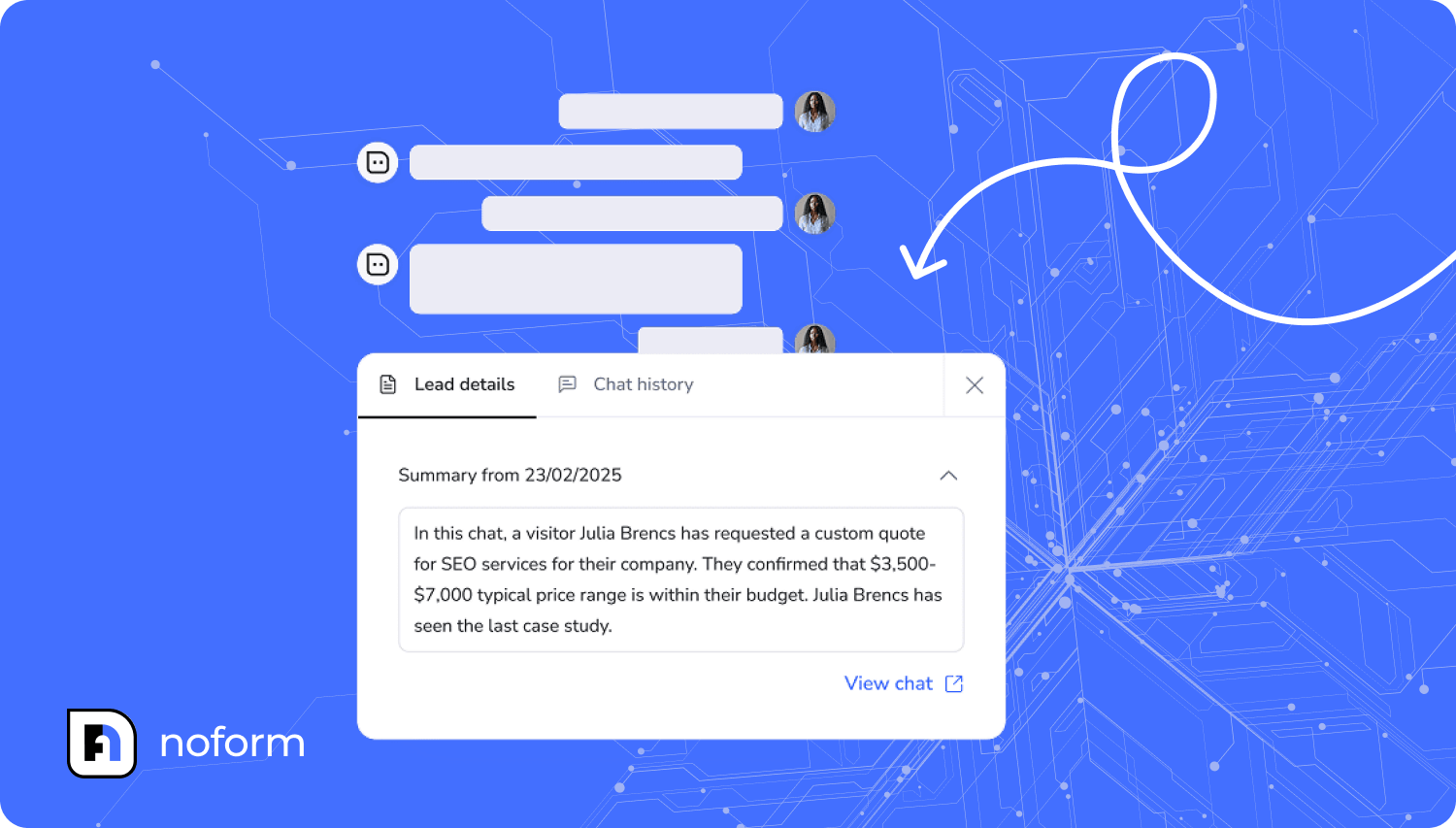
Instead of reading through 30+ messages to understand what happened, the claims handler has the relevant details ready when they open the file. When complexity triggers a handoff, the human agent receives context, not a blank slate. Fraud flagging happens as a natural byproduct of the same process. The adjuster still makes the final call – but they make it faster, with better information.
# 6 Make Communication Proactive, Not Reactive
The top policyholder complaint isn’t the settlement amount – it’s being kept in the dark. Automated milestone notifications solve this without adding headcount: received → under review → adjuster assigned → decision. Each update goes out automatically, each one cutting those “where’s my claim?” calls that drain your team’s time. Self-service status portals and chatbots take this further, letting claimants check in without ever calling. Fewer calls, increased customer satisfaction, no extra resources required.
# 7 Give Adjusters Better Tools, Not More Work
Adjuster capacity is the ceiling on your claims throughput. The way to raise it isn’t hiring more people – it’s removing friction for the ones you have. AI-recommended settlement ranges based on historical data, pre-flagged documents, pre-filled templates, and performance analytics that surface coaching opportunities before they become retention problems.
Better tools produce better outcomes: more successful claims resolved on the first attempt, cost savings from fewer reopened cases, and – this part often gets overlooked – better adjuster retention. High turnover in claims operations is expensive in ways that don’t always show up where you’d expect them.
How to Measure Whether Your Claims Process Is Actually Improving
Many improvement initiatives seem productive during the implementation phase – new tools, new workflows, and kickoff meetings. But six months go by, and no one can say for sure whether anything has actually improved. This is a problem of evaluating results, not of implementation.
What are the key KPIs for improving claims management?
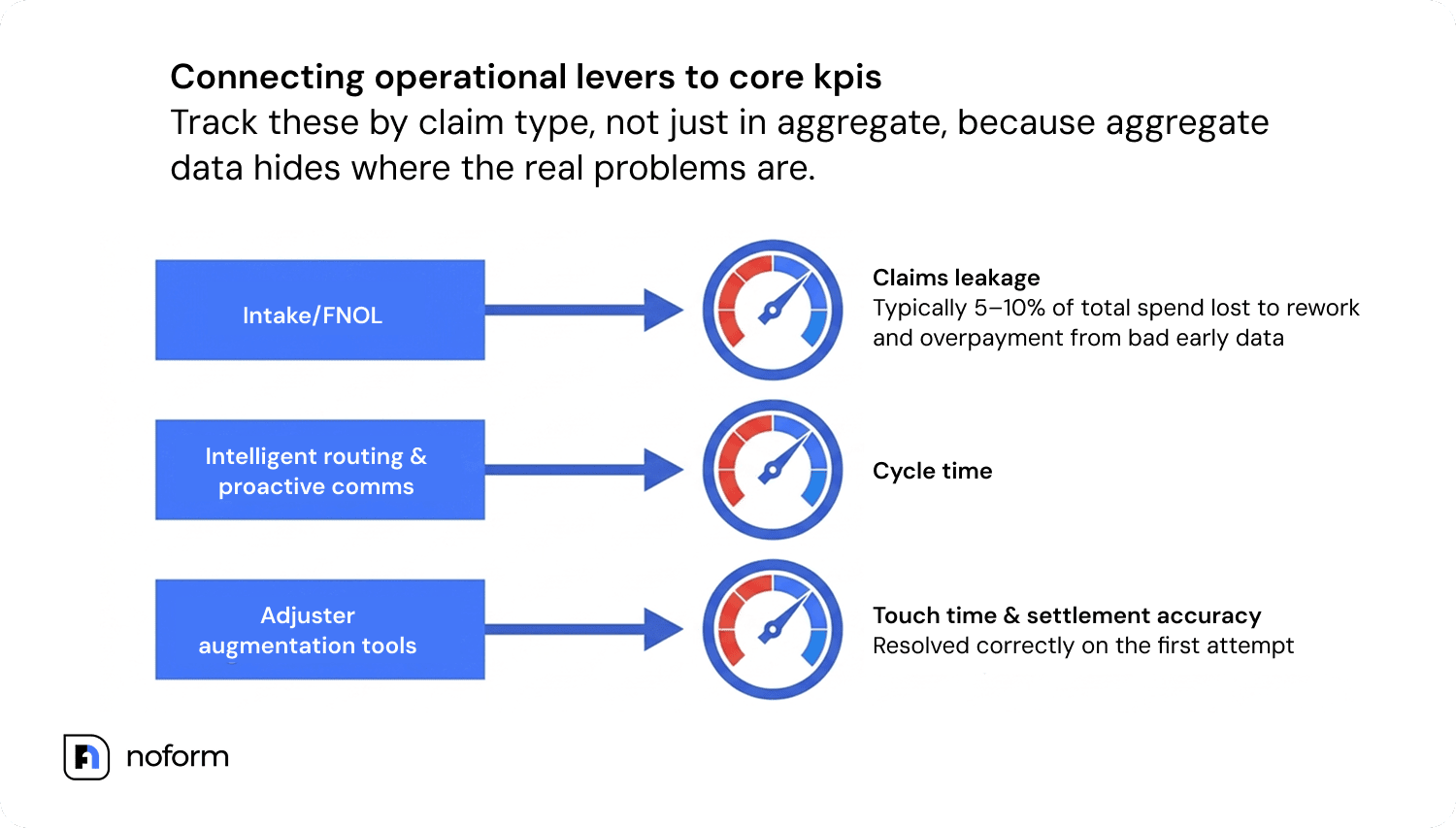
There’s no shortage of metrics you could track. The trick is knowing which ones actually tell you something useful, versus which ones make your reporting look busy. Three metrics tell most of the story:
- Cycle time – days from FNOL to settlement
- Touch time – active handler hours per claim (the efficiency signal most teams ignore)
- Settlement accuracy – percentage of claims resolved correctly on the first attempt
If all three are moving in the right direction quarter over quarter, your claims operations are genuinely improving – not just looking better because volume dipped. Track them by claim type, not just in aggregate, because the aggregate hides where the real problems actually are.
What is claims leakage, and why should you measure it?
Claims leakage – money lost to overpayment, fraud, rework, and inefficiency – typically eats 5–10% of total claims spend. It hides in the gaps between process steps, not on any line item. Capturing clean, structured data at intake is the most effective fix, because leakage almost always traces back to incomplete or inaccurate information from earlier in the process.
What Does the Future of Claims Processing Look Like?
Hybrid. AI handles intake, triage, and routine interactions. Humans handle complex cases that need empathy and real judgment. The goal is effective allocation, not full replacement. NoForm AI automates 24/7 intake and data collection, then hands off seamlessly when the situation calls for a human. That’s the model worth building toward. Insurers evaluating implementation can review how to set up NoForm AI or compare features on the NoForm AI pricing page.
Conclusion
Improving the claims process isn’t a project with a clean finish line. But the seven strategies above give you concrete places to start – from automating intake to building real triage systems to giving adjusters the tools they actually need. The insurers who get this right will have lower costs, better policyholder retention, and handlers doing work they’re genuinely good at.
Ready to see what better intake looks like? Book a demo call or try NoForm AI today.
FAQ
What is the difference between claims handling and claims processing?
Claims processing covers the administrative workflow – intake, documentation, routing, payment. Claims handling is the human-judgment layer on top: investigating, evaluating coverage, and making decisions. Inefficiency in either one slows the entire system down.
How can AI reduce the time to settle a claim?
Mainly by compressing the information-gathering phase. AI collects structured data at intake, flags fraud risks, and delivers ready context to adjusters before they open a case. Less time hunting for information means faster, more confident decisions.
Can automation coexist with a “human-centric” approach?
Easily. Automation handles the mechanical work – form collection, status updates, document requests – so human agents can focus on cases that require real judgment and empathy. Most policyholders don’t need a person to submit a claim. They need one when things get complicated.
What are the biggest challenges in migrating from legacy claims systems?
Data quality and integration are the usual culprits. Legacy systems contain years of unstructured data, and moving it without compromising integrity requires careful planning. Change management – getting experienced teams to trust new workflows – is the other piece that’s easy to underestimate.
What role does communication play in claim satisfaction?
An outsized one. Policyholders who receive proactive updates throughout the process report significantly higher satisfaction – even when the final resolution isn’t what they hoped for. Being kept informed signals that the insurer takes the claim seriously. It’s one of the cheapest satisfaction improvements available.